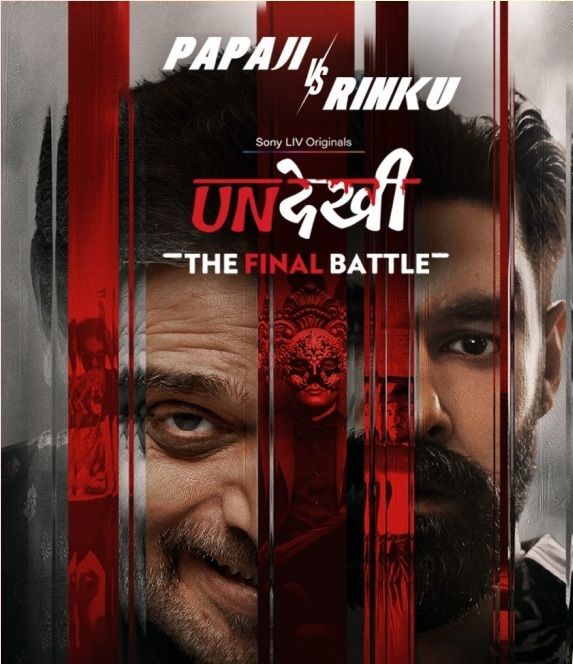

One of the main issues that I previously had with the third season of Undekhi was the shift in the core conflict of the show. What started off as a revenge saga pitted against an era of absolute power, soon transitioned into a generic gangster thriller that abandoned its core. This core was what set the series apart, particularly being a commentary on the shifting political landscape of the country. And so the pivot itself felt shocking and convenient – almost like a cop out on what the drama stood for all this time, before bowing to the ‘masters’. And unfortunately, the fourth season of Undekhi follows a similar trajectory that flatters to deceive – as opposed to course correcting the drama. In fact labelled as the final battle, I went in expecting karma to play a part in rattling the skeletons in the closet for the Atwals – even while pitting the protagonist Rinku (Surya Sharma) against his very own Papaji (Harsh Chhaya). But instead what you are served is an overstuffed and convenient drama that offers watchable moments, but achieving no real heights close to the first season.
Written by Abhishek Garg and Chirag Salian, the fourth season of Undekhi takes a five year leap from the previous season wherein Papaji is now in jail for the murder of Rinku’s wife Muskaan, whilst the latter is now a loyalist of Mahinder (Varun Badola), who happens to be his biological father. In fact, the power dynamics in play is evident at the start with Daman (Ankur Rathee) and Lucky (Vaarun Bhagat) siding with Papaji, thereby invariably being pitted against Rinku. There is a flesh-trade transpiring in the valley of Himachal – a la local Epstein Island as mentioned by a character, while a search is on for a minor by SP Ghosh (Dibyendu Bhattacharya) and Raashi (Lavvina Taandon).
There is a shady hotelier Vikram (Gautam Rode) and his neice Natasha (Shivjyoti Rajput) who have been taking care of Teji’s child after her mysterious accident. And Teji was married to Vikram at the time. Oh, and there is also the inclusion of a new psychotic character who is employed by Mahinder called DJ (Saqib Ayub) – who would later go onto be a wildcard in this wild wild mix of crime and violence. Clearly, there is a lot going on in this overstuffed narrative, that tries restoring the engagement but doesn’t always succeed!
Generally, the issue with such an overstuffed narrative remains that the character arcs aren’t fully fleshed out, and the narrative would be generally rushed. But while this is partly true, the bigger issue remained that of convenience – the convenience of introducing new characters who do not have a trace in the previous seasons. Usually, you would associate a set of new characters with a change in setting. So in Sapne Vs Everyone if Prashant has shifted his base to Mumbai, it makes more sense for the inclusion of new characters there. But when the setting remains the same, it really boils down to the age old cliche of keeping the narrative interesting with a new bunch of characters who would be randomly introduced to take the plot ahead. This, without accounting for a change in the setting.
To be fair, the writing doesn’t intend to lower the stakes in the narrative – being bold enough to eliminate some of the established characters (and new ones), right in the first act. But the issue remained its structure – eliminating characters in a stack, while leaving a lull in the second act. The events are watchable whilst mainly focussed on the dynamics between Rinku and Papaji, with the latter holding onto a secret with regards to his past that may disrupt the power vessels of the present. But the stakes in these exchanges get repetitive in the second act, something that leads to brief, uneventful passages. In the same breath, an interesting character like Saloni (Ayn Zoya) isn’t fully utilized, despite threatening to skew the dynamics at one point.
The drama remains tonally inconsistent in a few junctures too, even while departing from the gritty tone of the first season. In a scene, you see a character surviving an attempt to murder while meeting with an accident, only to randomly turned the tables on a perpetrator. In another, you see a character being fatally-wounded – only to utter a short monologue before dying. In another, you see a character being buried, only to return as if nothing has happened. Hell, I was even hilariously witness to a kid diffusing a bomb randomly!
This, even as some of the interesting twists are short-lived – starting with a revelation, not quite capitalizing on it, and eventually bumping off the character concerned. This instance occured twice in the final act that increasingly felt cliched and convenient. It remained a specific cop-out that didn’t raise the bar of engagement, while capping off the drama on a rather messy note. And a little outro is enough to tell me that there is another season round the corner, even as the concept of redemption remained a sore thumb as opposed the idea of Karma catching up. No, I did not root for Papaji and Rinku at any point in their journey, but if each of them are given redemption arcs (with even cops helping them out), then that remains a miss in my books. And when some threads are still left open, you do feel a little cheated too.
The dialogues are conversational but fiery, and they do enough to just about hold your attention. The BGM is decent and works in the context of the drama, but the missing link remained the idea of a central theme that would play out at critical junctures in the narrative. The cinematography beholds a pale colour grading that metaphorically adds a complex texture to the pale realities that the characters reside in. At times, the frames are slightly outlandish, particularly in action set-pieces that remain a callback to the 70s and 80s. But, the emotional core of the characters are accounted for through most of the frames here.
The editing pattern is decent but at times a little choppy during critical action set-pieces. Also, the moments of lag in the second act needed to be ironed out further. Director Ashish R Shukla does a decent job here but he doesn’t hit the bullseye. The issue remained in the drama mostly unfolding at the same wavelength, wherein even pivotal twists in the narrative felt slightly underpar. And that remained a consistent feature here, while woefully stumbling in a messy final act that didn’t really have a flavour of a face-off. Some of the character dynamics save the day, but the end result is that the direction is middling.
The performances are superb here by the members of the cast. And honestly, I have never had an issue with the performances throughout its four seasons. The new entrants Saurav Khanna as Bobby, Daksh Ajit Singh as Jogi, Garvil Mohan as Sukhi and Debattama Saha as Preeti have their moments to shine. Anit Chauhan as Shera and Akhil Khattar as Bagga are first rate as well. Omna Harjani as Kavita has a good screen presence, and she does a good job too. Shruthy Menon as Deepika is excellent to witness here, and how I wished she had a longer screen time.
Ayn Zoya as Saloni has always remained an unpredictably tactful character, but whilst she does a stellar job with her body language and expressions, the writing doesn’t give her enough screen time – something that felt unfortunate. Saqib Ayub as DJ perfectly epitomizes the eccentricity tagged to his character, almost making him a psychotic killing machine with a machate/sword. Vaarun Bhagat as Lucky has an emotional arc of repent tagged to his character, and he does really well in tapping into this emotional core.
Gautam Rode as Vikram has an unassumingly mysterious presence, and does a decent job in keeping the intimidation around his character alive. Shivjyoti Rajput as Natasha has a solid screen presence, and while she briefly struggles during emotional scene – she more than makes up with her body language that exhibits sinister strands within her. Lavvina Taandon as Raashi and Manik Papneja as Rehaan are wonderful to witness here, while doing their best to raise the intensity of the drama.
Dibyendu Bhattacharya as SP Ghosh remains an interesting case study, simply given how his character has had a major cop out as far as the Atwals are concerned. Nevertheless, the poise, restraint and grace that he brings to the table is a treat to watch here. <span;>Ankur Rathee as Daman has a massive transformation from the previous seasons and he is quite impressive here. <span;>Varun Badola as Mahinder is subtly intimidating and does a fine job, although his character needed a lot more screen time for an impact in the third act.
Harsh Chhaya as Papaji is excellent to the core in a foul-mouthed character that is repulsive with his body language. His constant smile in the most weird situation will make you churn your teeth, and that for me was a victory for an actor who is brilliant to witness. Surya Sharma is such a talented actor who depicted such softness with his character in Bhakshak. Yet here as Rinku, he is unabashed but still balances his act with a touch of vulnerability that you notice in his character as a continuation from season three. He is such a good actor that scores yet again with his towering act!
Despite good performances, the fourth season of Undekhi is a middling affair that flatters to deceive. It is disappointing that the core of the show has been compromised since the first season, and while the proceedings are watchable, it doesn’t fully make an impact. It remains the weakest season yet, which is rather unfortunate! Available on SonyLiv.