

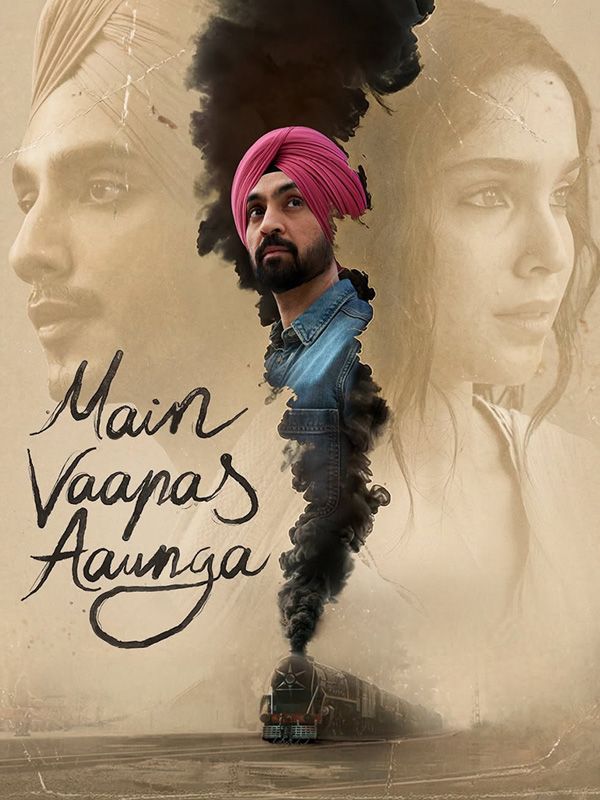
The contrasting themes form an early premise of the new Hindi film Main Vaapas Aaunga, when you are introduced to an elderly statesman (Naseeruddin Shah). In a scene, you see him flipping channels on television while pausing at a news channel and asking the anchor to listen to him. The advancement of technology cuts past the rigidity of the 95 year old, even as he isn’t fully adjusted to it. In another, you see him asking his driver to head to the India-Pakistan Atari Border, in order to traverse to the city of Sargodha in Pakistan – another contrasting facet of how his mind is stuck in times of pre-independent India when Pakistan didn’t exist, and the country extended its borders to cities that are now divided by it.
The same themes of contrast exists for Nirvair (Diljit Dosanjh; his name meaning without hate, something that would reflect his persona later on) too, who is the grandson of the elderly man. Nirvair essentially epitomizes the youth of today – confused between contrasting worlds of being a software developer, and an amateur standup comic. But in the larger context of things, the key contrasting trait that formulates the narrative remains that of love – one, wherein you see Nirvair never fully committing to his relationship with his girlfriend, even as his grandfather now on his deathbed reimagines his love for Jiya (Sharvari Wagh) from over seven decades. The contrast between an old-school romance and a new-school romance is for everyone to witness and study.
Written by Imtiaz Ali and Nayanika Mahtani, Main Vaapas Aaunga is almost a companion piece to the 2021 Hindi Film Sardar Ka Grandson – wherein the parallels of a grandson arriving to fulfill the final promise of his grandparent, whose roots lie across the border are immediately established. And yet, there is a deeper resonating emotion that transcends into an aching wordplay as far as the title is concerned, something that immediately draws you in.
The two parallel tracks offer different degrees of emotions – one involving a character disassociated from his reality muttering references to his past life in the form of gibberish cricketing and astronomical references that require deciphering. And the other, a classic old-school romance that sprouts at the mention of a whiff of perfume, or the softening ink on paper being the witness of words that complete a poetry. And in a way, it intertwines the personality of two individuals in what is seemingly a refreshing odd and aspirational coming-of-age story – one who is at the fag end of his life, and the other, testing his footing as far as love is concerned.
The character of the elderly stateman that forms his roots as Keenu (Vedang Raina) from the past remains an interesting one. In a world that would soon be ruled by alpha-males – particularly in the context of the partition of 1947 too, Keenu remains a whiff of fresh air. He loves to write poetry while silently glancing at his love Jiya in a poetry recitation event. He isn’t necessarily prepared for the change of fate that would have to be endured in his near-future, while only wanting to marry the love of his life. Interestingly, the politics associated with the partition, specifically in terms of religion would go on to have a massive role to play in the life of the two lovers – both of whom aren’t well-versed with the seriousness of the situation, while pledging to stick together even at the cost of converting to Christianity in order to attain immunity.
There is a pleasant charm to the proceedings, particularly with the dynamics that Nirvair shares with his grandfather. Perhaps, the thought of longing and an incomplete wish is what ties the characters together – even as Nirvair wishes to standup for his grandfather against his own family, who have discreetly given up on his health. The presence of an aching pain is what drives the narrative, even whilst the writing dares to ask – how would an individual react when his heart is told to reallocate to a new land. Would it continue to long for love every single minute, despite knowing that the world around it has changed? It resembles a searing needle that is pierced gently in your heart, only for it to palpably spurt out its pain. As mentioned in a scene by a character, every drop of pain acts as a poison, something that is enough to kill an individual.
There is a subtle trait of softness even as the two lovers make promises that would soon be tested, against the backdrop of the communal riots that would also be a test of survival for their respective families. A searing subplot involving a character’s family is touched upon, along with horrific and nightmarish scenes of the partition that tap into a deep emotional space without wanting to sensationalize it. The proceedings manage to retain the softness of the characters, while putting the generational trauma and pain of one of the characters on the pedestal – something that makes for a gut-wrenching watch.
There is a hint of the Korean film Ode To My Father (2014), or more specifically on the grounds of its remake Bharat (2019) – particularly with respect to its final act that trascends borders and virtually brings the two countries (and the worlds closer). But more importantly, there remains a subtext of a place that one would call ‘home’ – it could be a specific area, or a person, something buried deep within your conscience that is left behind along the way. But the what remains is its memory – in the form of an inanimate object, or a whiff of perfume, or a little beautifully worded poem that often acts as a time-machine, in order to fuel a sense of unresolved longing.
And yet, it is humanity that often finds itself suffering but also holding hands against fate – only with a hope that the world would be a better place to live in, while harbouring the spirit of the past wherein life was simple and filled with love. The subtext remains a relevant symbol of hope in times when war has displaced homes and the people that reside in it – even as many people continue to harbour a sense of hope with respect to their love much like the old-school soul on his death bed. The screenplay is painfully aching and heartbreakingly beautiful to witness.
The dialogues are poetic in nature, with every word intended to sprout an emotion of love, despair or hope with deft doses of laughter. The tone remains beautifully understated, and christened with pain and longing that maintains the emotional core of the narrative intact through its lines – without deviating into an area of melodrama. The Music and BGM by AR Rahman is bittersweet and heart-wrenching with every note designed to immerse you in the emotional core of its characters. There is depth to the drama that exudes of melancholic undertones, almost forming a painfully aching arc of its own – even as the songs gently tug the strings of your heart.
The cinematography by Sylvester Fonseca epitomizes poetry in motion, with frames that perfectly encapsulate the emotional core of the characters across two distinctly different timelines. Given that the past is viewed through the lens of a 95 year old, the frames are rose-tinted – almost representing a distant memory of longing, while employing poetic wideshots to represent a whiff of nostalgia. The latter has a deeper allegory of freedom which in itself felt ironic against the backdrop of the 1947 partition – something that cleverly acts as a contrasting social commentary. This, while also employing statutory frames to allow silence to act as a foundation for emotions in a scene.
The editing pattern by Aarti Bajaj is a poetic masterclass, intercutting events of multiple timelines while retaining the emotional core as a connecting thread. In a beautiful montage, you see this technique in full bloom even as two characters along two different timelines travel through the same street. This specific theme is almost presented as a fever dream in a few instances, wherein the hallucinatory streak of a character coincides with his memory of longing from the past.
Director Imtiaz Ali has a poetic style of narration, something that he christens his world with, once again. There is a touch of sensitivity to his approach, always allowing a sense of longing to creep in through his characters – even while mounting the surrounding of horror with love. The focus remains on the fleeting moments of glances or shyness, sandwiched between tense moments of horror, and restrained moments of longing. Hence, what you get at the end is a gut-wrenching and soul-stirring piece of art that stays with you, long after the drama has ended. I legit needed 10 odd minutes to calm myself down, something that remained a nod to a brilliant piece of direction.
The performances are outstanding by the members of the cast. There are understated but pivotal moments carried with such restrained by talented artists like Rasika Agashe, Shruti Sodhi, Aliyah Khan, Jashn Kohli, Neha Pawar, Butta Badbar, Vinod Nagpal and Dolly Ahluwalia, that are wonderful to witness. The latter in particular features in that one specific horrofic scene that is worth a million nightmares (and so well performed too). Sahil Mehta and Kashmira Irani aren’t merely fleeting characters, but important symbols of humanity that shape the fabric of the narrative that is built around love. And both of them are wonderful to witness here. Harshul Kaul as Aftab has a naive and affable presence to his character, wherein he does manage to shine.
Sanjay Suri as Jasmer and Manish Chaudhari as Muzaffar remains characters at opposite ends of the communal situation erupting in the region, but tied by humanity – and both of them are sincere to witness here. Danish Pandor felt like an extension of his iconic character of Uzair Baloch from Dhurandhar, with the exception that his alpha-male abilities remained muted yet prominent with respect to his shades of grey. And at the cost of repeating myself, his screen presence is outstanding as always. Banita Sandhu as Nirvair’s girlfriend has an understated presence while doing a fairly good job. Each of Anjana Sukhani as Meher, Rajat Kapoor as Iqbal, and Jaipreet Singh have distinct characteristics of greed, compassion and caringness that beautifully laces the narrative, even as each of them make their presence felt with subtle bouts of humour and affability.
Shavari Wagh as Jiya aka Afsana has a charming screen presence, something that she elevates with her beautiful use of emotions while putting forth a commendable act. The art of emptiness and longing is deftly communicated by her in a wonderful little act. Diljit Dosanjh as Nirvair backs his performance with measured doses of comedy that directly acts as pondering set-pieces on the darkest chapter of the country (read: partition). And yet, this remains his coming-of-age story – specifically in terms of love and acting as a messenger of sorts for his grandfather, that adds warmth and depth to his character. There is an ease to his performance that is pleasant on the eye, while accounting for some searing emotions within him.
Vedang Raina as Keenu is terrific to witness here, in a character that exudes of an emotional depth while forming a character arc of his own. He starts off as a shy character seeing the world through his tinted rose gaze, only for the horrors of the reality to creep in. Ironically somewhere in between, there is an arc of consent which is also presented through his character – all of which shape up his trait of longing in an unfinished memory later on. There are a plethora of emotions to work with, and Vedang nails his character in a brilliant performance that marks a matured paradigm shift in his young filmography.
But the star of the show for me remained the veteran Naseeruddin Shah who delivers one of the finest performances of the year, as the elderly version of Keenu. The gravitas of the performance can be understood with the fact that most of his scenes are in bed – having to utter inferences of his past in gibberish, even while maintaining a strong emotional core with respect to longing and his unfinished memory. His eyes reflect pain in the purest form, even as his body language and mannerisms immerse you in his journey of angst and despair. The deeper you dwell, the deeper the emotions are to be explored. And all of it is brought together in a towering acting masterclass of the highest order. His performance will stay with you long after the film has ended.
Backed by majestic performances, Main Vaapas Aaunga is a painfully aching and heartbreakingly beautiful old-school romance wrapped in a searing poetry of longing and an unfinished memory, that makes for a brilliant watch. Jeez, this may well be the Best Film Of The Year 2026 for me across languages – DO NOT MISS THIS! Available in a theatre near you, and Highly Highly Recommended!


