

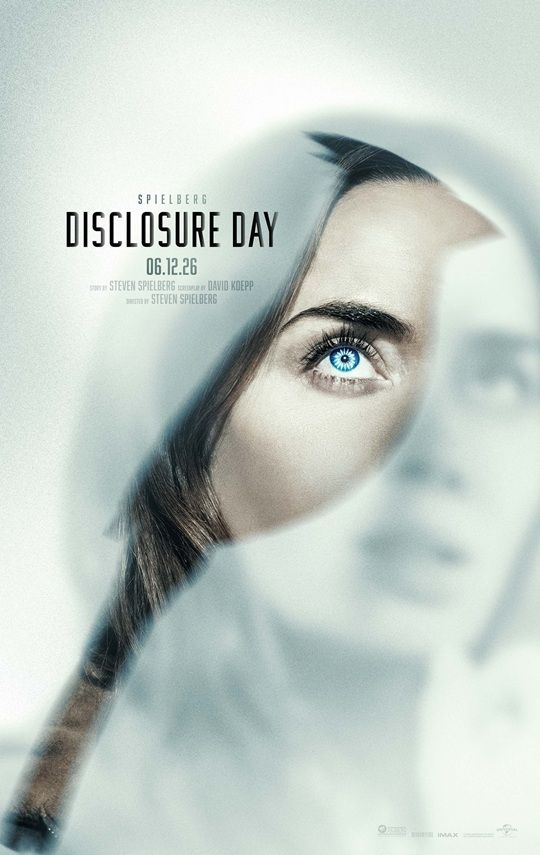
The cold open of the English film Disclosure Day is a dialogue closer to home, with humanity taking a backseat in a wrestling war between nations. The context remains a wrestling match that pits two individuals with each other – much like humanity fighting amongst each other. The subtext remains that of World War III that perfectly fits in with the situation at hand. And whilst most eyeballs are on the match – much like most of us watching the news daily, you are introduced to the protagonist Daniel (Josh O’Connor) who remains the only one distracted while not watching the match. You get a glimpse of his mathematical trait almost as a foreshadow – even as he counts the perfect second to break through the security. And yet, Daniel remains an interesting character given a sense of ambiguity surrounding it. You understand at the start that he is a whistleblower, having stolen some critical data from his capitalist company headed by the chief antagonist Noah (Colin Firth), but the details of the same are deliberately withheld. All you get in return is a high-stake chase, between Daniel and his girlfriend Jane (Eve Hewson), who escape the clutches of Noah – to a place that is intentionally unknown to Daniel. The stakes are set, and so is the mystery around it.
Written by David Koepp and Steven Spielberg, Disclosure Day largely acts as an allegory of the times we live in. With nations being at war, and the information being withheld from the public, and a mirage of peace and goodwill being created, the significance of the title almost has a deeper meaning to it – something on the lines of Judgment Day, when the wrath of the almighty would take over. In fact, there is a passing reference of the same when a character asks if it is right for a believer in God to assume that there is a race superior to humans in the universe – a direct counter to humans being pitted as God. But the writing persists on the burning question on why is certain information withheld while being classified with the government? In fact, the subtext of the screenplay poses a similar question – wherein all you get are strange occurences pertaining to a few of its characters, a meteorologist Margaret (Emily Blunt) being one of them.
The proceedings intercut the two worlds of the protagonists – Daniel and Margaret. While the former has been on the run, the latter is subjudicated to some strange phenomena – stuttering during a weather report, talking gibberish on live television in another, following her gut to a particular location, all of it after encountering a gentle bird. The symbolism in hindsight stands for empathy, a trait that remains a prominent driving factor for the protagonist. In an instance, you see her walking through a room of people, only for people to see their individual loved ones in her. In another, even Noah who is after her, sees a reflection of hia dead wife in her.
In the same breath, Noah remains an intriguing figure too, steering away from the usual tropes of an antagonist. In fact, his philosphy remains that of control – opposing any information to be made public that would potentially cause chaos in the lives of the people, particularly against the backdrop of the third world war. His subtext isn’t necessarily absolute power, but a machinery that would control the narrative pertaining to the institute of research that he owns. Hence, the idea of performing research on aliens after a 1947 year crash, or utilizing a part of their powers to attain a dimension-shifting superpower for himself often remains hidden to the world.
One form of criticism that I had was with respect to the structure of the screenplay. It almoat resembled a card game with the dealer holding the cards close to his chest, while revealing little information every now and then. So the information with regards to Daniel revealing the classified research performed on aliens, or the true purpose of Daniel and Margaret being the chosen ones – joining forces of mathemathics and empathy to form a strong communication between humanity and aliens, are used as layered but stuttering set-pieces as opposed to a cohesive narrative. And the reason why this is a drawback (relatively speaking) is because these episodes of revelation are spread across vast phases of a car chase or a game of hide n’ seek – something that could possibly disconnect the viewers, or also lose sight of the proceedings.
But all said and done, the proceedings are laced with subtle bouts of humour while shifting its focus to the dynamic between Margaret and Daniel, that majorly forms the crux of the narrative. In a sequence, you see them being involved in a train sequence laced with adrenaline and intensity, in another being invisible to armed men – thanks to an ‘alien’ device that adds a new dimension to the proceedings.
Or even the finale wherein both characters join forces to put out the classified tapes of research to the world, even as Noah being assured of a defeat, looks on. In the same breath, the finale is a bold one – a little abrupt for my liking but enough for me to ponder on it. And much of it depends on how you perceive the world and the universe to be – a symbol of destruction or one large family of universal brotherhood. In that sense, the subtext also remains that of misinformation being sent and consumed by people, even as the truth is enough to shock and amuse you. The key word at the end is ‘Listen’, with an invisible subtext of refraining to react while reading between the lines to interpret the government secrecy. The screenplay may not be the best for a Spielberg film, but it has enough of flesh to ponder upon.
The dialogues are conversational but also laced with bouts of humour to balance the larger grim themes driving the narrative. The BGM has inferences of mystery that caters to the mysterious undertone of the narrative. This, while elevating the moments of intrigue along the way. The cinematography comprises of visuals that are kinetic and pulsating, something that ably maintains the tempo of the drama. The same holds true for the visuals during a pumping action set-piece that had me at the edge of my seat, even while maintaining the finer traits of the characters in tact. The closeups are aplenty, but they do their bit in allowing viewers to explore the psyche of the characters, all in order to decipher the themes of classification in play.
The editing pattern is in line with the kinetic tempo, while maintaining the mystery leading up to the final act. The flavours of a massive actioner with subtle bouts of humour are ably presented in the narrative, even as the editing style maintains the tone of the drama efficiently. Director Steven Spielberg isn’t at his absolute best here, opting for a narrative that can easily disconnect viewers. But despite that, he is fairly successful in building a world of constrasting halves – one being eerily haunting and secretive, whilst the other being a humble reminder on the magical interventions of the universe. He is quick to maintain this thread through contrasting characters too, in a template that largely deals with good versus the evil. There is much to appreciate in his craft, bolding opting to enter the Michael Bay or Rohit Shetty zone of SUVs ramming through the walls, or exploiting subtle traits of humour along the way. Or even the levels of tension tapped into towards a pondering finale. The direction is pretty good here despite him not being at his best.
The performances are pretty good by the members of the cast. Henry Lloyd-Hughes as Casper Boyd maintains the intensity levels in the drama. Wyatt Russell as Jackson exhibits his flair for comedy wonderfully well, while putting forth a commendable act. Elizabeth Marvel as Sister Maura has her moments to shine, while being a pivotal figure in the conflict between faith and belief. Eve Hewson as Jane acts as a perfect foil for Daniel, while also showcasing different shades of her character rather well. Colmon Domingo as Hugo remains sincere and earnest while almost being a character similar to Daniel (minus the ‘superpower’) but in a different age demographic.
Colin Firth as Noah remains an understated antagonist, being calm and collected while also willing to concede a defeat towards the end. There is a vulnerable side to him that is exploited in glimpses, even while allowing his ‘controlling’ ability to supersede his persona. These are grounded emotions that he touches upon really well, while delivering a solid act.
Josh O’Connor as Daniel adds his share of urgency to the drama, while delivering a pretty good act. There is a deliberate attempt at approaching his character with practicality and math, while completely stripping his character of emotions. As a result, the character is mysterious but a little one-dimensional in hindsight, although the performance papers over the cracks of the writing. He was commendable to witness here.
Emily Blunt as Margaret is brilliant to witness here, using her body language and expressions to such great effect in communicating the emotional depth to her character with subtle doses of humour. She delivers a rather measured act that effortlessly touches upon many facets of her character.
Disclosure Day is a mysterious sci-fi thriller that isn’t perfect but infuses a thought-pondering message amidst a highly entertaining and kinetic narrative that makes for a solid watch. It keeps you moving but gives you something to think about after the credits roll. Available in a theatre near you.


