
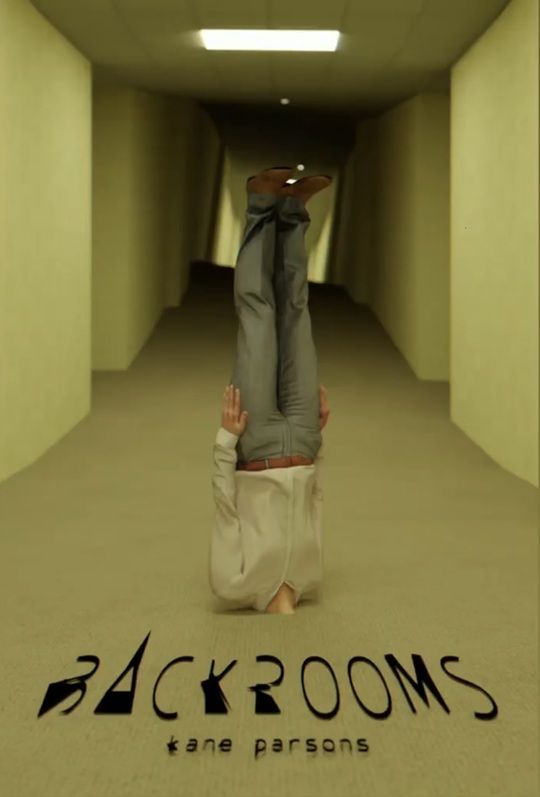
The best way for anyone to understand the concept of the new English film Backrooms is to imagine yourself taking a stroll in your liminal terrors of the conscience – a wide passage with peeling yellow paint amidst a vast space that is eerie, haunting and mysterious, almost representing the endless possibilities of the human mind. But with the human mind comes traces of negativity varying in degree – each representing a haunting cutout of your worst trauma, or a raging picture of the worst version of yourself, collecting creating monsters that would consume you. In fact, you get a glimpse into the horror streak of the film right at the start when a character aimlessly traverses through a daunting space – unsure of the uncertainty each door brings with it, a booby trap or a trace of loneliness that christens the ambience. It can best be termed as one’s worst nightmare of being stuck in a space that is an alternate dimension of your mind – a place so scary and so haunted that would send a shiver down your spine, something that the world is collectively subjected to in its full consciousness. The horror here isn’t in the jerky camera movement or the sudden ambush at the end of that scene – it is in the atmospherics of the space that is layered, something that is pivotal to the drama.
Written by Will Soodik, the core sentiment tagged to the Backrooms is trauma mixed with ambiguity, even when you are introduced to its two protagonists – Clark (Chiwetel Ejiofor) and Mary (Renate Reinsve). Interestingly, both these characters are tied with trauma – the latter being subjected to a generational trauma revolving around her house demolition and the agoraphobic mother, and the former having marital issues with his wife while being an alcoholic and a failed architect who is running a furniture store against his will. Hence, trauma remains an important ingredient that forms the basis of the drama that would soon be consumed by the horrors of the subconscious.
The concept of the backrooms has a foreshadow of flickering lights – a form of symbolism for glitching of reality that lures Clark into the backrooms. The subtext remains the tipping point of Clarke’s psyche – wherein his reality is glitching, while pushing him into a realm of madness. Here, the backrooms can be understood as a printing machine of sorts – often scanning your brain, identifying the portions of comforting trauma only to transform them into cutouts of people, labelling them as ‘Still Lives’, and also creating the worst version of individuals while labelling them as ‘Monsters’. You get shadowy glimpses of the latter in Clark’s first encounter, before he decides to lure his manager and her boyfriend in order to prove his point to Mary.
One of the best passages of the drama remains the trio’s tryst with the backrooms – a haunting trail that leads upto a bloodbath. But the symbolism remains a crucial element in the mix – particularly given how both characters with Clark are eventually killed off. It remains a representation of how Clark’s fractured personality has adverse effects on people around him, either consuming them completely, or acting as ‘still lives’ in his subconscious state, something that his mind gravitates towards – a low-level form of negativity. It is similar to the concept of how negativity attracts more bouts of negativity – something that you witness in the form of cutouts of his wife with red hair at the end, or his grandfather who keeps flickering the lights.
Likewise, the same form of symbolism extends to Mary also when she enters the backrooms. You see versions of the furniture clamped up at various intervals, a reference to her traumatic past with respect to her house’s demolition. In the same breath, you also get contrasting representations of trauma when she stumbles upon Clark for the first time in the backrooms. The latter is at his tipping point willing to stay in the shadows of his negativity, while there is still hope for Mary.
Ironically in the scene when Clark finally wants to change, he is killed by his Monstrous version – an intimidating figure on the lines of a version that is built around the mascot that he dresses up as for television. It remains the worst version of himself because he has always dreamt of being an architect while ragefully having to appear as a mascot for his furniture shop. And the scene of his killing is representative of his rage consuming him.
There is a hint of capitalism in the third act with the introduction of an organization called Async which had accidently stumbled upon the backrooms while researching on MRI machines. But the subtext lies in the context of humans trying to map and control the subconscious side of the human mind, while wanting to colonize it for energy – a form of foolishness given how every mind is different while reacting to trauma and emotions differently. And the final scene representing a ‘still life’ version of Mary is symbolic of the same – with the backrooms creating a version of trauma inside it after scanning through her mind. The screenplay remains a classic case of the subtext overpowering the horror elements, in a concept that remains an absolute winner for me.
The dialogues are minimalistic while allowing most of the visuals to do the talking, which basically meant that the concept itself ended up being ambigious – something that could distant the viewers who aren’t familiar with the concepts of the subconscious mind and an alternate dimension. The BGM uses silence in the narrative almost as a symbol of fear and horror, something that wonderfully builds the foundation of atleast three sequences of the drama. The cinematography begins with a first person single shot that itself sets the tone for the eerie atmospherics of the drama. This, while forming a physical representation of trauma through inanimate objects of pale yellow walls or a pile of furniture – all of which contribute to the ambience of the drama, and in turn elevating the horror quotient of the narrative.
The editing pattern is crisp and sharp, while even allowing some sequences to linger on without any cutaways or cheat cuts which would reduce the impact of the narrative. Director Kane Parsons absolutely hits it out of the park with a concept that is catered to work in the subtext. He doesn’t wish to mount his horror drama simply on the basis of conventional tropes. It is layered and deeply atmospheric, while challenging the intellect of his viewers. The ability to take a wild swing while maintaining his sensibilities meant that the direction was spectacularly, boldly traversing through bouts of ambiguity and leaving you with a lingering, unsettling feeling at the end.
The performances are pretty good by the members of the cast. Mark Duplass as Phil, Finn Bennett as Bobby and Lukita Maxwell as Kat are pivotal characters in the narrative, and each of them have their moments to shine. Chiwetel Ejiofor as Clark remains a layered character consumed by negativity and rage, and he portrays these complex emotions with a sinister energy that is understated in many ways. Renate Reinsve as Mary delivers yet another dignified performance while allowing her expressive eyes to reflect on the generational trauma endured by her character. She was wonderful as always to witness.
Backrooms is a haunting stroll into the liminal terrors of the subconscious mind wrapped in an unconventional, high-concept horror that lingers on long after the credits roll. It is eerie, atmospheric, and a fearful visual representation of trauma and rage that makes for a brilliant watch. Available in a theatre near you, and Highly Recommended!


