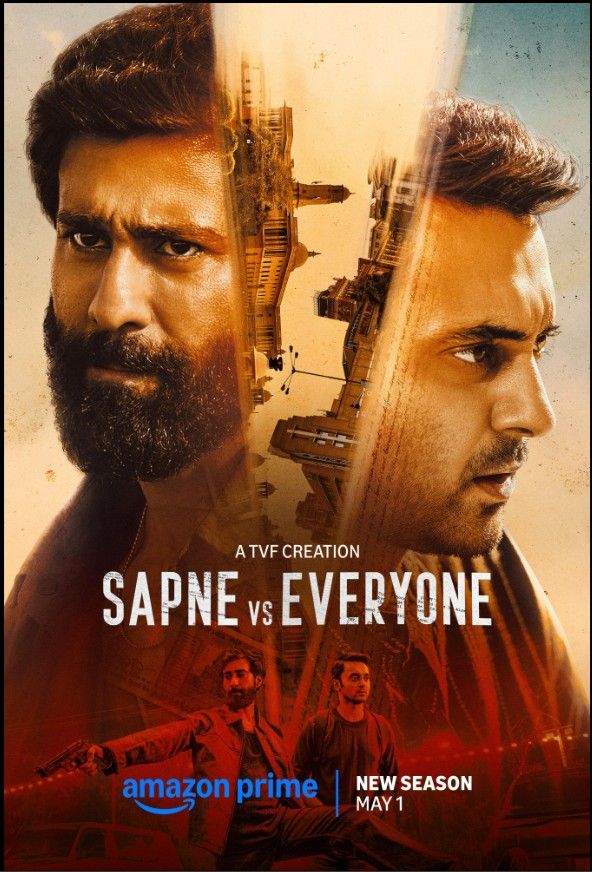

The show Sapne Vs Everyone has always been special to me in many ways than one. I still remember being trapped in life at the time when I first discovered the first season of the show on Youtube. My phase was dark and uncertain, but the show nudged me into dreaming and pursuing film journalism as a full time gig with my portal – Popcorn Reviewss. And as ironic as it may sound, the second season of Sapne Vs Everyone has found me at yet another crucial juncture, while keeping the basics right of the continuing the dream alive.
The title Sapne Vs Everyone itself is a powerful metaphor on the plight of the dreamers, even while being pitted against the various obstacles that life and ‘everyone’ in it has to offer. So when you are reintroduced to the two protagonists – Prashant (Paramvir Cheema) and Jimmy (Ambrish Verma), the events almost seem like an aftermath of the previous season. Both have their dreams in check – Prashant is about to perform in front of his ailing mom for the very first time, and Jimmy wishes to elevate the stature of his father by giving him a posh place of his own, even while wrestling the ego of his uncle Kukreja (Vijayant Kohli). And ironically, both ‘dreams’ meet with an early obstacle of unfulfilment – an indicator and a harsh reality check on life itself, wherein all dreams aren’t met with a rosy ending.
Written by Ambrish Verma, the second season of Sapne Vs Everyone doesn’t wish to sugar-coat or glorify the ‘dreams’ of the respective character. And therein lies its emotional core that is edgy but extremely heartfelt – even as you witness two characters trying their best to hide their emotions rather unsuccessfully onstage in the aftermath of a tragedy. Or a fatally shot character reminiscing about the significance of his dreams while being ‘virtually’ on his death bed. The drama is quick to establish the fact that dreams in the larger context of things may seem irrelevant, but in the moment, it remains a case about life and death – ironically when a person is alive. It remains a philosophical take that would eventually branch out the narrative with respect to its two protagonists, structurally speaking.
It is interesting on how the dual settings of Gurgaon and Mumbai coincide with the personality of the two protagonists. Jimmy remains edgy and increasingly obsessed with the idea of giving his father a new life. In a scene, you see him roughing up a couple of guests at a hotel who had mocked his father, simply by ordering cake and asking them to finish it all up. It is his way of coping with the obstacles that society has to offer – while also being pitted against his uncle in a battle of egos. This, while trying hard to arrange funds just so that his personnel gets a candidature against his uncle. On the other hand, the basic trait of Prashant is hustling, in his bid to become an actor by trying his luck in the film industry. Here the word hustling is metaphorical – an ideology for the city of Mumbai with respect to everyone who is trying to make it big. But as they say, bigger the dreams, bigger the struggle!
The characterization plays an important part in the drama, while consistently keeping the drama edgy in more ways than one. So on one side you are introduced to Tony (Abhishek Chauhan), the son of Kukreja who wishes to diffuse the tension between his father and Jimmy, while invariably being sucked into their strained dynamics. On the other side, you are introduced to a bunch of strugglers from Versova – Manish (Rajat Dahiya), Vedha (Nidhi Shah), Tripti (Khushali Kumar) and Ashvin (Akhil Kaimal), all of whom are a part of Prashant’s new life. In the midst of the latter, the subtext remains that of a very specific power dynamics that doubles up as a stark commentary on the film industry. Life in Versova is hard – be it the struggles with a casting director, or the unending wait for audition calls, or like in Prashant’s case to begin with – a conflict of interest of an actor working as a casting associate. Hence, it is worth noting on how the politics in Rishi’s life can be equated with Kukreja (and Tony), while as the politics in Prashant’s life can be equated to an entire system (read: film industry) that is power hungry and works on favouritism.
Over the course of the drama, you notice two distinct approaches for a specific dream with regards to each of the two protagonists. Prashant remains moralistic – quitting his casting job given the bias shown towards his actor roommate Manish, while later on also quitting a film on the account of plagiarism imposed by the writer of his film who conveniently borrowed the idea from his writer-filmmaker roommate Ashvin. On the other hand, Jimmy remains street-smart in nature – finding loopholes and favours to arrange funds, all in order to supersede his uncle.
The writing introduces an intercutting theme of nostalgia – with definite shades of grey to back the layered narration. For instance when Prashant is reconnected with his teacher Sumit Sir (Naveen Kasturia), the emotions are measured and viewed through a practical lens as opposed to paving a path of pure elation. Likewise, Prashant’s past trauma is reimagined and given the face of his erstwhile boss Shishir (Vaisakh Shankar) – almost replicating his scheming personality through similar characters that he encounters in Mumbai. These characters remain a reality check while accounting for a complex journey of survival for Prashant in the big bad but dreamy city of Mumbai. And yet, these complex themes are sandwiched between Prashant’s personal life – including his complicated love life with Vedha, that unfolds as a byline.
There is a very specific sequence narrated by Prashant at a specific juncture on the show – wherein a character is given a wish by God that would be fulfilled, only for the character to be confused on what is that one thing that he wants in life. That sequence has a large bearing in terms of the themes of fate and the high cost of ambition endured by its protagonists – one of them ending on a trajedy, while the other sticking to morality in a continued journey of struggle. Like a character at the end says – the destination would always offer a stumbling block, which is why enjoying the process is important too. And that single line remained my takeaway too – while holding the power to control the controllables!
The dialogues are edgy while being perfectly in sync with the tone of the drama. The dialect of the characters add authenticity to the setting as well. But what truly hit home were the couplets that made their presence felt at varied junctures in the narrative. The music is terrific with the soundtrack being less of melodies and more of edgy notes to signify a rebellious outlook to the drama while also imparting a fiery sense of hope. The BGM perfectly captures the vibe of the drama while contributing to the edginess along the way.
The cinematography upholds a sense of edginess to the proceedings too, with frames that successfully emulate the setting. There is a hue of grey that encompasses the screen – a sort of a spiritual connect between the two cities of Gurgaon and Mumbai that offers a measured instance of chaos coinciding with the lives of the two protagonists. Likewise, the frames offer an emotional hinge in the drama through its characters, something that allows you to stay abreast with their individual arcs.
The editing is crisp and sharp with not a single dull moment that would end up being preachy. The costume department needs a shoutout too for designing attires for the characters, often focusing on subdued shades that coincide with the complex themes of the drama. Prashant is given sobre shades of the shirt while the more flamboyant Jimmy enjoys darker shades in his attire. This perfectly is reflective of their characteristics as well.
Director Ambrish Verma is honestly a superman dabbling with different departments here. His direction has a raw energy that would ignite a spark, while always balancing the narrative with the larger messaging. I liked how committed he was to not take sides, and instant have conflicting emotions integrated in both characters who are flawed in many ways. Yet, he doesn’t once compromise on the emotions that unfold beneath the surface. His ability to approach a drama through a practical lens without sugarcoating the idea of selling ‘dream” to his viewers, while always being mindful of the consequences – was a slippery slope to slide on, but he showcases utmost control here. The direction was spot on here!
The performances are excellent by the members of the cast. Naveen Kasturia as Sumit Sir is such an earnest character, performed with conviction and care with a touch of softness that wins you over. The likes of Narinder Bhutani as Karan, Prashant Mishra as Madhur, Prakhar Prakash as Dhruv, Abbas Syed as Ronak, Amit Behl as Malhotra, and Amreen Bhui as Eva are wonderful performers who remain sincere and earnest with their respective acts. Sujeet Chaubey as Prakash, Jatin Sarin as Sonu and Annu Priya as Anita have a streak of grey tagged as vital traits of their characters, and each one of them manage to impress. Naseem Mughal as the mad man (fighting rain) remains a stark imagery of consequence of people in the quest for their dreams, and he is terrific to witness here.
Bhavya Sharma as Neetu has a lovely screen presence, and she manages to hold her own. Neeta Mohindra as Prashant’s mother is all heart and she delivers such a delicate and heartfelt performance that remains profound in many ways. Babla Kochhar as Jimmy’s father is wonderfully restrained with a streak of empathy that results in an immaculate payoff that will break your heart. Divyansh Deshwal as Deswal and Pradeep Kataria as Kataria add a distinct flavour to the proceedings with their authentic acts that are quietly intimidating.
Ishan Anuan Singh as Chauhan has a limited screentime here, but he instantly leaves a mark. In a pivotal scene at the start, notice his beautifully expressive eyes and a masked ‘cracking’ voice that play a part in his quest to hold back a tragedy from his friend who is about to go on stage. That scene was enough to tell me on what a brilliant performer Ishan is. Nidhi Shah as Vedha is quite affable to witness here, while delivering a heartfelt act mixed with trauma, ambitions and love. Her screen presence was superb to witness too. Khushali Kumar as Tripti has a wobbly beginning but soon settles into a carry, while performing with bouts of grace and restraint.
Rajat Dahiya as Manish has a nice little arc of transformation to essay, and he is absolutely on point with his body language, thereby allowing his emotions to land effortlessly. Akhil Kaimal as Ashvin is sincere and earnest while often being a perfect foil for Prashant. Ashvin also remains the most matured, with his maturity erupting for his years of endless struggle – something that results in a sea of patience too. And Akhil wonderfully essays his character with a lot of restraint and sincerity. Abhishek Chauhan as Tony has a reverse arc to contend with – and that adds layers of unpredictability to his character. Abhishek wonderfully absorbs the naivety of his character while transforming into a beast of sorts that would leave you seething with anger. And that is a sign of a brilliant performer who has excelled in his act.
Vijayant Kohli as Kukreja is intimidating with a daunting presence and he is simply terrific while being a perfect nemesis to Jimmy. In fact, one little complaint that I had was that his character remained a touch underutilized this time around. But nevertheless, it remained a smashing performance with the right doses of intimidation and stature. Vaisakh Shankar as Prashant’s cocky erstwhile boss Shishir/ director Ronak/ casting director Tarun is brillliant to witness here – with each character adding a distinct flavour to the proceedings. It was a (wicked) treat to witness him play effortlessly with his expressions, while putting forth a commendable act.
This brings me to the twin champions of the show – Paramvir Cheema as Prashant and surprise surprise, Ambrish Verma as Jimmy (who is omnipotent, just seen doing everything). Paramvir is quiet and subdued while allowing his beautifully expressive eyes to do all the talking. He is even careful to not over express himself, often resorting to stoic expressions to represent his helplessness. Yet, there is an endearing quality in him that always makes him so likable that you are invested in his journey and always wish him the best. He was excellent to witness here.
Ambrish Verma as Jimmy brings a sense of edginess to his character, while effortlessly flaunting his swag and his attitude. And yet deep within, Jimmy remains a vulnerable entity who just wants the best for his father, following years of discrimination. It remained a very specific quality that distinguished him from some of the other cinematic alpha males doing the rounds. There is a measured madness in his demeanor while putting forth such an incredible performance that fills you up with bravado but also offers a heartbreaking reality check at the end.
Featuring excellent performances, the second season of Sapne Vs Everyone is a realistic take on dreams wrapped in a brilliantly complex and layered drama that absolutely hits home, thereby making it a heartfelt watch. Available on Amazon Prime and Highly Recommended!