

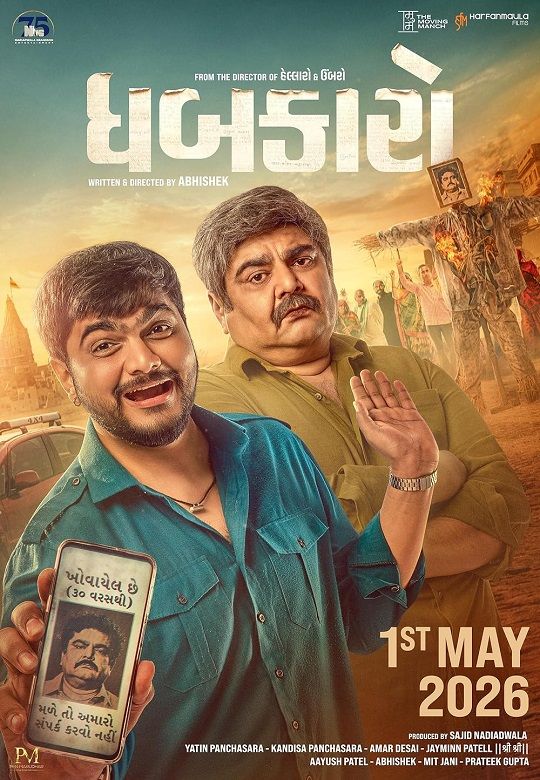
Within the first few reels of the new Gujarati film Dhabkaaro, you get a glimpse of the personality of the protagonist Ashok Patel (Deven Bhojani) living in Dubai. In one, you see him eve-teasing his housemaid. In another, you see him being rude to his cook by firing him. Later on, you see him spitting at the vehicle of another man who mistakenly interrupted his journey. And you also see him creating havoc at a restaurant, by heckling a group of people. You do understand that this 65 year old man is perhaps a leech disguised as a human being – often rude, dishonest and callous about the people around him, so much so that he doesn’t care much about anyone’s existence. A series of glimpses into his past, further establish the notion that his traits aren’t exclusively reserved for strangers, but also for his immediate family featuring his wife who is beaten up by him. In other words, Ashok Patel is perhaps a miniature version of many of the world leaders doing the rounds here, someone who offers no real streak of redemption, until a particular event in his life leads to a ‘change of heart’ for him….literally speaking.
Written by Abhishek Shah, Dhabkaaro follows an unusual screenplay structure to begin with. Given the road to redemption for the protagonist by design, you would usually associate a journey of transformation over the course of the film. But the writing offers an immediate arc of change within the first act itself – something that kickstarts the journey of redemption for the protagonist. There are seeds of the Malayalam film Hridayapoorvam (2025) to be discovered early on, even as the protagonist goes on a reflective journey of introspection – something that he associates with his ‘change of heart’. But the writing doesn’t wish to sugarcoat his karma, or whitewash his sins with a specific hinge based on the heart donor’s identity. It wishes to go deeper into a journey of realisation, without offering a catalyst of identity along the way – something that immediately makes the drama deeper, and emotionally richer.
In many ways when the drama shifts to the state of Gujarat in India, Dhabkaaro can be labelled as a road movie – with the protagonist literally and metaphorically traversing on the path of redemption (and notice how his original name remains ‘Dahya’ which means ‘good’ in Gujarati). To give him company is a local taxi driver Kano (Aarjav Trivedi) who is fascinated and enamoured by the past of Dahya, while taking a keen interest in his journey. There is a sliver of unpredictability around his behavior – even as you see him indulging in money talks with the protagonist in a scene, while refusing to charge him with a single penny at the end of his first destination.
The drama wishes to tread with two intertwining tones, one involving an emotional journey of Dahya wanting to locate his estranged wife, and the one comprising of lighter moments of redemption involving people that were once at the receiving end of his wrath and rowdiness. This does make the drama slightly uneven in parts, given that the main USP remained the emotions in store. So on one side, when you are privy to a slightly higher pitch in comedy when Dahya is confronted by the villagers, or even a local priest and a paralyzed postman who had once been at the receiving end of his wrongdoings – the drama slightly falters. But when the writing chooses to focus on the powerful emotional core of the film involving Dahya’s wife – the impact is there for the taking.
The drama definitely offers a deeper commentary on the prevalent social issues in the society today. There is a beautiful commentary on communal brotherhood that is presented with much finesse, even as Dahya chooses to seek forgiveness from his Muslim friend Gaffar (Kumud Mishra) – going out of the way to help him in his neighbourhood, thereby echoing a beautiful message of peace and brotherhood along the way. In another, you also see Dahya helping out his sister who is at the receiving end of the age old caste stigma with respect to her son who has fallen in love with a girl from a higher caste. The seeds of commentary may not always be as deep, but they are relevant – and you can make out that the writing has its heart in the right place with regards to what it wishes to portray. And to top it, the events are entertaining too!
What truly elevates the drama here is the haunting final act – a considerable change in the tone, while offering the viewers plenty of room to ponder upon. It comprises of a twist that wouldn’t be too hard to guess for hardcore cinephiles, but it wishes to go deeper with the core messaging of the drama. The concepts of redemption and second chances, along with the laws of karma circle back to a powerful and hard-hitting ending that lingered on long after the film had ended. I honestly, wasn’t expecting a dark ending such as this one – and it remained a bold one for the ages. It is heartfelt, gut-wrenching, and hits you exactly where it hurts the most.
The dialogues range from being frivolous to profound, while accounting for the entertainment quotient in the drama. If anything, the lines are slightly tonally inconsistent – but the gulf wasn’t too wide to throw me off in any way. The music is outstanding here, with notes that seep into your heart and allow you to feel every beat of the emotions in play. The BGM compliments the emotional journey of the protagonist wonderfully well, while allowing you space to empathize with his past regrets. The cinematography accounts for a strong emotional core, with tight camera angles that offer you a sneak peek into the psyche of the characters – with a scope to invest emotionally in their respective journeys.
The editing pattern is decent, at times slightly choppy and episodic in nature – given how each event doubles up as an individual set-piece in the life of the protagonist. But, the huge redeeming quality of the editing style remains the strong emotional core, something that is kept alive from one scene to another. It won’t be wrong to say that this creates a cohesive connective tissue in the narrative, while holding the proceedings together.
Director Abhishek Shah who is best known for his spectacular Gujarati film Hellaro (2019), definitely manages to stir up a range of emotions. His focus remains majorly on the characterization of the protagonist, that drives the narrative here. And barring a few tonal inconsistencies, he manages to maintain an emotional grip on the narrative, leading to a brave and bold ending – which will go down as an epitome of responsible filmmaking. The direction is pretty good here.
The performances are wonderful by the members of the cast. Sweety Mahavadiya, Ami Trivedi as Ganga, Suchita Trivedi as Dr Lubna, Pratik Rathod and Tarjanee Bhadla as Suvarna are superb actors, and each one of them has their moments to shine. The veteran Sanjay Goradia as Aata Patel is hilarious in a cameo, and he will surely managr to tickle your funny bone. Kumud Mishra as Gaffar is so well restrained while conveying his pain through his eyes. This remained a masterclass on mininalism. Tejal Panchasara as Urmila is endearing and delivers a haunting performance in the final act. Aarjav Trivedi as Kano is sincere and earnest while being consistently affable throughout the narrative. He even scores wonderfully with the strong emotional core of his character in the backend of the film.
The film though belongs to Deven Bhojani who is such a brilliant actor in every sense of the word. As Ashok aka Dahya, the man offers no redeeming qualities to begin with – so much so that I was seething with anger with his onscreen antics. But the shift in his attitude is backed by such sincerity and innocence that I was invariably invested in his journey on an emotional level. He uses his tender expressions and such expressive eyes to create an air of longing and regret, something that is so heartfelt to witness. And he is wonderful to witness in a painfully emotional final act, to sum up a performance that was haunting and something that would go onto linger on for a while after the film had ended. A word to the casting directors if they are reading – don’t just cast him in comedy roles, he is a splendid actor with a high degree of versatility!
Despite a few flaws with its tone, Dhabkaaro is an emotional journey of redemption backed by sincere performances, that makes for a heartfelt watch. Available in a theatre near you.


