

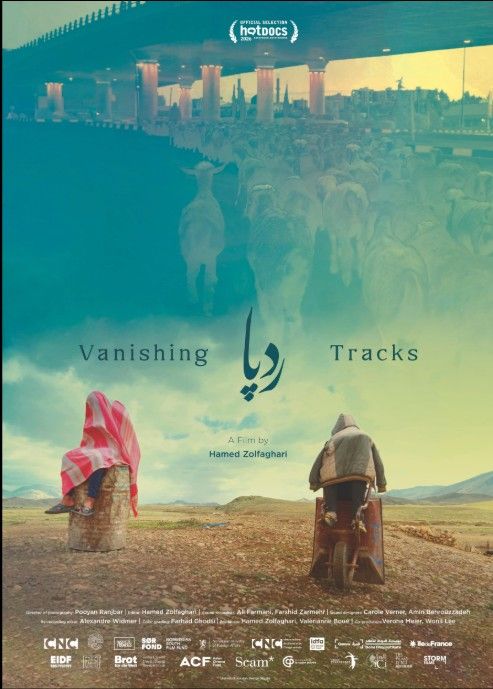
There is a pivotal moment in the film Vanishing Tracks wherein you are witness to a homage of odd events from the archives. In one, you notice a flock of sheep waiting for the metro just like other people around them, getting in and out from the metro station on the first cue of the doors opening and closing. In another, you witness the flock of sheep waiting at the bus stop with other folks – only for the bus to arrive and the camera panning on the empty bus stop, signifying the sheep getting into the bus. These may seem rather odd events that may slightly appear to be amusing, but the subtext is a nod to the metaphor tagged to the title. The searing commentary on the side-effects of development of cities coupled with the entangled effects of climate change forms a pivotal representation of the flock of sheep dispersing, while having to live like humans in the big cities. This remains true for the title of the film wherein the vanishing of the tracks features a spiralling effect on the family of shepherds who are as affected as their sheep.
Written by Hamed Zolfaghari, Vanishing Tracks immediately offers a sneak peek into the lives of the nomadic family who essentially earn a living through the sheep that they take care of. Reality for them isn’t as polished as the one you would view in a film like The Sheep Detectives, often finding it hard to make ends meet. In fact, this smaller conflict is addressed in a pivotal subplot that touches upon the generational divide between the father Valiollah and his kids.
In a scene, one of the sons tells his father on how life has moved on in the big cities, even as they are more worried about the sheep being stolen – a clear change in the mindset of majority of the people that automatically acts as a foreshadow for the drama to follow. In another scene, you literally see Valiollah and his wife wait for their sons to wake up before serving them food – a subtext that addresses the shifting lifestyle of the younger generation who don’t wish to slog in a traditional way.
The start of the conflict remains the theft of sheep – wherein the context isn’t a whodunnit but more like a metaphor of the social condition of the people. So even as the amateur thieves leave an unintended trail for the family to trace them – the reason for the theft remains the growing financial hardships of the vicinity, something that even Valioallah and his family are subjected to. For instance in a scene, you witness the protagonist claiming on how losing four sheep would be a major financial deterrent – not only in terms of wool, milk and meat but also the birth of lamb that would possibly be missed upon.
The drama also focuses on the themes of global warming, and how climate change would affect the condition of sheep. So due to the blazing sun, if the green pastures dry up – there is nothing left for the sheep to graze on, thereby invariably affecting the food chain. But more importantly, the issue lay with the migration which given the shifting landscape of the setting, would pose even further issues. The layer of civilization sandwiched between two settings would essentially mean that people aren’t okay with sheep grazing their lawns, or largely irritated when sheep cause a traffic jam, or worse, even run over sheep as a part of an unintentional accident. These remain pivotal points that are poignant, even as the ending doesn’t wish to offer a resolution while simply acting as a mirror of the reality we live in today, particularly with the shifting cultural landscapes of the nomads in the wake of the social and environmental issues around them.
This isn’t particularly a flaw, but the sudden shift of a visual tone in the final act may be disconnect a few viewers in the drama who may find it jarring – given how the tragic situation of the family is transitioned into bouts of archival humour involving sheep behaving like humans – almost similar to the ones in The Sheep Detectives. The pessimistic undertones in the drama are also evident, while being enough to repel a casual viewing. But having said that, the shift of tone invariably adds a layer of sarcasm to the drama with the intention of serving up a mirror of how far humans have delved in capturing a planet that essentially belongs to nature.
It is interesting on how the drama here delves into the specific lives of nomads who aren’t directly responsible for the causes of global warming. And yet, they find themselves in the circle of karma that invariably has started to affect mankind. It is increasingly alarming on how the forest covers are being cut down to breed civilization, when the very forest cover would act as a shield for the many environmental catastrophes that would affect mankind. And invariably, everyone in the food-chain would be affected.
This is a beautiful planet that belongs to animals, and with humans designed to be the protectors of the land – but when the tables turn and humans claim their inheritance, then it would definitely affect the planet the most. Development might be important, but not at the cost of destroying the planet – for if even one species of animals (like sheep here) are affected, then the repercussions of the food chain would have a direct impact on mankind. This, along with the financial struggles of the lower section of the society in the wake of major developments in cities that invariably would meet the fate of sheep – slowly trying to ‘mingle’ with other humans, while silently staring at a dark future.
As part of our Tribeca Film Festival coverage, Vanishing Tracks emerges as a must-see documentary. The film offers a quiet, pondering space to reflect on the cultural shift of the nomad life in a rapidly changing world. At the same time, it delivers a searing commentary on the climate crisis and how modern development speeds up this destruction. And by doing so, it connects global issues to deeply personal losses – something that acts as a vital warning for anyone who cares about the future of the planet. Highly Recommended!


