

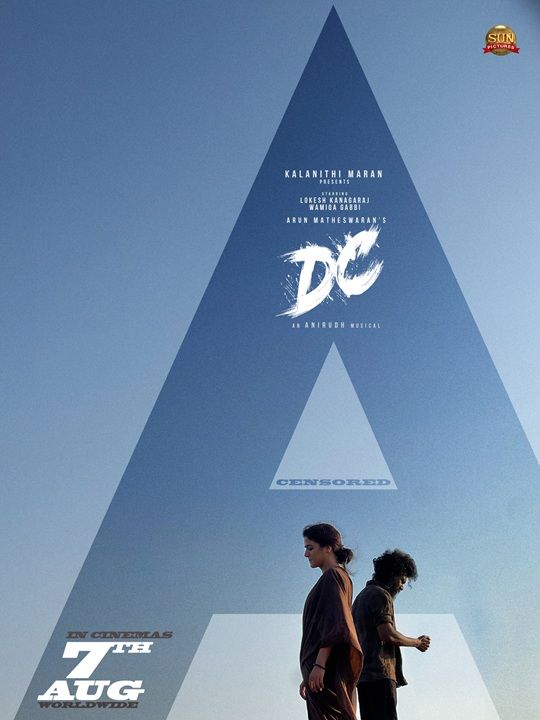
The character of Devdas has got to be the perennial tragic-hero through all the cinematic iterations on celluloid. Be it the trauma owing to the suffering of unrequited love as seen in a version closer to Sarat Chandra Chattopadhyay’s classic novel, or simply owing to an emotional distance with regards to his close ones around him like in Anurag Kashyap’s Dev D (2009), the chief connecting tissue is of grief owing to a past trauma. But interestingly in the new Tamil film DC, Das (Lokesh Kanagaraj) is already a character stricken with grief, even before he falls in love. The protagonist is driven by a sense of the loss of a parent at a young age, that has unknowingly shaped up his violent persona that goes against the fundamentals of his father. The scene of the father retelling his own son’s origin story may not have been as impactful, but you still get a gist of an unsaid world left behind by the protagonist that is a far cry from the ‘thug’ world of bandits and guns that is his new reality.
And yet his persona stems from a deep sense of morality, that feels like an irony to begin with given his life as a dacoit, steadily garnering a sense of righteousness at regular stages in the narrative – volunteering to avenge the death of a character by the hands of a cop, who wanted his son to study in an English medium school (just like his own father has fathomed). Or even handing over a sum of money to another character, even while the same character had bailed out on him by calling the cops. In that sense, this remains a world of contrasts – from the literature text converted to celluloid, and from characters that are flawed and have their moralities skewed.
Written by Arun Matheswaran, Arun Ranjan and Franklin Jacob, DC has some interesting nuggets to spill through its engaging and increasingly gory narrative. For instance, the duality of the characters cannot be denied. So while the protagonist can easily be referenced as a modern day Robin Hood, keeping his strong sense of morality intact, the antagonist Bhojraj (Krish Dayal) is a contrasting figure in every sense of the word. He works for the law, is the law, but is known to break every law in the name of ‘justice’. In a crucial scene, you see the camera panning on the fragmented pieces of glass reflecting on his ‘broken’ persona, even as he aims and shoots at an already injured and unarmed character, at a pivotal juncture in the narrative. So clearly, both these characters remain grey that immediately strays away from the binary side of things with regards to the proceedings.
The one issue that I had with the writing was with regards to the characterization of a few characters. For instance, Bhojraj as an antagonist felt slightly one-dimensional given that he didn’t showcase a vindictive side to him, other than the standard tropes of his character. Likewise, the character of Parvathy (Sanjana Krishnamoorthy) needed a little more screentime, to fully invest and indulge in her journey. I liked how there are inferences of a matured love dynamic brewing between Das and Parvathy – willing to refer to each other as ‘strangers’, even while baring their souls and pain with each other. It was an interesting start that felt slightly undercooked given that the writing was too quick to pull the plug! It needed a slightly more lingering feeling of loss, something that the protagonist would go onto equate to with his past, and something that would shape his future relationship too. The grief is there, it just needed a little more simmering to enhance it. The same also applies to the motley group of characters in Das’ gang, who could have been developed further with regards to their individual traits.
That said, the character of Chandra (Wamiqa Gabbi) felt like a companion piece to the protagonist (in a good way). In a riveting sequence intercut between the two characters, you notice how a group of cops take turns to beat the protagonist to pulp, similar to how a group of men enter the dimly lit room of Chandra in order to commit the infuriating sin. At a point, both these characters are equated to ‘madness’ – something that would define their relationship too.
But it is also important to note on how Das’ madness gives birth to Chandra’s madness – an astonishingly bloody and gory sequence that also marks as a ‘rebirth’ for Chandra, who until that point has been exploited for over 18 years in her room without stepping out ever. The same is reaffirmed in the very next scene when you see her walking away in open waters, finding that one moment of peace that is momentary but crucial in keeping her alive.
In many ways, the dynamic between Das and Chandra reminded me of the characters of Adivi Sesh and Mrunal Thakur from Dacoit (2026); and a way better version of it. Or even a brewing insightful bond like the one in Leon The Professional (1994) – with the addition of romance. And this account for specific set pieces of violence and gore that are laced with details of compassion. Like a sequence involving the protagonist reluctantly holding onto the fingers of his love, afraid that he might lose love all over again. Or a metaphor in the form of a gun or a plastic rose placed together that ably outline the twin worlds of the Das and Chandra.
There are a few of action sequences that really stand out – be it the corridor of bloodbath at the halfway mark, or a resounding and gory sequence at the police station, or even the finale showdown between the characters, immediately after the stakes are raised. But within them, the writing also touches upon an undercurrent of a father and son tale that completes a circle right at the end through a third character – even as his injured self is respondant to a familiar voice of his child at home. In that sense, the narrative goes beyond the regular conventions of a road movie, formulating a road journey for characters and their respective dynamics – in a rugged and edgy adaptation of Devdas that isn’t perfect but still well worth your time!
The dialogues are laced with grief and longing while being dipped in a sea of madness, being perfectly in sync with the broader themes of the original source material. The music by Anirudh is an absolute banger of a soundtrack, overwhelmingly contributing to the ecstasies of the gore and violence of display. In many ways, the resounding and thumping BGM papers over some of the flaws in the writing, refocusing your attention to the madness of the moment through a fusion of classical music (featuring ragas) and modern sounds. Anirudh is in God-mode here, and at its most unique self – delivering a banger for the ages!
The cinematography by Mukesh Gautam is an incredible trance of wide-angle shots and poignant closeups that add texture to the proceedings. Be it the greyish brown hues that christens the scenic locations that are marred by the grief of the protagonists, or the superb long shots that give a sense of the landscape, or even poignant moments of gore (on the back of incredibly well shot action sequences) that keep the emotional quotient of the drama in check – the frames are beautifully curated here. The editing pattern is superb here, ably holding the narrative through impeccable transitions, at times intercut wonderfully to draw a parallel between its characters.
Director Arun Matheswaran does a fine job here despite not being at his absolute best (watch his films like Saani Kaayidham (2022) for your reference). And yet, this form of narration is an instant departure from his style of labelling gore as the prime character, ably using emotions to draw the viewers in, and then curating bouts of gore to feel for the characters or their actions. It is everything that Dacoit (2026) wasn’t, despite slightly faltering with the characterization. The direction is pretty impressive here.
The performances are wonderful to witness by the members of the cast. Pranav Teophine as Sebastian has hia moments to shine. Balaji Deviprasad and Kasthuri Raja offer nice little emotional hinges in the narrative through their earnest acts. Sanjana Krishnamoorthy as Parvathy absolutely aces her role with the required amount of grace that christens her act. Her presence is soft, almost comforting in many ways that does just enough to invest in her short-lived journey. Her body language and mannerisms are beautifully curated, even as she puts forth a solid act.
Sharath Ravi as Chunnilal has a shady and edgy trait that he wonderfully showcases in a nice little performance that will infuriate you (which reiterates the prowess of a good act). Jawahar Sakthi as Karuppan is sincere and earnest. Avinash Raghudevan as Kitty is wonderful to witness here, offering varied shades to his character that automatically contribute to the layers in the narrative. Krish Dayal as Bhojraj is decent although I missed his vindictive trait that would have truly elevated his venomous act.
Wamiqa Gabbi as Chandra beautifully epitomizes a sense of innocence through her wonderfully expressive eyes, even while possessing the madness of a serial killer. The emotions that she brings to the table is stupendous, even as Wamiqa shines in a brilliant act that packs a punch.
Lokesh Kanagaraj delivers a masterclass in minimalist acting, commanding the screen through profound restraint rather than theatrical outbursts. While the script paints his character as a volatile hothead, he bypasses typical cinematic explosions, choosing instead to let a quiet, simmering anger resonate with the audience. Without the aid of dramatic monologues or emotional breakdowns, he effortlessly embodies a deeply fractured soul, projecting raw vulnerability solely through his presence. It is a remarkably grounded performance, showcasing a natural comfort in front of the camera that was a joy to witness here.
Despite its narrative shortcomings, DC delivers a gripping, ultra-violent gangster adaptation of Devdas that excels through visceral gore, stellar performances, and a staggering, resounding background score. While the edgy screenplay occasionally stumbles due to underwritten secondary characters, the sheer momentum of the dark, stylized drama effectively anchors your attention from start to finish. By seamlessly blending classic tragic tropes with modern noir brutality, the film successfully overcomes its structural flaws to offer a high-octane, blood-soaked ride that is thoroughly worth your time. Available in a theatre near you.


