

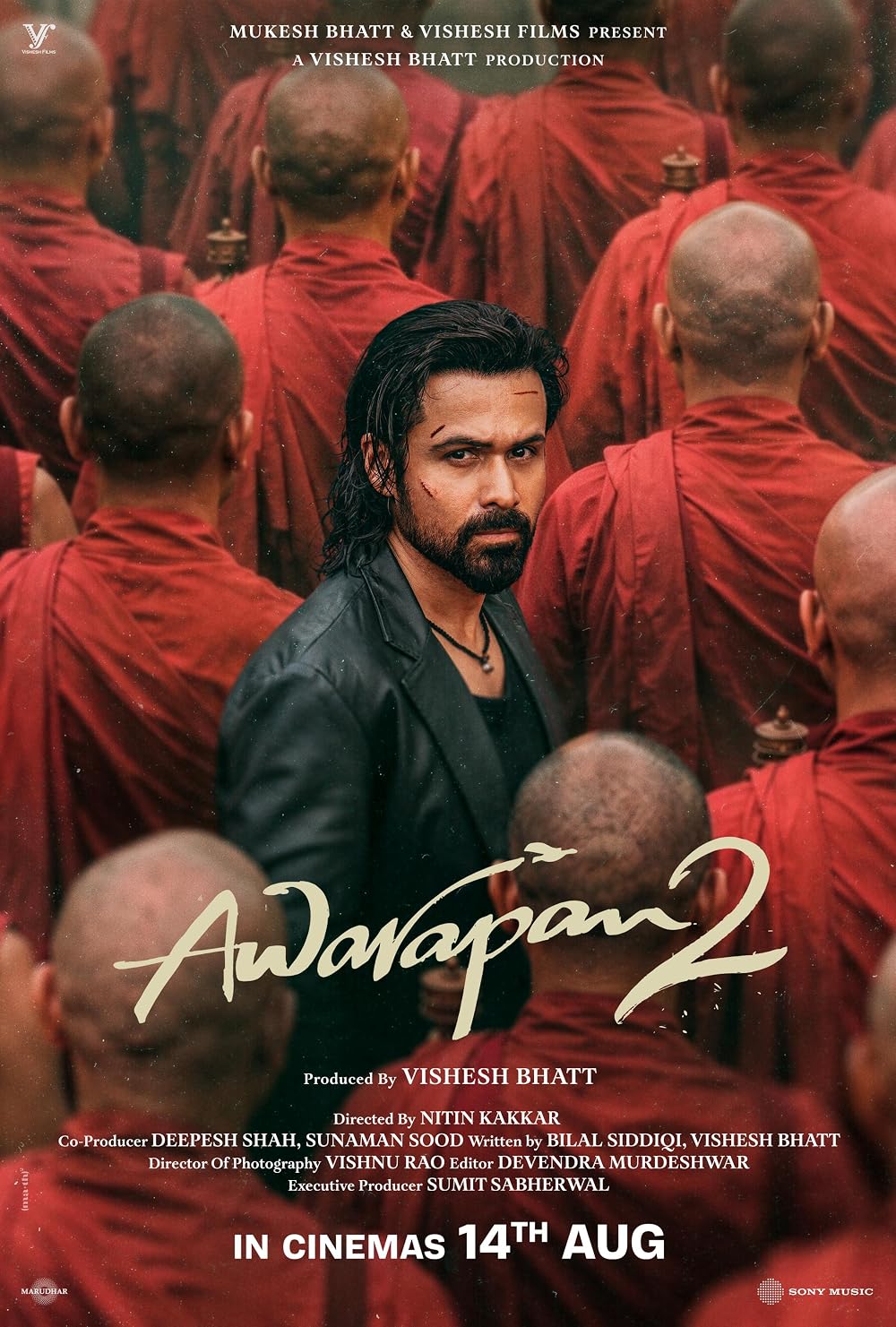
Nostalgia baiting is like retro cafes designed to serve you drinks that would be reminiscent of your past, only to charge you for its whims and fancies as per the current economy. And while slurping a sip or two of the drink, you do realise the trickery of the aura of nostalgia being created around it, while refusing to have an identity of its own. And that is something that you exactly see in the introduction shot of the protagonist Shivam (Emraan Hashmi) in the Hindi film Awarapan 2; riding through the barren lands on his bike with a cigarette in his mouth, a classic case of the filmmakers wishing to cash in on aura farming traits of the character. The nostalgia bait is clear in a nod to justify the ‘sequel’ tag of the film – he is the same Shivam apparently killed at the end of the first film, but miraculously saved by some Chinese monks, only for him to continue searching the purpose of his life, even while visiting his dead girlfriend’s grave, with a rendition of the number ‘Toh Phir Aao’ playing in the backdrop. The convenience is there for everyone to witness even as he notices an unclaimed baby right at the graveyard, only for him to get acquainted with her, name he Aaliyah (again after his dead girlfriend) – and make her the ‘purpose’ of his second innings in life.
Written by Bilal Siddiqi (the co-writer behind the iconic Emraan Hashmi line from The Ba***ds Of Bollywood (2025)), Vishesh Bhatt, and Nitin Kakkar, I couldn’t help but think on how closely exploited the nostalgia bait was in Awarapan 2 – a film that lacks an identity of its own, if the nostalgia were to be stripped off. Think of it this way – watching a routine gangster film featuring a fractured protagonist and a bunch of goofy gangsters, only for the interesting bits to be the sentiments or people from the last film that are incorporated as flashes. The attempt is clear to create a cash grab – and going by its box office performance, they may well be right about it. But when mediocrity is overlooked, nostalgia lives to fight another day.
The events of the film are as predictable as night and day – Aaliyah is kidnapped by a crime syndicate on accounts of child trafficking, only for an incompetent Interpol officer to reach out to the protagonist to infiltrate the gang. The latter is straight out of the books of Don (1978) or the recently released Dhurandhar (2025), even as the fractured protagonist gets a new purpose in his life – to free Aaliyah, and similar ‘birds’ like Aaliyah.
To be fair, the core theme of the narrative is a similar companion piece to the first film – wherein the political subtext of the protagonist saving two Pakistani lovers from the clutches of his crime syndicate in Hong Kong are replaced by the tropes of child trafficking in Bangkok (I love the South-East country parallels too). And the underlying themes of staying connected to the almighty even in moments of atheism form another nostalgic parallel – even as an iconic moment of the monks converging from the first film is recreated here. And to top it, the renditions of the smash-hit songs from the first film, that had me mull over my little broken heart from school. Well I am all grown up now, but probably my emotions aren’t!
The issue is with everything else with regards to the writing. And it begins with the characterization of all other characters around the protagonist that are too stereotypical, without really having an identity of their own. For instance, the antagonist Zorawar (Puran Gabbi) is more cartoonish than intimidating, almost squandering close to ten instances of killing off the protagonist. In one instance, I literally cracked up even as he goes about initiating a gun assembling competition as opposed to using the weapon for what it is. In another, he goes about ordering the killings of people around him by saying he will count to ten, but instead starts from five – something that felt increasingly silly. And don’t get me started about his derivative approach at recreating the aura of an iconic character like the Joker from The Dark Knight (2008), but instead is mounted on the lines of the character of Purab Kohli from Awarapan (2007).
Even other characters have hardly an individuality of their own – two right-hand men of Zorawar in the form of Mehmood (Vijayant Kohli) and Jaideep (Suvinder Vicky), who have hardly anything significant to contribute to with regards to the writing. Or even a crime ‘queenpin’ in the form of Nafisa (Shabana Azmi) who is hardly even there. Or even Zorawar’s siblings in the form of Zara (Disha Patani) and Sikandar (Aniruddh Rawal) – one who forms the inevitable love-interest of the protagonist while possessing zero chemistry, and the other being a masterclass in how not to form a representation of autism – almost possessing child-like qualities that are straight from the 90s, an era where mental health was association with the derogatory term ‘paagal’.
The events get sillier by the minute in the second hour – going from a subplot involving a mole to a subplot involving the protagonist having to safeguard Zara and Sikandar from the shackles of their evil brother. The writing almost had to be reminded that there is a child trafficking plot that needs to be integrated somewhere. Even the sporadic face-offs between the protagonist and the antagonist felt weirdly staged, except for a particular face-off at the end inside a container that evoked a brief sense of interest.
But how would you justify the generic nature of the writing that wishes to borrow the spirit of its predecessor without formulating an identity of its own here. Medriocrity wins, and nostalgia dies a natural death. But hey, nostalgia would probably be woken from its grave again in the third part, just like the protagonist at the start of the film. Excellent cash-grab, I must say – John Snow would be proud!
The dialogues also felt dramatic, almost baiting on the nostalgia factor with themes of purpose often being highlighted in the form of heavy-duty lines (and frequent flashbacks). The music is serviceable, but none of the original tracks stand out outside the popular rehashed versions that are incorporated here. In fact, the music plays a very big part in baiting the nostalgia too – with renditions of ‘Tera Mera Rishta’ playing out at the end against a face-off, or ‘Toh Phir Aao’ being used at the start. The identity of everything else remains a question.
The cinematography is pretty solid here, be it frames exploring the contrasting landscapes through an aerial drone shot, or a specific grey filter mixed with shades of red accompanying your screen. Even the frames capture the combat sequence ably – using the setting and the presence of light to good effect in that one particular sequence inside a container with light penetrating following gunshots. The editing pattern is slightly old school too – often stitching up scenes with a flair of convenience, that instantly took me back to the slick thrillers from the early 2000s. But this technique does lower the impact of the emotions in play, making you feel rather indifferent towards the characters. And not to mention moments of lag in the narrative that had me fidgeting in my seat.
Director Nitin Kakkar probably did understand his assignment pretty well – something that required him to splash the wave or nostalgia, even in the midst of having to construct a generic gangster drama that lacks an identity of his own. The direction isn’t as great as that of Mohit Suri from the first film, and that is where just riding on the nostalgia doesn’t work. The world building is too generic, the characterization is too surface-level, and so it brings about another wave of convenience along with nostalgia to drive the narrative ahead (that is filled with laughable, logical loopholes). That isn’t a good space to be in, making the direction average at the very best.
The performances are a mixed bag here, by the members of the cast. Veterans like Atul Kumar as Samarth, Suvinder Vicky as Jaideep, amd Vijayant Kohli as Mehmood are inexplicably wasted in characters that have no real meat to boast of. Likewise, even a veteran like Shabana Azmi who was terrific in the tepid film Batwara 1947 (2026), is hardly there in the narrative – having little to do, and nothing much to showcase her intimidating side. Aniruddh Rawal as Sikandar has a juvenile rendition of his interpretation of an autism patient – often possessing child-like qualities that are straight out of the 90s.
Disha Patani as Zara looks beautiful here (she always has been), and this felt like a slightly more assured performance, despite the generic nature of her character. She seemed in some sort of control, something that added deft moments of intrigue in a character that otherwise needed better writing. Puran Gabbi as Zorawar is nothing short of a caricature himself, trying hard to showcase his eccentric streak but largely losing out on his intimidating quotient. As a result, the performance itself felt silly and all over the place, an outing from which he can learn from and get better at in his next outing.
Lastly, this is an Emraan Hashmi show who is brilliant as ever as Shivam. His body language and expressions reflect of a person who is broken while searching for his purpose in life, after nearly being killed. He brings a layer of depth to his performance even in the most generic moments, filling the screen with bouts of intensity that oscillates through his eyes and his antics. He was a phenonemal bright star in an otherwise dull film. Someone has rightly said – ‘Aakhkha Bollywood Ek Taraf, Aur Emraan Hashmi Ek Taraf’.
Awarapan 2 is a routine gangster movie that lacks its own identity and uses nostalgia as a cheap trick to cover up a weak story. Reminiscing about the original film isn’t a bad thing, but when a movie relies solely on that feeling, it becomes a lazy cash-grab – one where mediocrity lives to fight another day, while genuine nostalgia is killed. Perhaps nostalgia will rise from the dead again in the next installment, much like the protagonist here, only to give birth to a fresh wave of mediocrity. When will this pattern finally break? Available in a theatre near you.


