

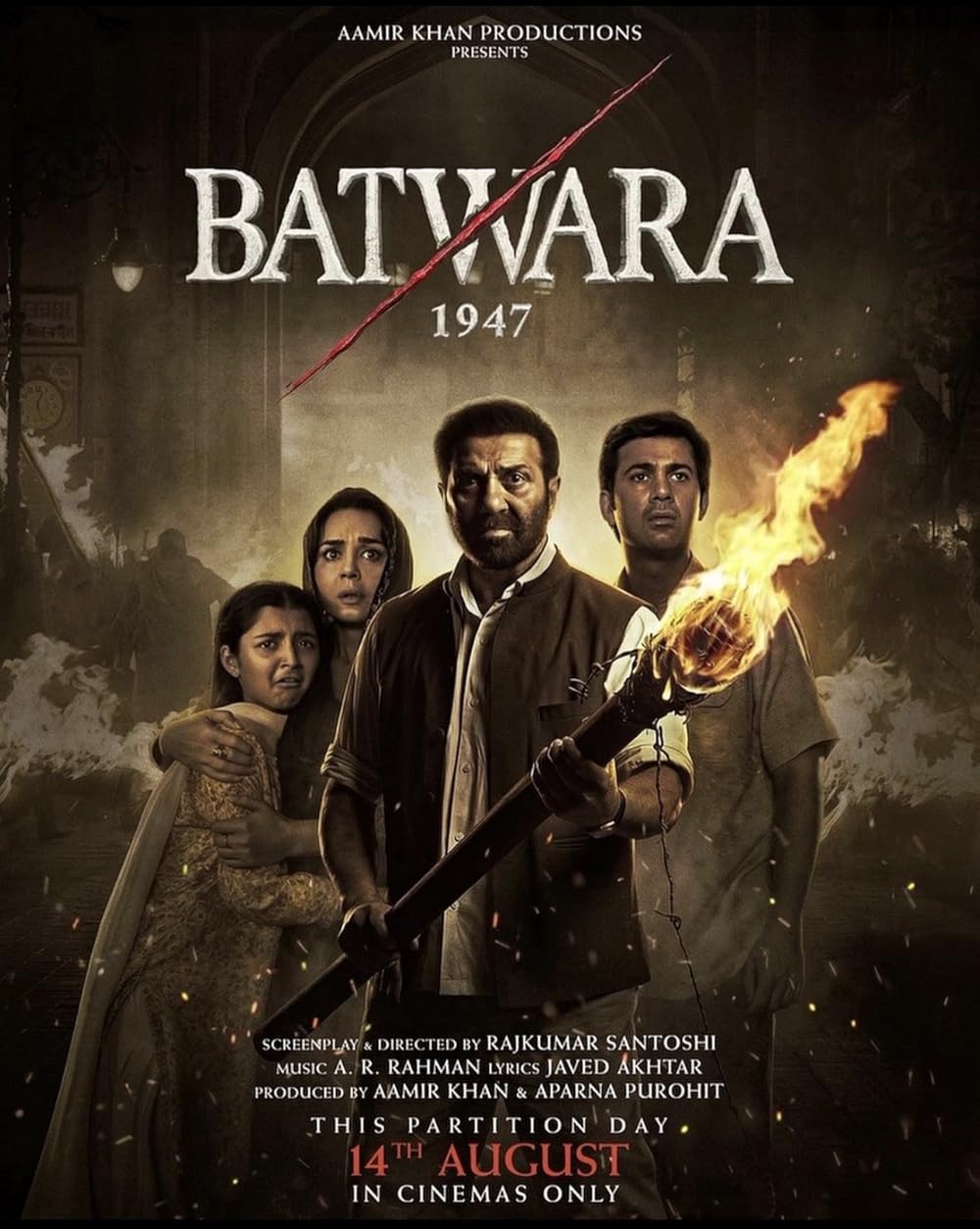
There was a beautiful line in the French film Persepolis (2007) that defined its vibe – ‘Freedom Comes At A Cost’. This same line can be applied twice in the Hindi film Batwara 1947, one with regards to the subject matter, and the other with regards to its filmmaking. It is just that the latter comes with a tweak, wherein the word ‘Freedom’ may well be unceremoniously replaced with the phrase ‘Creative Freedom’ (that comes at a cost). And this is exactly what hurts the film the most – its tone deaf treatment that almost gives a vibe of watching a film like Gadar (2001), wherein the soul of the drama ought to have been an offshoot of Imtiaz Ali’s Main Vaapas Aaunga (2026).
The staging remains an immediate issue when you are first introduced to the protagonist Sikandar Mirza (Sunny Deol) and his family, even as one nation is divided into two, with each being on the cusp of independence. The swinging moods of elation mixed with uncertainty is what defines the mood of the drama here – even though the vibes wish to portray itself as a soap opera. So on one hand you see Mirza almost dismissing a specific communal threat to his family’s existence, even as each of the family members double up as soothsayers in addressing the elephant in the room – that of religious discrimination, and communal violence. For Mirza, every character irrespective of their faith would speak a similar language to his, and so the miscreants would often be outnumbered. The issue though is on how the scattered narrative (that also forms a pattern later on), doesn’t allow the emotions to land, while completely straying away from its original nuanced subject matter.
Based on a book titled ‘Jis Lahore Nai Dekhya O Jamyai Nai’ by Asghar Wajahat, and written by Rajkumar Santoshi, the one thing that Batwara 1947 gets right is the politics of the drama. Mounting itself on the fundamentals of humanity upstaging the concept of religion, the subject matter itself forms a sliver of relevance, particularly in times today. This is particularly true even when you witness the struggles with regards to the partition for Mirza and his family – firstly who are separated in the wake of communal violence at the railway station, only to reunite in the city of Lahore.
There is a matter of convenience, but it forms a few of the more meaningful moments in the narrative, given how the underlying subtext doesn’t allow the characters to simmer in hatred, despite the damages during the partition. Sadly though, it is the former that slowly begins to find a voice – something that deeply impacts the drama, going forward.
At its core, one of the key driving themes remains that of humanity triumphing against all odds. And the same is explored through the character of Mai (Shabana Azmi) – an elderly Hindu woman who continues to await for the news regarding her missing son and his family, even while continuing to live in her mansion that is now allotted to Mirza. It is a crucial face-off that forms their fleeting dynamic – even as Mirza and his wife Hamida (Preity Zinta) look for ways to send her packing. And I say fleeting cautiously, because the focus doesn’t always remain on this dynamic that in my opinion was the core of the film. You only get occasional momenta of love bringing people with differing faiths together, even as Mai chooses to address Mirza and Hamida as her own children, or the latter choosing to look after her and cook for her, after initial bouts of resistance.
The focus instead shifts to a repulsive character in the form of Yakoob (Abhimanyu Singh) – a local Muslim extremist, who wishes to bump off the sole elderly veteran of an opposing faith. And this is also when the drama loses its tone – almost dipping the antagonist in stereotypical waters, often giving him room to don glares just to reiterate his evil intentions. Or even the theatrics around his character, that often results in ‘dialogue-baazi’ (exchange of high-pitched dialogues), meant to dramatize the situation. The pitch of the character is so high that it nullifies the understated mood of the drama, while increasingly pushing it towards a massy template.
The same holds true for a character like Mirza – a noble protagonist who initially resists the stay of Mai, before slowly accepting it, and later warming up to her. The tropes remain typical too – equating the elderly lady to his own mother whom he had lost when he was a child. Or miraculously having a change of heart, even as the latter offers her piece of land for the protagonist to start his business. The issue remains that every incident unfolds in isolation, seldom forming a thread that would seamlessly connect to the main plot.
The bigger issue remains the pressure of serving a massy entertainer too – even as you witness Mirza turning a Desi Hulk, and upstaging goons at will, or miraculously appearing just in the nick of time to avoid an attack on his Mai, or in another scene also saving her by making those goons fly in the air (after they are struck by his ‘dhai-kilo ke haath’). Or even equating his Mai as an emblem of humanity in a local Town Hall, that is a scene designed for claps, more than allowing the larger sentiment to stay with you in the moment. In all of it, the larger messaging becomes all the more louder and preachy, even as the protagonist doesn’t miss a single moment in reminding the antagonist and the viewers, on how humanity is greater than all religion – virtually by explaining the quotes from the Quran, or providing his unfiltered opinion on the teachings of his own religion. Again the intentions are great, but the tone goes for a toss.
It doesn’t help either that the proceedings are adapted from a play – a medium that thrives on its one acts. The same one acts that would appear seamless on stage, do not always work cinematically – often being equated to convenience in writing more than anything else. For instance, you notice Mirza’s son Javed (Karan Deol) randomly appearing at his doorstep in Lahore, when he was separated and nearly killed in India (and we don’t get an explanation on how he survived too when everyone around him had died). Likewise, you notice a character like Habib Anwar (Ali Fazal), appearing at pivotal moments to bail out the protagonist and his Mai, also providing his backstory to an extremist side of a specific character, only for the character to later transform. Both of these instances amount to convenience.
There is an endearing quality in the drama, something that briefly shines every now and then. Be it a scene wherein the characters of a specific faith come together to celebrate Diwali with Mai, or a resounding moment involving people joining a funeral procession that formulated the visual dynamic of the film, both in film and in spirit. But these moments are fleeting, almost brushed under the carpet that wishes to present itself as an expensive massy accessory. Ultimately, the tone deaf moments outweigh the understated messaging of the drama, resulting in the screenplay to be preachy, loud and an utterly missed opportunity.
The dialogues formulate the heavy-duty and fiery exchanges between characters, that focus on the dramatization, more than the subtle messaging that was the need of the hour. The heavy-duty lines blur the tonality of the drama, making the latter more massy than what was required. Another straying factor remained its preachy undertones that often wish to present the message like a sledge-hammer. All of it while completely being devoid of any emotions, even while refusing to stay in the moment. The music by AR Rahman is good, with some beautiful melodies in the mix. But these melodies are awkwardly placed in the narrative, so much so that the impact of the songs (and then lyrics) is missed out upon. The BGM blows hot and cold, often in sync with the fragmented tonality of the drama, something that makes the drama appear soapy and staged, rather than emotional and poignant.
The cinematography comprises of frames that briefly flirt with the resonance of emotions, before quickly moving on to another sentiment on offer. The frames lack the consistency, something that was evidently present in a film like Main Vaapas Aaunga. The frames don’t always choose to present the emotional vulnerability of the characters and their psyche, often extending its focus on the massy elements that end up being an eye sore. The editing pattern is extremely choppy, wherein the events often unfold in isolation while refusing to carry the emotional baggage of the characters from one scene to another. Be it the issue with the cinematic medium, but the transitions just aren’t integrated in the narrative – thereby something that had me disconnected at frequent points in the narrative.
Director Rajkumar Santoshi completely squanders a significant opportunity here by trading genuinely heartfelt moments for a louder, massy template. The swings are wild and tonally off, something that significantly lowers the impact of the narrative. And ultimately, even the messaging ends up being loud and preachy – something that significantly overshadows the well-intended ploys of the filmmaker. The direction itself is woefully dated (much like his counterparts – Indra Kumar, Anil Sharma and David Dhawan; you can’t sell the drama on the nostalgia of Gadar, given its important subject matter), treating every event of the drama in isolation, as opposed to forming an emotional thread – and that honestly summed up the direction here, something that is woefully substandard.
The performances are a mixed bag too, by the members of the cast. It is interesting on how actors of a specific faith in real-life are given roles of the opposite faith here (barring the character of Ali Fazal), something that felt like a deliberate choice, refreshingly speaking. Isha Sandhir as Tabassum has a pleasant personality onscreen, and she offers a tender outlook to her character. Kanikka Kapur is essentially a character in a similar mould as Tabassum, and she has her moments to shine. Khalid Siddiqui as Ratan, Rukhsar Rehman, Khushi Hajare as Tanvir and Sunil Saraswat are decent, and they do enough to showcase their sincerity with regards to their respective character traits.
Ali Fazal as Habib is sincere and earnest, while often striving to provide an emotional hinge to the proceedings despite his limited screentime. Abhimanyu Singh as Yakoob Pehelwan is hammy with his performance (a case that might be an issue with his character briefing), often stereotyping every move of his, in the most dramatic way possible.
Karan Deol as Javed is obnoxious and terrible with his dialogue delivery, something that instantly flattens the emotional moment on offer. He looks visibly uncomfortable mouthing some of the lines (in his Juhu accent), and his expressions tell you a tale or two on how he still has a long way to go in the acting department. Preity Zinta as Hamida delivers a soapy and dramatic act that felt more suited for a play, rather than for the screen. As a result, the emotions around her character just do not land, the way they are intended to.
Sunny Deol as Mirza does what he does best – mouth some electrifying lines with a certain amount of flair. He even scores in some of the softer moments, allowing some emotions to speak. But at the same time, I can’t help but think that his ‘Gadar’ image has got him in creative jail, so much so that even the filmmakers wish to farm his aura in a script that doesn’t demand it.
Lastly, it is only Shabana Azmi as Mai who consistently shines with the emotional core of the drama. You witness her expressions that are so tender and gentle, that my heart went out to her (and her grief and tragedy). It briefly reminded me of the character of Naseeruddin Shah in Main Vaapas Aaunga, but with a different dynamic. And I hoped for the writing to focus on the emotions of her character, rather than opting for a massy route. Nevertheless, she remained a brilliant spark in an otherwise preachy and tedious film.
Batwara 1947 squanders a powerful historical premise by misjudging its tone, trading an intimate human drama for a loud, preachy narrative bogged down by forced commercial tropes. This heavy-handed approach dilutes the emotional gravity of the subject, a flaw further worsened by an outdated, old-school filmmaking style that feels sluggish and archaic. Ultimately, while the film is well-intended and socially relevant, its melodramatic execution and archaic delivery completely stifle its impact, making it a huge missed opportunity. Available in a theatre near you.


