

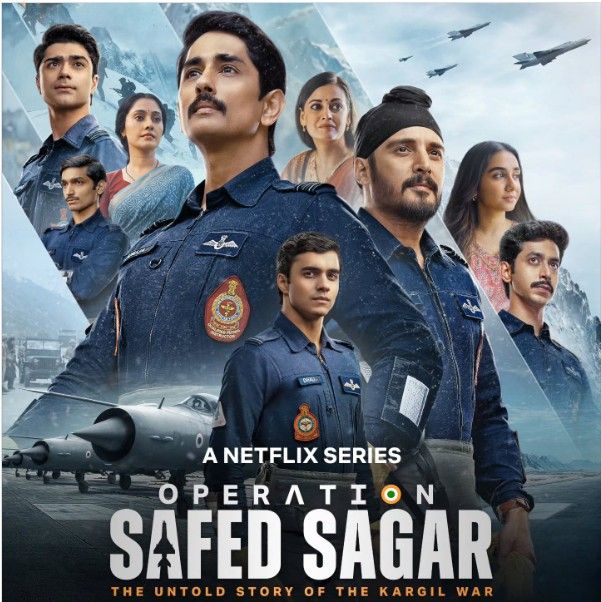
The key trait connecting the two parallel timelines in the new Hindi show Operation Safed Sagar is that of camaraderie. On one side, you are privy to the camaraderie between the two nations India and Pakistan who are on the cusp of the Lahore Declaration – a new found peace-talk that would cement a new found friendship. On the other side, is a drama that is reminiscent of films like Top Gun Maverick (2022), even as you are acquainted to the young pilots of the Indian Air Force (IAF), particularly the Golden Arrow Squadron. The subtext remains familiar – a mock exercize designed as a tournament to test the limits of the young fighters, while allowing them space to execute mock sorties as a perfect simulation for war. There is a familiarity in their persona that cuts through the familiarity of their camaraderie – one is cocky, one is assured, one is slightly emotional with his thoughts, all seeded under the giant umbrella of competemt officers Ahuja (Siddharth) and Tony (Jimmy Sheirgill). The slight bouts of tension are POCs as well as parallel companion pieces to the politics developing elsewhere across the border – even as General Pervez Musharraf (Manu Rishi Chadha) tactfully fixates his rovering eye on the valley of Kashmir, even as the oblivious PM Nawaz Sharif (Vinay Pathak) is engaged with friendship ties with India led by Atal Bihari Vajpayee (Aanjjan Srivastav).
Written by Abhijeet Singh Parmar, Barun Kashyap, Sandeep Jain, Kushal Srivastava and Nikhil Ravi, the focus of the 1999 Kargil war in Operation Safed Sagar lies with the IAF, as far as the writing of the show is concerned. In a pivotal scene at the start, you see Tony addressing his young pilots by questioning them about the ongoing politics of the two countries. After a pause, he states on how the pilots just need to do their job, without focussing on the politics of the land.
That sentiment applies outside the realms of the drama too – where the major focus lies on preparing for the war, carrying out mock drills, learning and executing new formations in the air, and ultimately responding to the moves of the enemies in the battlefield. It is a very specific focus that in the bargain also steers itself clear of the sentiment of hyper-nationalism, something that refreshingly grounds the drama in reality. Hence, the references of the drama won’t be as outlandish as the one in Fighter (2024), but more specifically understated on the lines of Gunjan Saxena (2020) – sharing an invisible universe of sorts here.
The only form of politics brewing in the narrative remains the one across the border – something that forms a context to the otherwise documented fact that Pakistan did infiltrate the Indian territory in 1999, posing their army as Mujahideen, only for the Indian Army and Airforce to join forces in defeating them. The subtext across the border forms an interesting dynamic – the one involving an enticing power struggle between Musharraf and Nawaz Sharif, the latter being oblivious of the plans of the former, only to concede at a latter point.
In between, there are interesting nuggets to savour too – be it the tense relationship between Mr Vajpayee and Nawaz Sharif souring following a covert tape conversation, or even the onset of war that sees one of the characters being captured and later executed, doubling up as a pivotal moment that drives the narrative forward. Or even a brief moment wherein a commentary of a cricket world cup match between India and Pakistan subverts itself in the middle of the war, even as an elderly statesman leads a young rookie up in the sky, only for the latter to go onto save the day (oh, the exuberance of youth).
The emotional moments in the narrative form the familiar tropes of the genre – be it the better halves of the fighter-pilot characters that patiently wait for their well-being, while taking pride in invariably contributing towards unsaid moments for the country. To the show’s credit, these moments aren’t overwhelming while ably keeping the drama understated and grounded.
The brief criticism that I had was with regards to the one-dimensional moments towards the end (which by the way doesn’t necessarily derail the drama) – a pivotal game of one-upmanship up in the sky and down in the valley, even as soldiers are shot down, and bombs are dropped, even as politics across the border doesn’t want its men to give up (some of whom are disowned too). I must admit that the events felt a little repetitive, as opposed to probably implying a variation with the likes of the Indian Army capturing Tiger Hill on Kargil Vijay Diwas. But the screenplay still doesn’t derail itself from the core sentiments, keeping the viewers hooked with a variety of sentiments with regards to guilt and sacrifice of the characters, something that had me invested through and through. And that for me remained the core takeaway too, in a screenplay that remained focused while ending up being pretty well written.
The dialogues are conversational, but since this is a war drama I had my ears tightly tied up to sense any shifts in tone. And while there were brief moments of sensationalism, it still felt supremely satisfying to note that the lines weren’t curated around the word ‘Janaab’. The lines stayed grounded for most parts, while adding to the intrigue of the proceedings. The BGM is resounding while tactfully elevating the blaring moments of war cry, as well as the deft emotions sandwiched in the narrative with a lot of flair.
The cinematography is terrific, comprising of frames capturing locations that feel increasingly authentic, while possessing a power to immerse the viewers in its setting. Even the VFX shots of combat sequences in thin air feel enticing and exhilarating, without distracting the viewers from the narrative. The editing pattern remains crisp and sharp, while effectively maintaining the tempo of the proceedings. In the process, even the key sentiments are ably transferred from one scene to another, something that was pivotal in holding up the proceedings on an emotional level too.
Director Oni Sen scores wonderfully well with the world building and characterization, the latter being a pivotal cog in driving the pulse of the drama. He chooses not to subvert the drama in politics, often keeping it on the side and brewing as an internal conflict across the border, as opposed to say something like a Dhurandhar that had labelled its own countrymen as ‘enemies’ (although, not in as many words). Guess, that was thr difference between the two era – but then I digress. The direction ensures that the emotional core of the drama is intact, while using it successfully as a driving mechanism of the drama. In that regard, the direction is pretty good here.
The performances are wonderful to witness by the members of the cast. The veterans Mahesh Manjrekar as Air Chief Marshall Raghavan Deshmukh, Ananth Mahadevan as Jaswant Singh, Danish Hussain as Major General Javes Haasan, and Aanjjan Srivastav as Atal Bihari Vajpayee are tremendous to witness, and there is a sense of purpose to each of these characters. In the same breath, the likes of Sanjay Suri as Wing Commander Sandy, and Gaurav Sharma, Lalit Parimoo as Sartaj Aziz, SM Zaheer as Muhammed Sharif, and Mohan Kapur as Lt General Aziz Khan have their moments to shine, and each of them are impressive despite a limited screen time.
Prajakta Koli as Madhavi and Dia Mirza as Kamal account for important emotional bouts in the screenplay, in what were nicely understated acts. Amrita Bagchi as Alka is outstanding to witness here, using a minimalistic approach to showcase a range of emotions and that deep sense of loss through her character. Her performance elevates the emotional core of the proceedings. In the context of the drama, Barun Sobti as Colonel Sartaj Singh remain a vital form of casting, given that most of the proceedings focused on events of the airforce only. And his powerful presence is enough to keep you invested in the army side of things, that eventually resulted in a solid outing. Pawan Chopra and Harssh Singh are such competent actors who definitely put forth praiseworthy performances.
Taaruk Raina as Fly Officer Jangi and Arnav Bhasin as Flying Officer Goody are pretty good in their respective acts, but I couldn’t help but feel that their characters felt largely underutilized. Adil Hussain as Air Marshall Vinod Patney delivers another one of his dignified acts, perfectly being well within himself, and using his stature and posture to such good effect. KC Shankar as Group Captain Alok Chaudhary is sincere and earnest while delivering a well measured act too. Vinay Pathak as PM Nawaz Sharif is impeccable to witness here, almost giving the persona of a naive leader who is oblivious to the politics of his land. He was a quite effective in his character.
Serving as the emotional soul of the younger squadron, Mihir Ahuja as Flying Officer Baldy excels at capturing the tight-knit camaraderie and split-second panic of high-altitude aerial warfare. He masterfully channels the heavy psychological toll of war without losing the infectious youthful spirit of his character, ensuring he remains highly memorable even in a heavily crowded ensemble.
Stepping completely away from his previous boy-next-door comic timing, Abhay Verma delivers a first-rate dramatic performance as Flying Officer Dhaliwal. As a young, infectiously charged pilot tossed directly into a brutal mountain battlefield, he brings a raw sense of vulnerability and earnest patriotism. His seamless transition from wide-eyed cadet to hardened combatant highlights his incredible artistic range.
Jimmy Sheirgill as Wing Commander Tony completely owns the screen, particularly in the high-stakes final episodes<span;>. He portrays the heavy burden of leadership with quiet dignity and micro-expressions, perfectly capturing the impossible choices forced upon a military commander during active combat. If anything, the only time he briefly falters is during some heavy-duty dialogues that immediately felt out of character, in an otherwise superb performance that had me invested in his journey.
Siddharth as Squadron Leader Ajay Ahuja commands his scenes with an effortless, magnetic presence. His portrayal of the legendary character balances fierce wartime grit with an undercurrent of tragic emotional depth. He maximizes every single frame to leave a devastating, permanent mark on the audience.
Manu Rishi Chadha delivers a masterclass in cinematic restraint, transforming General Pervez Musharraf into a deeply chilling, multi-dimensional antagonist. Rather than resorting to loud, stereotypical villainy, he anchors the performance in a calculated, quiet authority, letting his sharp, icy glances communicate a ruthless military ambition. His command of body language and speech rhythm brilliantly captures the arrogance of a military mastermind who knows he is playing a high-stakes geopolitical gamble. By providing a fierce, formidable counterweight in the Islamabad backrooms, he elevates the entire tension of the narrative, making the heroic efforts of the Indian pilots in the skies feel profoundly urgent and hard-fought. He was simply brilliant to witness here.
Operation Safed Sagar is a masterfully crafted war drama that pairs a solid emotional core with a meticulous focus on pivotal technicalities and actual battlefield strategies with regards to the Indian AirForce. By deliberately steering clear of complex geopolitical narratives, the film anchors itself strictly in the grit of the Kargil War, delivering a grounded, understated, and thoroughly captivating viewing experience. While the narrative becomes slightly one-dimensional and repetitive in its final act, the authentic depiction of military tactics and the raw human element ensure the high-stakes conflict remains deeply engaging from start to finish, making this drama well worth your time. Available on Netflix.


