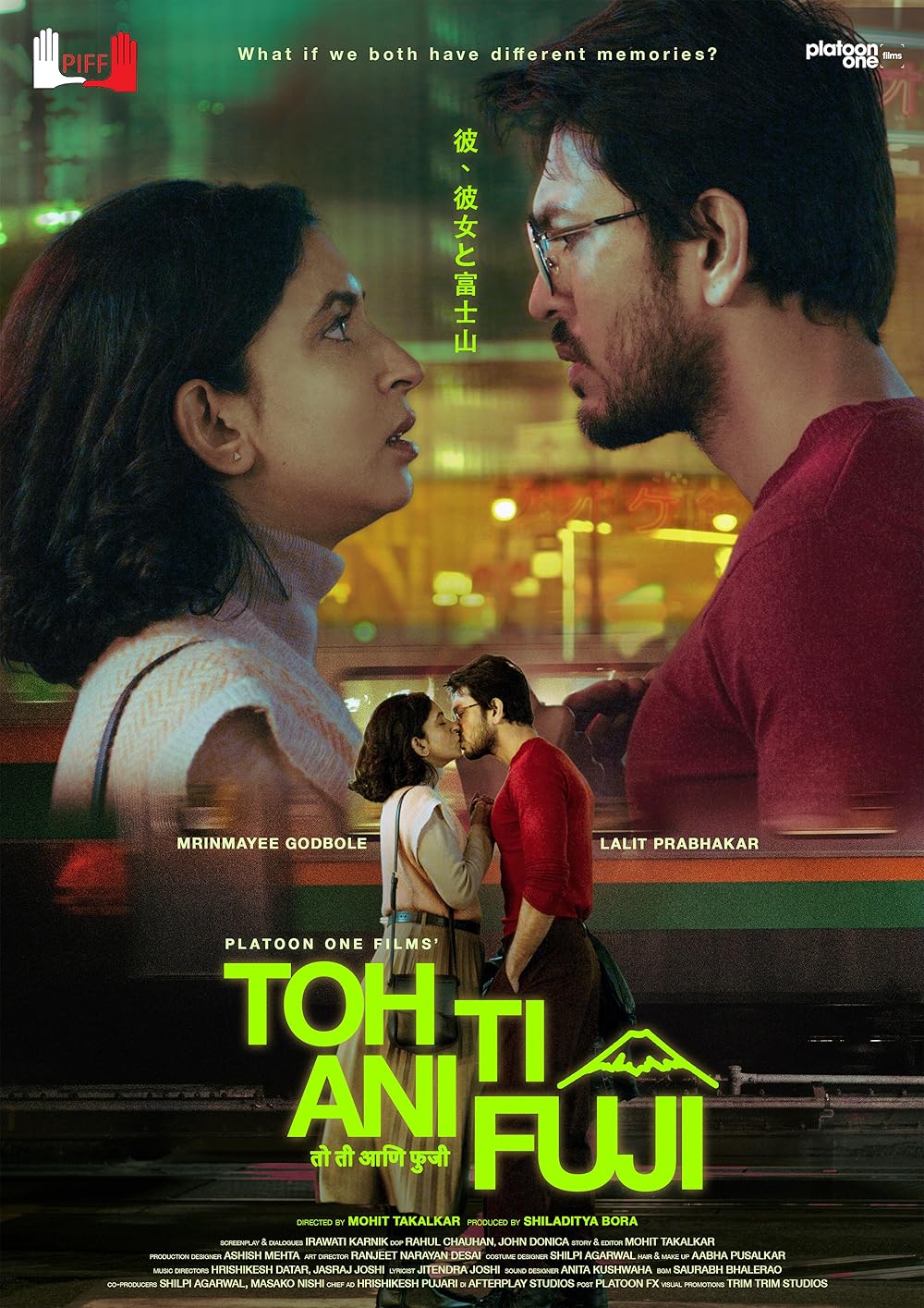
There is something achingly beautiful and utterly frustrating about the new Marathi film Toh Ti Ani Fuji. Initially, the setting of the drama in modern day Japan offers a distinct flavour even as you are acquainted to the two nameless characters. I liked this idea given how their ‘story’ would apply to thousands of couples in an erstwhile toxic relationship. In the same breath, the city of Tokyo plays an important part in Ti’s (Mrinmayee Godbole) life. She is hidden beneath a mask, only accustomed to quiet strolls in the lonely streets of Tokyo – only being witness to the sound on the streets. So a familiar beat of footsteps instantly reunites her with her ex-flame Toh (Lalit Prabhakar) – an unexpected meeting where the Fate Gods are kind and considerate. Or even the classic case of a movie situation coming alive – almost like Before Sunrise (1995) meets In The Mood For Love (2000). You are witness an explicit chemistry between the two protagonists – from sharing food to sharing hearts leading upto a fateful kiss that skews the relationship boundary for the worse. It is at this point that you also know that their past has been filled with toxicity.
Written by Irawati Karnik and Mohit Takalkar, I liked the contrast of the setting in Toh Ti Ani Fuji, wherein the flashbacks are set in the city of Pune – a specific place for breeding chaos as opposed to the calm and lonely setting of Tokyo. It is interesting on how the relationship between the two protagonists compliments the setting – with the chaotic and toxic portions reserved for the cluttered setting, and the overview of longing and angst woven into a calm and collected setting. But the writing partly suffers from the lack of a strong characterization that would add a different dimension to the otherwise obvious traits of the protagonists.
For instance, I was willing to buy the argument that Ti was a caregiver – having the responsibility of taking care of her dying mother, her toxic boyfriend, and her son – all at various instances in the narrative. There is a hint of maturity that separates her from Toh, almost willing to shoulder responsibility as opposed to the callous attitude of her partner. You literally see him partying despite a call for help in what remained an urgent situation. But in the same breath, the character of Tou remained one-dimensional. We have seen a long list of man-child representations on celluloid from Bunny in Yeh Jawaani Hai Deewani (2013) to the recently released show Maa Ka Sum (2026) featuring the character of Gust. The common thread remains a rich brat born with a silver spoon who wishes to rule the world with his badass attitude. And Tou is no different either. Therein lies the issue.
The justification of Tou being a man child doesn’t go beyond the ordinary, often coating his dynamic with his father with the same paint. The divide (and cliche) is clear – he is rich, she isn’t, he is a man-child, she is matured, and hence, they are a match made only on celluloid where toxicity thrives. To be honest, I was momentarily invested in their moments of intimacy – be it Ti’s ambition to just disappear to another country, or Tou’s attempt to launch his failed startup even though Ti is struggling financially to make ends meet. In the same breath, some characters aren’t written at all – like Toh’s father and his dynamic with his son, or Ti’s present husband and his equation with her, or even the little child of Tou and Ti that was used more like a filler than an emotional strand.
The issue lay with the slide, with conflicts appearing to be far too frivolous than they actually are. For instance, the fleeting moment of a pregnancy leading to an abortion felt too quick for me, as opposed to dwelling deeper in the psyche of the protagonist – something that is only hinted at twice, once at the abortion table, and second during her tryst with her beloved red-flag. The escalation of arguments between the couple needed a deeper outlook from atleast one character – but instead what we get is a character’s ego being hurt after he is unable to locate Paraguay on the map. These were specific moments that demanded depth, although I fully understand on what the writers were going for – of having arguments start from the smallest of things.
One important demerit for me remained its structure that didn’t allow me to settle into either of the two versions of the protagonists, for most parts of the runtime. Ideally, I would have liked an object or a trait to reroute the drama to the past and vice versa – the modes that weren’t really written, which in turn appeared to be sudden and jerky with its structure. The drama unfolded in an organic manner, yes; but the structure needed some better writing with respect to its integration. In a way, the structure represented each of the two protagonists and their fractured past.
The drama really does come to life in the final 30 minutes that increasingly reminded me of Marriage Story (2019). In a particular scene that was so well constructed, you find a regular day in the lives of the couple turning toxic and violent with a series of suppressed emotions coming to the surface in a layered bout of escalation. The situation felt stifled and haunting, only to be complimented by the calming influence of the current setting. The duality of the setting, structure and the characterization which felt like a criticism up until this point, rose to the occasion in a solid final act that felt terrifying real and tense. Even the reference of Mount Fuji being a dormant volcano that is visible to everyone on a good day, felt like a valid correlation with the core relationship of the characters – a calming influence to the outer world with a simmering tension within. And I so wished for more such moments of spark with the writing that felt middling and unidimensional for most parts of the runtime.
The dialogues are grounded but at times overused as well – a case in point being Ti’s mother’s death that is followed by a lot of chatter, or even Toh’s argument with Ti over the latter approaching a character for money. It stemmed from the fact that perhaps the makers weren’t confident of conveying the emotions through the frames, something that was beautiful done in a film like Tighee (2026). The frames here are sufficient by themselves, and work wonders when not christened with additional lines – a case in point being the melancholic final frame of the film. But otherwise, the use of lines could have been a little restricted while seeking to communicate feelings through bouts of silence (and the frames and the cinematography was excellent). The music and the BGM are decent, and the compliment the mood of the drama quite well.
The editing pattern works in isolation, but not fully in terms of the structure (apart from the terrific final act). The transition points are missing, something that is generally crucial for a non-linear narrative to fully prosper. Director Mohit Takaldar does a decent job but doesn’t always nail the drama here. I wished that the world that he had created, had further gone on to play a proper character – in complimenting the core relationship in play (there were instances of it, but scattered in the narrative). Additionally, I wasn’t fully convinced with the structure employed by the filmmaker, a trait that frequently took me in and out of the drama. Yes, the positives remain in his handling of a sensitive subject particularly towards the fag end of the drama, along with moderately scoring with the characterization. But the outing remains a mixed bag.
The performances are pretty good by the two leads here. Lalit Prabhakar plays the quintessential man-child only to transition into a changed man with certain traces of his past. In that sense, his character does have an arc to play with – and he uses his expressions and body language to pretty good effect here in creating a greyish aura of a character who isn’t always affable. Mrinmayee Godbole is even better here, particularly given the fact that the arc of her character remains narrower than her co-actor. She embodies silence brilliantly, often allowing her eyes to do the talking – while symbolizing a matured stance in a toxic relationship. There is an organic comfort in the romance that blossoms, and there is a world of grace in Mrinmayee’s performance that allows you to focus on a bed of roses as opposed to the thorns on it. If only the writing was a little better, both the performances would have had a better impact.
Despite good performances, Toh Ti Ani Fuji is a complex drama marred by middling writing and execution that results in a mixed bag of sorts. I really wished to like the drama a lot more here, but alas! Available on SonyLiv.