

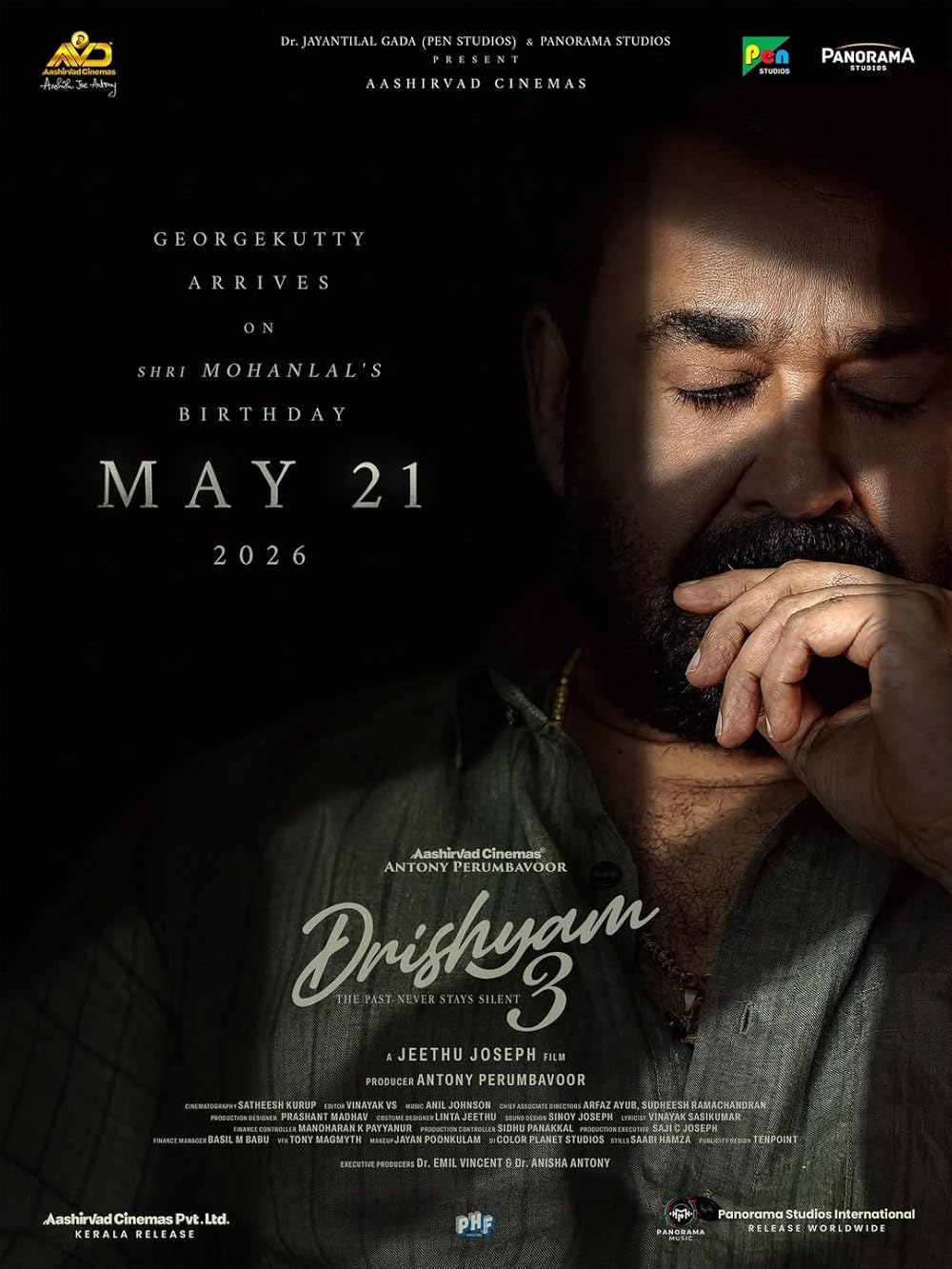
There was a meme floating a while back on the internet featuring the picture of a stallion christened with fire – a three part illusion that would start from left to right, and divided into its tail, its body and its ultimate reveal of the face. But the reason why it became a meme was because the fiery tail and body of the stallion was followed by a hand sketched drawing of the face – an indirect reference of how the final part of the image went awry. The new Malayalam film Drishyam 3, a direct sequel to the events of Drishyam 2 (2022) which in turn was a direct followup to Drishyam (2013) – follows this trope of the meme. While the first two Drishyams were absolute bangers, the expectations around the third film was massive – with the pressure also mounting from its potential Hindi remake starring Ajay Devgn. And while the third installment isn’t bad, it certainly buckles under the pressure of the massive expectations that the franchise had set. The bar was so high that this film was only playing catch up after a point.
Written by Jeethu Joseph, the events of Drishyam 3 take place exactly four and a half years after the events of Drishyam 2, wherein the protagonist Georgekutty (Mohanlal) had outwitted the cops and destroyed Varun’s body, while in the process saving his family and his daughter from imprisonment. And in the same breath, we are now privy to Georgekutty’s financial state that are only progressed from the first film – starting from a video library to a movie theatre and finally turning producer here to a movie IP (based on his life) worth 100 crores. In the same breath, you are also introduced to Geetha (Asha Sarath) who has slipped in depression following the endless pursue of her son, even as her husband Prabhakar (Siddiqui) remains a silent spectator. And immediately your loyalties are tested in the drama with regards to the plight of both families in question – one being cautiously jovial while the other on the brink of destruction.
In many ways, the writing here remains a character-driven plot, focusing on the characterization of the protagonist who has significantly evolved from the first film. While in Drishyam 2, you saw Georgekutty being extremely vigilant and sharp, the Georgekutty here is increasingly vulnerable while relatively lowering his guard. In a significant scene, you see him conveying his deepest insecurities to a character by exclaiming on how he fears that his children would perceive him like a calculative sociopath. This feeling of his probably stems from the fact that he is regretful of the event that changed his and his family’s life, while continuing to assure himself that he was only protecting his family. In the same breath, you also see him lowering his guard – not quite marking the moves of every character around him, while also volunteering to answer all the questions of his daughters Anju (Anjiba Hassan) and Anu (Esther Anil).
The writing here essentially follows the template that is synonymous with the Drishyam world – allowing the viewers time to immerse themselves in the narrative while getting reacquainted with the characters before delivering the hammering blow at the end. And yet, I wasn’t always approaching this narrative from the finale twist – significantly being invested in the protagonist’s journey of finding a potential groom for his daughter Anju, only to continue to receive rejections following the chatter on social media. In hindsight, this plot point felt slightly half-baked given that the chatter is only inferenced and never really shown on screen.
Other than the two nosey journalists doing the rounds, namely Yamini (Veena Nandakumar who mysteriously is forgotten after a point) and her colleague (Shiva Hariharan) – the atmosphere built around the chatter that was synonymous with the first two films is missing here. Be it the neighbours or the tea shop near the police station – the key contributors to the chatter aren’t a part of the narrative here, and neither is there an attempt at digressing into the social media space.
The Drishyam franchise can often be regarded as a mood piece known to lure the viewers in, before tactfully shifting gears. Keeping that in mind, I was blown away by the twist at the halfway mark, bringing back a character from the dead – this time with a vengeful purpose of completely destroying the life of the protagonist, something that raised the bar for me going into the second half. But once there, the writing continued to spiral down in the usual trappings of the genre.
One minor flaw remained on how the reintroduction of the character doubled up as the face of the antagonist here – as opposed to characters like Geetha or even IG Thomas Bastin (Murali Gopy) who were considered on the right side of the law. My point here is on how your loyalties were split between what is right versus what is ‘actual’ justice – simply based on the personality of the characters. But bringing in a character that didn’t sway loyalties even previously in the franchise, made this a one-sided road – even as the cat and mouse game was in full mode. Some other characters like a psychiatrist, or a morgue attendent, or even a grave-digger ought to have added a little more weightage to the drama than they actually did – a drawback that is felt towards the end wherein their contributions don’t really circle back to the ‘twist’.
One major disconnect for me was a U-turn of a character that was always calm and collected, despite being an important stakeholder in the crime that was being committed. My issue wasn’t as much with the situation at home that prompted him to ‘switch’, but more in lines with how the ‘switch’ was only used as a device to take the story ahead, while never fully being in sync with his personality. And from thereon, the slide was a reality, sadly!
The idea of stacking every twist along the way in the final 20 minutes is a risky proposition – given how the film would only work if the twist in itself is outrageously brilliant. In hindsight, the twist in Drishyam 2 was convoluted but it very much felt believable, while leaving you in awe of the protagonist. But the twist here doesn’t have the same impact even while being convoluted. At one point, the events felt like a youtube video in 2X speed – with a central event unfolding through alternate perspectives. The issue though for me was with the desperation to impress along with a bout of indecisiveness – that lead to a convoluted conclusion.
It also didn’t help that the protagonist is shown to crack the trap by a mere chance, as opposed to orchestrating the events of the conclusion. The idea of reverse engineering the twists has been a recent feature of Jeethu Joseph’s filmography, and that would always come under a scanner if they don’t organically add up. So even a relatively emotional ending here isn’t enough to save a film that sadly ended up being a sequel bait. Like the great The Godfather franchise featuring two legendary classics, I would assume that the third film doesn’t exist. In the same breath, why was there a tease for a fourth film? Just let Varun’s soul RIP now, please?
The dialogues are understated and that definitely grounds the drama in reality, despite some dramatic and wild swings towards the end. The BGM contributes towards a brooding buildup in the first half, with subtle traces of comedy to depict the everyday life of the protagonist. But the crescendo gets louder and louder in the second hour, and to its credit – it is atleast in sync with the shifting tone and mood of the drama. The cinematography remains a mixed bag here. The frames definitely play a role in conveying the vulnerability of the protagonist while accounting for his emotional insecurity too. But the staging completely goes for a toss when the twists are employed, something that significantly lowers the impact of the drama. As a result, the finale twist seems laboured and manufactured instead of organic and impactful.
The editing pattern follows a similar suite here, being assured, immersive and laid back at the start to completely chaotic and convoluted towards the end. And that was the entire drama in a nutshell too! Director Jeethu Joseph has got to be one of the finest voices of the thriller genre, but offlate his idea of reverse-engineering a story is resulting in a shortfall. What that does is put a lot of pressure on building a path – something that wouldn’t be organic always. Here, I liked how he focused on the character of the protagonist while accounting for his vulnerability. But his direction also falls into the trappings of the genre that Drishyam never stood for previously. The pressure of the twist felt so high in terms of expectations, that I couldn’t help but feel that the prolific director mildly buckled under its weight. The direction isn’t bad, but this is far from the high bar set by the filmmaker with regards to this iconic franchise.
I had absolutely no issues with the performances by the members of the cast who were impeccable in every sense. Nikhil Nair as Avira, Dinesh Prabhakar as Rajan and Shraddha Gokul as Shreya have their moments to shine. Santhi Mayadevi as Adv Renuka has a solid screen presence and she does a fine job here. Muhammed Musthafa as Aneesh and Biju Menon as Harikumar are well restrained and manage to act their parts quite well. While Asha Sarath as SI Geetha has little to do here, Siddique as Prabhakar is fiercely good while delivering a fine performance.
Veena Nandakumar as Yamini is calculative but the writing oddly moves past her after a point. A character making a comeback (name of the actor and character name under wraps to avoid spoilers) is outstanding here, with bloodshot eyes and a demeanor that automatically makes him intimidating. Muraly Gopy as IG Thomas Bastin is good but the writing limits his capabilities here.
Irshad as SI Suresh Babu is sincere and earnest while acting as a perfect foil for the protagonist. Meena as Rani is decent here while being an effective support system for her husband. Ansiba Hassan as Anju and Esther Anil as Anu are outstanding actor, and you get a glimpse into their distinct personalities here – in the wake of a crime that was accidently committed years ago. The latter is fierce is independent as opposed to the former who is visibly restrained given how she was the one who had committed the murder – and both of them are excellent to witness here.
If anyone were to ask me why I am a fan of Mohanlal then I would show them this film (along with his previous classics like Kireedam, Vanaprastham and Thanmathra). The Drishyam franchise is synonymous with Georgekutty, and through the course of the three films, you see three distinct characteristics of survival, instinct and vulnerability. And hence, you needed an actor of the skillset of Mohanlal to pull this off with grace. There is so much that he conveys through his eyes and body language, that had me in awe of his brilliant performance. If this film worked to some extent, then it was due to Mohanlal’s flawless act who absolutely nails the emotional core of his character. And I could literally go on and on and on about his brilliance in what was a towering acting masterclass of the highest order. If only the writing was better…..
Driven by engineered twists, Drishyam 3 is a film that oscillates between brilliance and mediocrity. While the character-centric plot initially resonates, the chaotic, convoluted finale represents a narrative harakiri that fails to deliver the expected payoff, making this the franchise’s weakest installment. This misfire raises immediate red flags for the anticipated Hindi counterpart. If the remake fails to deploy smarter creative liberties, it faces a grim outlook – irrespective of the loyal fan base primed to accept any output. Available in a theatre near you.


