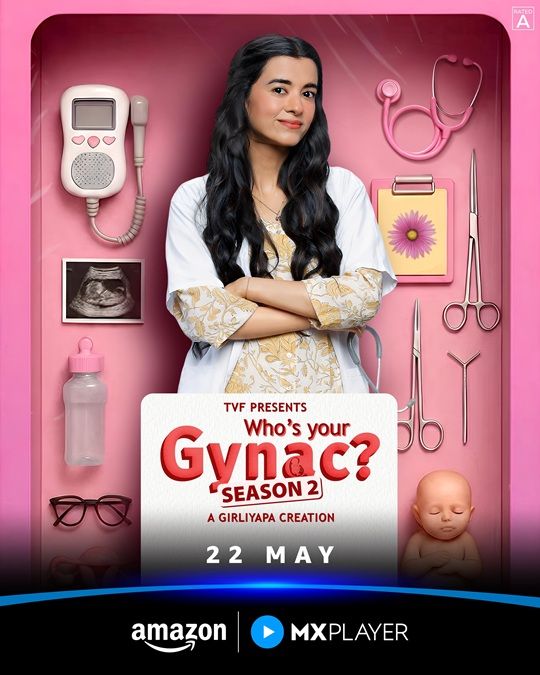

One of the biggest positives of the second season of Who’s Your Gynac remains its characterization. In a way, the second season marks a natural progression of the characters from the first season – almost invariably accounting for their arcs of maturity. And as they say, maturity is relative. For instance when you are reintroduced to Dr Vidushi (Saba Azad), life seems to be perfect, at a glance. Her new found love life with Dr Arth (Kunal Thakur) is all rosy – he is calm and collected, she is a tad goofy but deeply in love, and things couldn’t have been any better. But the moment you dig a little deeper in the protagonist’s life, you realise that she is much similar to the folks in their late 20s or early 30s – struggling with her finances, while trying to hold her life together.
Her financial costs include having to cope with the rising rent of her clinic that is aptly named ‘Choice & Care’, without wanting to opt for the fallback option of asking money from her father. And the cost of living in a city like Mumbai forming its own tropes of hardship, including having to provide a raise to her assistant, Nurse Violet (Vibha Chibbar). Yes, life is hard for Dr Vidushi – much like most folks of my generation struggling with our finances that are juggled between our dreams and aspirations.
Written by Shreya Srivastava, Mohak Pajni, and Shivani Bhasin, the second season of Whos Your Gynac has a breezy outlook to it with a touch of sincerity and a whiff of feminism that play essential cogs in the narrative. Given that the protagonist is a gynacologist, the issues related to women healthcare is dealt with utmost sensitivity and grace, while doubling up as an important conversation starter. For instance, the character of Swara (Karishma Singh) who had previously delivered a baby, is suffering from postpartum depression – a common issue that isn’t being discussed as often. The usual tropes of a baby giving way to joy and laughter in a family is an utterly rosy picture, something that the writing steers clear of, particularly with the character of Swara who is virtually lost on the back of hormonal imbalances, amidst potential career sacrifices that have been clouding her head.
In that sense, the writing doesn’t wish to be a game-changer in any way – almost being content in harbouring a conversation around such common healthcare issues that are integral to women, but also a good guide for men to understand and reflect their care on them. In the same breath, I wished that these issues had a little more depth to them, as opposed to simplistic resolutions being provided in fleeting moments. But the idea of it being a conversation starter cannot be denied – even while touching upon some other important issues related to Polycystic Ovary Syndrome (PCOS) or a general issue of a performance anxiety before the act, or the callous nature of popping in pills without consultation.
One criticism that I had was with regards to a creative decision of the actors frequently breaking the fourth wall, a case that was also prevalent in the first season. What that did was disconnect me from the drama a little (and I get the mockumentary style of play here, but all stories don’t warrant it). This, even though the frequency of the same has been reduced from the first season.
For me, the emotional hinge in the drama remained the character of Dr Vidushi – who would always hide her own vulnerability behind her flashy and disarming smile. Be it the maturity with which she would handle her patients, or be an unparalleled support system for her friends including Mehr (Aaron Arjun Koul) who is shown to be balancing his personal and professional life without much luck in the latter. And yet, she remains someone who keeps her issues to herself – something that forms a bit of a pattern here.
Be it in an instance wherein she refuses to open up with her ‘green-flag’ partner on a potential goofup that he invariably carried out at a conference. Or her decision to work in a business collaboration with a franchise owner that meant dealing with more patients without her trademark ‘personal touch’. Or even refusing to approach her father for money in what felt like an important roadblock of her career and ambitions. She remains an ideal friend, an ideal therapist, an ideal confidant, an ideal boss (to Violet), an ideal girlfriend, and an ideal gynac – all wrapped in one without accounting for her own vulnerabilities.
The episodic nature of the writing, almost shapes the show to be a Sit-Com – something that is a comfort watch. The flip side to that argument is that it trades depth for breeziness, wherein some important instances in the narrative remain nothing more than fleeting moments along the way. And that was the one structural complaint that I had with the writing – some rather pivotal moments didn’t have enough screentime to fully realise their emotional potential. The case in point being the heartfelt conversation between the protagonist and her father that needed to linger on for a tad bit more in order to fully allow the emotions to land. But nevertheless, the importance of the show lies in the fact that it wishes to be a conversation starter of the healthcare of women, as much as it wishes to be a coming of age drama. In that sense, the journey is breezy and pondering, thereby summing up the screenplay that makes its mark in quite a few moments.
The dialogues are tender and breezy while adding a gentle layer of sincerity to the proceedings, that allows the drama to stay grounded in reality. The music and the BGM are heartfelt, and they wonderfully work in sync with the earnest themes being explored along the way. The cinematography sprouts a nice brand of pastel shades in order to make the drama eye-pleasing, even as the frames do their bit in keeping you emotionally invested with the characters. The costume department deserves a mention for curating attires according to the varied personalities of the characters. For instance, the shade employed on Dr Vidushi is mostly pastel – something that aligns with her personality. The editing pattern is slightly episodic – a format that brings with it, its share of shortcomings with the emotional quotient of the drama in play. But largely, the emotions do land (if at all, fleeting in moments), and in that regard, the editing style is decent.
There is something beautiful about women telling women stories, something that is drastically different from men telling women stories. The amount of sensitivity that director Himali Shah brings to her characters and the situation that they find themselves in, is often christened with grace and tenderness while never losing out on effervescence of humour. The protagonist isn’t a victim despite all the troubles in her life, a stark observation on how she carries herself on the back of her disarming smile. This, unlike Chandni from Chand Mera Dil (2026) who ends up being a confused version of what she wants in life with her troubles. And this is the difference right there in handling female characters – one through a female gaze, and the other through a male gaze. In that regard, Himali does a wonderful job here while handling the subject with grace.
The performances are wonderful by the members of the cast. The likes of Ismeet Kohli, Rishika Nag, Shivam Khajuria, Gunjan Hariramani, Shruti Seth, Kenneth Desai, Gayatri Bansode, Apoorva Kiran, and Anushree Kushwaha have pivotal moments in the narrative, and each one of them are able to hold their own here. Adithi Kalkunte as Sangeeta is sincere and earnest while delivering a supremely grounded act. Pushkaraj Chirputkar has a playful energy with a dash of shrewdness, and he manages to hold his own. Vibha Chibbar as Nurse Violet flaunts her stoic expressions perfectly, while silently showcasing her traits of care and compassion along the way.
Jai Talwar as Rahul and Kunal Thakur are well restrained while being a perfect foil to Swara and Vidushi, respectively. You don’t see them under the limelight while quietly offering unsaid support to their partnerw. That is what alpha-males do – they don’t try to dominate but instead just aide their better halves! Aaron Arjun Koul as Mehr has a natural flair of effervescence to his persona, while allowing his deep vulnerabilities to take a backseat. And he is a treat to watch.
Karishma Singh as Swara is outstanding to witness here, in a character that is provided with an arc of her own. She is dazed and lost at the start, triggering an important conversation about post pregnancy depression, while flaunting her boss lady vibe later on. These were two varied shades, and she absolutely nails both versions of her character.
The soul of the show has got to be Saba Azad as Dr Vidushi. There is something affable about her presence – be it her disarming smile or her comforting body language that allows you to warm up to her. She also handles her emotional vulnerability and uncertainty with a lot of grace, while never losing her calmness. I liked how she never approached the character as a victim, but instead an important contributor to the society – someone whom even the viewers could seek for and warm up to in their individual lives. She was brilliant as ever in yet another graceful and towering act.
Despite the drama lacking depth, the second season of Who’s Your Gynac serves as a timely conversation starter on women’s healthcare, while ably delivering a linear coming-of-age narrative backed by steady performances. Available on Amazon MX Player.