
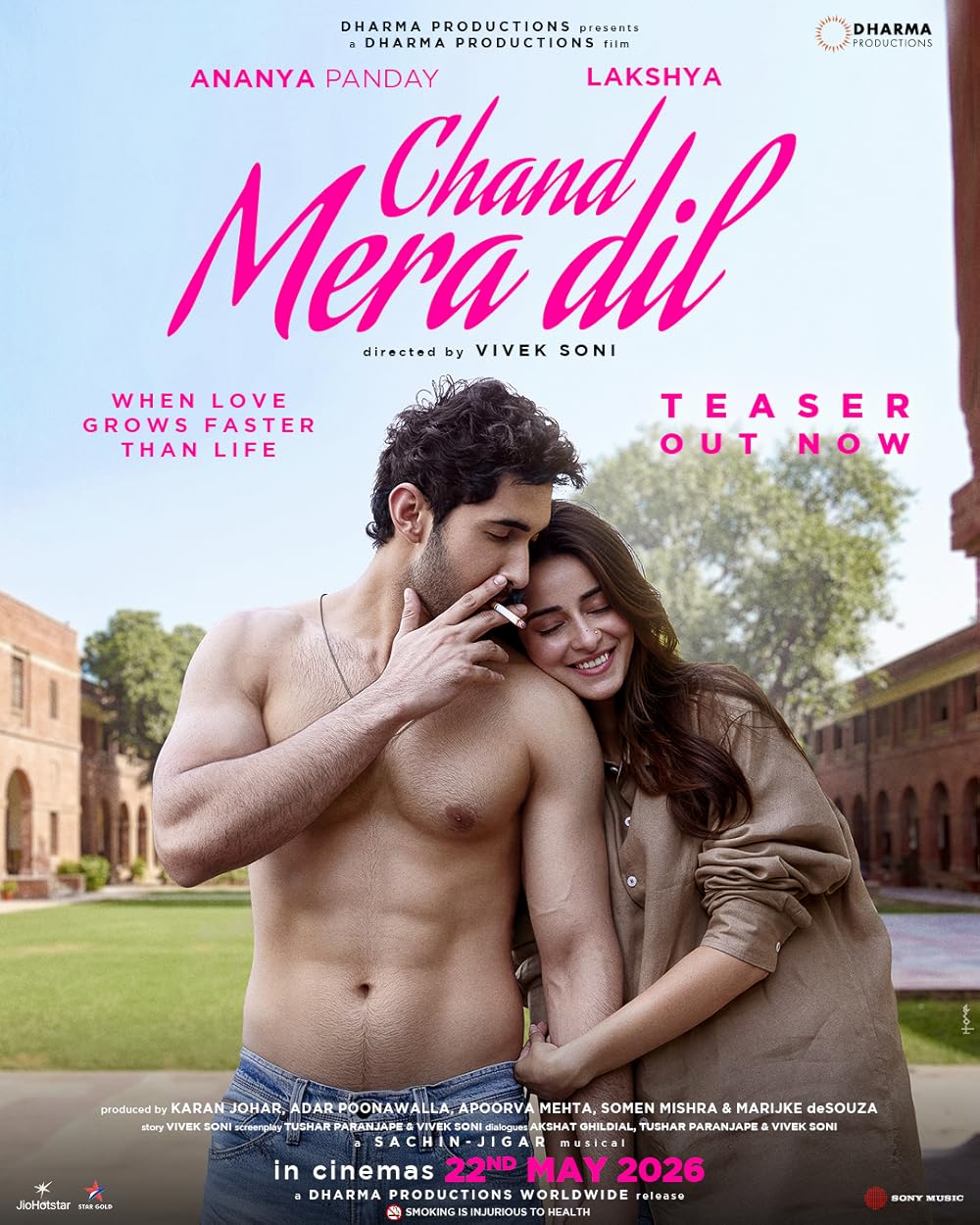
The initial marketing material of the new Hindi film Chand Mera Dil, almost gave a derivative impression of last year’s superhit Saiyaara. Be it the impaired derivative lighting illuminated by radioactive rays, almost giving the film a Wong-Kar Wai illusion. Or crooned number by Faheem Abdullah that will supposedly bring the Gen-Zs with a glucose dip in a packed theatre. Or even the rage-filled nature of the protagonist that felt straight out of the Toxic Paglu Cinematic Universe. But I must admit that Chaand Mera Dil does have an identity of its own – something which if pursued would have resulted in a far better film. But the makers do not fully commit to the source material, often relying on unsaid gimmicks that tilts the drama to a supposed mood piece – except that the writing remains woefully surface-level with an inference of Bollywood that comes back to haunt the film. This made me step out of the theatre with mixed feelings – of having watched something aesthetically different with dollops of stupidity and overindulgence.
Written by Vivek Soni, Tushar Paranjape and Akshat Ghildial, I had an immediate issue with the representation of Gen-Zs in Chand Mera Dil. The setting remains that of an engineering college on the lines of 2 States (2014) wherein aesthetics precedes over the rawness of the vicinity (no way are the rooms of guys this clean), even as you are introduced to the two protagonists – Aarav (Lakshya) and Chandni (Ananya Panday). The idea of them falling in love seems woefully frivolous – he sees her dancing to a fusion beat only to fall in love, continue stalking her with themes of ‘twinning’, only for her to eventually spice-up the chemistry quotient by incinuating the colour of black coffee to match her underwear. Yep, you read that right! Kinky but also cringe!
The reason why I say this is a misrepresentation is because the Gen-Zs are treated as a concept – they are assumed to behave in a certain way. So if he opens his arms to her at a railway platform, only for her to jump on him while barely missing the incoming train – then that is the assumed form of madness. Or if the protagonists randomly stop their bike in the middle of the road in order to engage in intimacy over their future, it is assumed that it is a norm amongst the Gen-Zs. Or if the couple being arrested immediately, continue to divulge into their private lives at the police station – then that is considered a form of madness and intimacy by the writers. So while the details of her dad being a wife-beater and him being emotionally distant from his family are fine – the setting doesn’t warrant that dialogue. As a result, its impact is significantly lowered – a masterclass on how the setting is so important to the narrative.
As far as the identity of the drama goes, the writing peaks in its second act, with a conflict that seems relevant – that of the couple being pregnant whilst studying in engineering. The complications introduced are searing – they decide to support each other, he takes extra math classes at a coaching centre to support his family, her life changes after the birth of her child, they both have to sacrifice their studies and grades and campus interviews, in order to stick around and survive, in a vlassic case of young adulthood. In between, the tracks of the respective families and friends really don’t make much sense, even as the production company continues to have a hangover of Rocky Rani Kii Prem Kahaani (2023). Yes, we get it – it is all about loving your family, but they needn’t feature in all of your films!
My core issue that I had with the writing remained on the lack of clarity in dealing with a conflict at hand. The writing remained rather unsure of the characters and their reactions to the conflict. So following a pivotal incident that crucially separates the two protagonists, the writing never chooses to fully commit to the conflict. Chandni is definitely the more matured character out of the two, but I was confused with respect to the purpose of the character – was she deeply affected by the incident so much so that it reminded her of her childhood? Was she still in love with Aarav? If so, was she using her colleague Kevin (Paresh Pahuja) as a ‘spare tyre’? Ironically, the answer to all of these questions is a resounding ‘Yes’ – something that makes her a conflicted walking red-flag! It ain’t me folks, it is the writing – Trust me!
This remains much of Aarav’s problems too – a concept of a heartbroken lover that only spews anger as a release mechanism. This is the core issue of men writing women characters – wherein the wave of sympathy always tilts towards the male character, painting him as a victim more than a perpetrator. This isn’t a Thappad wherein the female protagonist would take a stance, come what may! This is a Dharma world wherein Aarav becomes a victim of mixed signals including an anniversary role-play, or even the one who gets to know about his ex-wife’s marriage at a family reunion. So when the father compares his relationship to the one-year warranty of an LED – it felt out of place in many ways, something that resulted in a bout of laughter at my auditorium.
I was still willing to give the drama a benefit of doubt, with an intention of writing off the flaw with respect to the characters – simply because the emotions felt palpable despite being heavily tweaked to suit the narrative. But just then, Bollywood decided to make a comeback at the worst time possible – through a stormy alter with banging windows and flickering lights, and a camera with motion sickness, allowing the two protagonists to interact dramatically. Yes, she still remained the perennial red-flag (the conveniece of the writing will tell you otherwise) – almost imitating the protagonist from the film The Worst Person In The World (2021) with an uno reverse card, he still had anger issues – never fully being calm and understated in crunch situations while invariably making Kabir Singh (2019) his God, thereby resulting in an ending that had me rolling my eyes!
The dialogues are corny and then some more, even during some fleeting moments. Be it the characters sharing texts like ‘I Just Hugged You’ or ‘I Kissed Your Forehead’, or a random interviewer exclaiming on how child marriage is banned in India – everything felt ticklish, while breaking the momentum of the emotions that were built through moments. The music and BGM remained one of the strongest aspects of the drama, and the notes accounted for some beautifully heartfelt moments told through the gaze of some rather heavy and intense emotions.
The cinematography remains an interesting point of discussion here – with frames that feel symmetric to messy with constant movements, with extreme closeups of lips, attire and everything in between (wait, no puns intended😅), and with heavy reliance of gimmicky radioactive or neon lights that are prevalent in every scene. Even the use of natural light tries hard to be a metaphor – from being fairly bright to moments of cloudy darkness and rain, or ramming windows – to amp up the intensity. Or even flashlights that are blinding to the eye! The idea was probably to create a mood piece on the lines of the works of Wong-Kar Wai – but it felt extremely distracting, almost with a feeling that the makers weren’t sure of the emotions in play. As a result, even the emotions drowned in certaim places due to this gimmick!
The editing pattern features abrupt cuts amidst fast tracking shots, that also at times contribute to the distraction, as seen in the frivolous first act. The emotions in the drama are prevalent, particularly in the second act – and that is also when the editing is most assured, treating a montage with sensitivity too. But the faster cuts that are prevalent in the third act, adds nothing but hollow intensity to the drama.
Director Vivek Soni has all the skills in his armoury that he is willing to showcase onscreen. The issue though is that he doesn’t know where to draw the line. His purpose remains similar to a fast bowler who wants to flaunt his slow-balling technique, when the actual need of the hour is a yorker. As a result, you see the gimmicks taking precedence in a scene that may superficially feel beautiful, but it doesn’t fully warrant the setting or the characters in it. The idea always remains on less being more – to keep the approach minimalistic with occasional bouts of assistance sprouting from technicalities of cinematography. To his credit, he is able to land the emotional core in its second act with a conflict that was inclined in making the drama progressive in nature. But the idea of a Bollywood inference coupled with gimmicks and gimmicks of colour and frames meant that the purpose of the drama was lost. In other words, the direction remained a mixed bag here.
The performances remain a mixed bag here, some due to the writing and some due to the skillset. The likes of Aastha Singh, Manish Chaudhari, Charu Shankar, Iravati Harshe, Vidushi Kaul, Pratham Rathod and Akhil Kaimal are fine actors who shine, but they literally have nothing much to do in the context of the narrative. Paresh Pahuja as Kevin is sincere and earnest, while putting forth a commendable act.
But the burden of the performances is on Ananya Panday as Chandni, and Lakshya as Aarav. Ananya Panday doesn’t always land with the intensity required for her character, even though her expressions are good. The fumble is mostly in uttering lines while maintaining a certain mood, wherein the rhythm feels slightly compromised. Lakshya fairs relatively better, adding bouts of intensity and emotions to his persona, while using his body language and expressions to great use here. But the chemistry between Ananya Panday and Lakshya is a bit of a hit and a miss – it lands in a few scenes, while being completely off in others.
Featuring waxing aesthetics and a waning romance, Chand Mera Dil is like a lunar eclipse that looks pretty from afar, but ultimately leaves you completely in the dark. It honestly feels like if the Saiyaara title track was stretched into a 2 hour movie – Saiyaara Tu Toh Badla Nahi Hai, Mausam Zara Sa Rutha Hua Hai’. Passable at best but nothing beyond that! Available in a theatre near you.


