

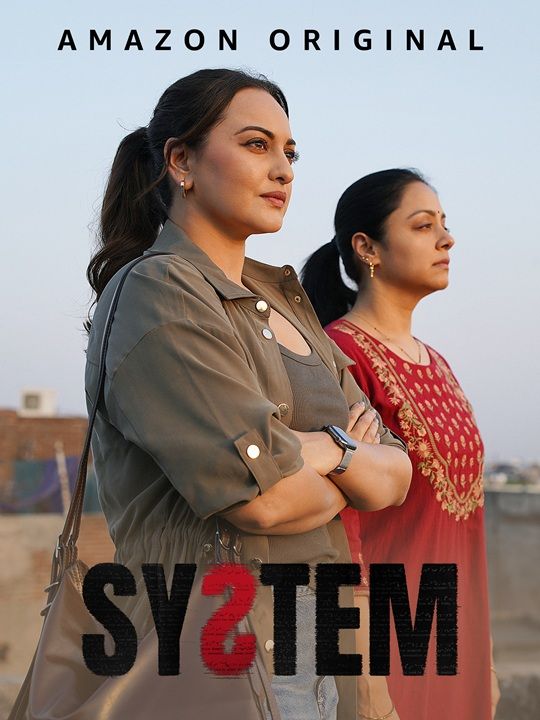
There is a subtext of gender bias even as you are introduced to the protagonist Neha (Sonakshi Sinha) in the new Hindi film System. In her professional setting, you see her struggling with a certain case as a lawyer – almost being intimidated by the men around her. In her personal setting at home, the gender bias is slightly more pronounced – with her father Ravi (Ashutosh Gowariker) offering a job in his legal firm only if Neha were to win 10 cases on the trot. It remained a gender bias given how there were no such conditions applied for his son Alok (Adinath Kothare), who was happily and snobbily working with his father.
In the same breath, the subtext also reeks of a class difference even as you are introduced to the other protagonist of the drama, Sarika (Jyotika). You witness that both Sarika and Neha have a common professional setting of carrying out their duties – but while Neha is a lawyer, she remains a humble stenographer at the court. The medium of transport remains a key cog in defining their characters – while Neha travels by her swanky car, you witness Sarika hustling in crowded buses. The same applies to the personal space of both characters too – Neha stays in a luxurious place that is spacious, even as Sarika’s family remains crammed up in a small little ‘box’, further iterating the class difference between the characters.
Written by Arun Sukumar, Ashwiny Iyer Tiwari, Harman Baweja, Tasneem Lokhandwala and Akshat Ghildial, System offers a searing take on the legal system that itself is fractured and divided for the people seeking justice. And the latter bit is all the more prevalent for folks that are essentially ‘underdogs’ of the society, even as they are pitted against the rich and powerful who know their way in pulling the strings of the law. In a couple of early instances, you see Neha being ‘out of options’ in trying to prosecute the ‘guilty’, simply because they are influential beings – be it a case involving drugs that are found at a local restaurant, or a motel being the hub of prostitution involving a minor. These might be stray incidents, but each of them play a pivotal part in shaping up the twisted reality in the court of law.
One form of criticism that I had with the writing to begin with, remained on how uneven the drama remained with the court cases mentioned above. While I understand that they weren’t the central conflict in the drama, the surface-level treatment felt a little too easy and idealistic for its own good – particularly, when the idea was to establish a ‘rich versus poor’ narrative in the court of law.
Having said that, the writing does score with the dynamics between Neha and Sarika – right from the time that the former offers the latter a lift to the court, to them joining forces with Sarika aiding Neha in winning the cases that she has taken up. The bond remains warm even as Neha begins her ascend to the top – wanting mostly to win cases while never fully signing up for the phrase ‘justice being served’, a pivotal moment that would eventually shape her arc.
The dynamics between Neha and her father Ravi reminded me of the father-son dynamic in the TVF show Court Kacheri (2025) – particularly, given how the degree of experience between the two individuals is as clear as light and day. But more importantly, the core dynamic between the two characters is intertwined with the central conflict of the drama – a murder case of an influencer, with the main accused being a real estate shark who claims himself to be innocent. It is interesting on how the daughter-father duo are pitted against each other in the court of law – even though the sharp shades of grey needed a little more teeth in order to explore their dynamic. In other words, the exploration of ego on behalf of the character of Ravi was half-baked – even as his ‘win-at-all-cost’ attitude remained only briefly tapped.
The proceedings are layered even as the investigation unfolds, but if you are a regular with the crime genre, it won’t be too hard to put two and two together. In other words, the ultimate reveal is predictable just like the one in the Hindi show Glory (2026), but I was more concerned about the journey taken to reach the destination. And while a little uneven, I liked how the smaller details in the narrative that didn’t hold a bout of significance supposedly, found a voice to tie back to the narrative.
One complaint that I had with the final act was the way in which the reveal transpired – almost giving an impression of things being too cliched and convenient, as opposed to Neha ‘shockingly’ unraveling the mystery. I wasn’t sure at which point the switch flipped for Neha, but what also followed was an exposition dump that literally felt like spoon-feeding the viewers. In between, I liked the subtext of the lines blurring between right and wrong in the midst of capitalism, power and poverty, that had me seated. But in hindsight if I were to think rationally, the emotional grain needed to be amplified in a drama that chose to opt for the ‘shock factor’, something that nullified the former trait. And this is as close that I can actually get without tipping into the spoiler territory. But nevertheless, the writing although uneven, has its moments along the way – enough to keep you engaged throughout the narrative.
The dialogues are grounded and something that keep the drama ticking throughout the narrative. Perhaps, the trait of angst felt like a missing ingredient here, but otherwise, the lines felt sincere. The music and the BGM were a miss for me, particularly given how the nature of the songs never fully coincided with the emotional plight of the characters. The BGM too felt far too inconsistent – almost playing out like a comedy or a parody at the start, while never fully allowing you to engage with the narrative. In fact, the impact of a few scenes was considerably lowered and flattened, because of this feature.
The cinematography compensated for the lack of a solid BGM, by emotionally keeping you stimulated with regards to the characters. The frames offer a steady subtext into the class divide while also allowing you to sympathize with the characters. The editing pattern is crisp but at times too crisp for my liking, particularly during the scenes of revelation that felt far too quick and abrupt. Probably, adding another ten minutes to the narrative to curb the sudden turns in the narrative, wasn’t such a bad idea after all.
Director Ashwiny Iyer Tiwari does a decent job with the world building here, but majorly scores with her characterization. There is a bit of grace in her approach, never fully investing in her characters to be victims of the ‘system’, but instead working a way around it. While she falters with an information dump at the end, the grey dilemma being created is commendable – often acting as a reminder that she definitely knows her craft. The overall impact may have been uneven, but the filmmaking is still pretty decent here.
The performances are mostly good by the members of the cast. Saad Baba as Adv. Prakash, Preeti Agarwal as Renuka, Nikkie Bareja as Payal, Sayandeep Sengupta as Raghav, and Diwanshu Gambhir as Juggi deliver assured acts, while having their moments to shine. Divija Gambhir as Jhanvi and Freya Kothari as Inaaya have a good screen presence, and the same reflects in their performances that leave an impact despite a limited screentime. Aatm Prakash Mishra as Atmaram almost felt like an extension of his character from Criminal Justice. And from the glances to the awkward body language of his character, he delivers a commendable act. Adinath Kothare as Alok and Gaurav Pandey as Akshay have character arcs that are mirror opposites of each other. And while the arcs are sudden towards the end, both of them deliver sincere performances along the way. Aashriya Mishra as Kusum has an affable presence onscreen, and she does an earnest job.
Upen Chauhan as Inspector Rathi offers a cocky presence, and he definitely manages to impress. Nishant Singh as Laxman has a likeable quality that automatically allows you to empathize with his character, and his tragedy. And the bouts of sincerity also account for a fairly strong emotional core that defines his character, thereby making for a strong impact. Vijayant Kohli as Juggi again felt like an extension of his character from Sapne Vs Everyone (2024). And he remains terrific in a character that required him to be shrewd and calculating.
I don’t like singling any one performance but Ashutosh Gowariker as Ravi misses the mark here. If the subtext of a gender bias, or an exploration of ego through his character doesn’t always come across, then it is due to his performance that doesn’t always hit the mark. The character itself needed a little more personality, something that isn’t accounted for in his acting.
Sonakshi Sinha as Neha is understated and delivers a good performance. While this act may not match the levels of Dahaad or Lootera, it still remains grounded in the wake of her professional identity-crisis that eventually leads to a solid character transformation. She does a pretty satisfactory job here.
Jyotika as Sarika is the star of the show. For starters, she has such beautifully expressive eyes that weigh in on her emotions, and do most of the talking. She boasts of an assured presence even in certain questionable moments in the narrative, while putting forth a brilliant act that is sincere in every regard. She was a treat to witness here.
Featuring mostly good performances, System is an imperfect but fairly engaging courtroom drama that makes for a decent watch. Available on Amazon Prime Video.


