

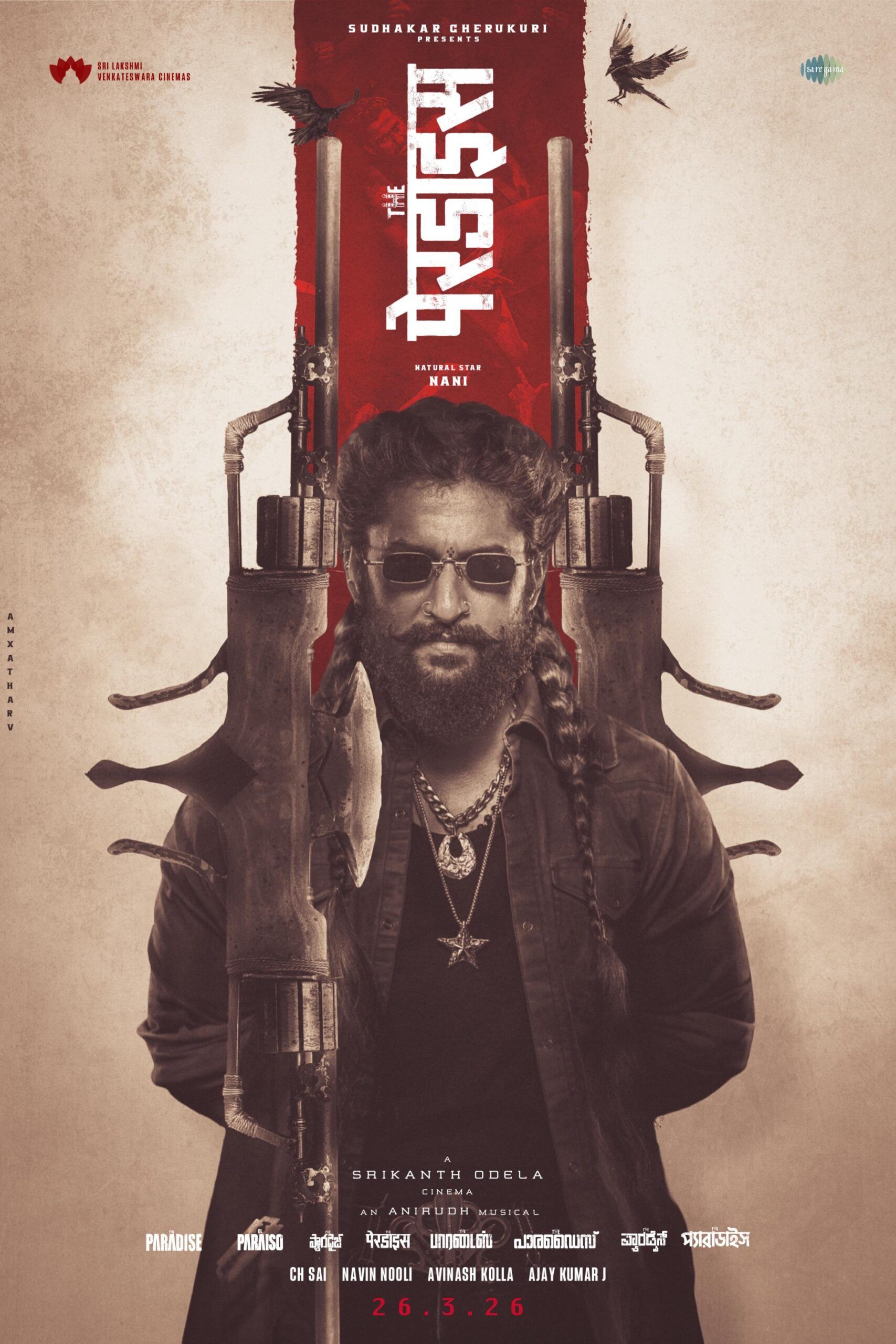
The new Telugu movie The Paradise is filled with ironies – both in terms of the design and world that the characters are subjected to. The setting remains that of Secundarabad, more specifically a place called The Paradise that would immediately paint an image of a lush green area with a pattering waterfall, and blue skies. Instead, what one is subjected to is a grimy world filled with dark skies, blood, and garbage that welcome you into the film. The irony also extends to its characters with the members of the Savari tribe being coated with bronx and grime, while donning shades of brown to paint a picture of the oppressed. This, while the oppressors are handed out shades of white – a direct contradiction to their brutal actions. Someone in between, there is a searing commentary on identity – the core conflict that the members of the Savari tribe are fighting for. But even in the midst, the writing isn’t interested in building up a drama around them – it is more interested in sensationalism, the idea of blood and gore that would soon go onto upstage the basic emotions in the narrative. That for me was the biggest downer, given that this familiar and derivative template still had potential to drive home a point!
Written by Srikanth Odela and Vinay Sagar Jonnala, The Paradise can be viewed as a derivative film in every sense. Its central conflict of identity is straight up borrowed from the Telugu dud Peddi (2026); the setting and world building is a cinematic baby of films like KGF (2018) and Salaar (2023). Even in a scene when a derogatory tattoo is imprinted on hand of a character – the scene instantly reminded me of the film Deewaar (1975), with a character suffering from a similar tattooed trauma of ‘Mera Baap Chor Hai’. In between, the drama remains a derivative of ‘The Chosen One’ template – the latter being a part of so many films now that every major star is a chosen one in his own world. And on any given day, these issues would have formed the core criticism of the film, simply given how it is the same format recycled over and over again. But in that case, The Paradise is an exception – it brings to the fore another major issue of detachment that has a main character energy in the wake of some newfound criticism.
A specific sequence in the cold open is enough to establish this point – even as a rebellious pregnant character is electrocuted to the point of delivering her babies – one of them that would go onto live, and bear the looks of his sister too. This potentially emotional moment is never fully realised even from a writing stand point (I will get to the technical aspects in a bit), often wanting to rush across from point A to point B in a matter of a montage comprising of a collection of sequences.
In the midst, even the women are looked down upon all in the name of sympathy – even as the child protagonist gets to know that his mother Sammakka (Sonali Kulkarni) has sold her body at one point. In a separate instance in a different timeline, the grown-up protagonist Jadal (Nani) also gets to know that the love of his life Subbu (Kayadu Lohar) is actually an ‘adult’ actress – using her body to survive and repay her deceased father’s loan. In another action sequence, a female character’s clothes are ripped apart by a sword, only for her to take shelter by submerging her body inside a water puddle. There is a fine line in evoking a sense of empathy and objectifying women with a ‘logical’ reason – just with a gaze to titillate the viewers.
It is ironic on how the core conflict of identity is never fully tapped into, briefly being ‘referred’ to during the protagonists’ tryst with the villains cut out of a cardboard. Both the villains namely Shikanja (Mohan Babu) and Vikram (Raghav Juyal) feel increasingly sketchy – the latter in particular modelled on the lines of his own identity crisis of wanting step out of his father’s shadow, while the viewers know nothing more about him. His appearance also felt like Ranga from Aavesham (2024) – from his white attire to a moustache, all making him a resounding caricature.
The only silver lining for me was the interval block, wherein the sentiments around the action set piece came to life – culminating in a stylized end to a particular character. But outside that, the writing just felt like switching from one gory action set-piece to another – with limbs slashed and body-parts sliced like a game of fruit slasher, ironically also laced with a raspberry syrup with an idea of the battle to appear more bloodier than ever. The objective of the film was totally lost in translation, even in moments when the emphasis was a lot on the central character as opposed to the central conflict in question – a criticism that could easily be shared with the recently released travesty Toxic (2026). It was torture p*rn and how!
I could sense a few potential plot-points – be it a scene involving the Savaris holding an incense stick given how the illusion created by the oppressors on how they ‘stink’ – something that was a direct and relevant commentary on marginalization. Or lore of the tribe being equated as crows. Or even the potentially emotional bond between the mother-son duo, particularly hinted at in a scene wherein Jadal after hearing about his mother’s sacrifices also sheds a tear. Or the relevance of the twin-ponies donned by the protagonist in the memory of his late sister. These moments are scattered and often fleeting in their stay, even as the emphasis remains on blood, gore, and violence without a purpose.
The second half completely goes for a toss completely leaning on torture p*rn, with random characters going in and out of the narrative. For instance, Subbu is there in one scene but disappears at will in another. The main antagonist also follows a similar trope, even while introducing a lawyer and a Punjabi cop as allies – even as these characters don’t have any identity or purpose of their own in the narrative. There is an intercutting dance-fight face-off, a subplot involving the survival of a newborn, some guest appearances of heads separated from the bodies, sliced limbs having no identity of their own, and a sea of blood erupting out of an insipid finale. It was exhausting, repetitive and quite honestly frustrating.
The dialogues are loud and soulless, much like any big-budget entertainers – with characters shouting at the top of their voices in order to convey their points across in a universe dominated by the alpha-males. The music by Anirudh is decent, with a couple of songs standing out. But the integration of songs was once again atrocious – you can’t have the protagonist striking a deal with a local minister in one scene, and break a leg with a random girl in a dance sequence in the very next scene. What that did was further strip the drama off any emotions. Even the blaring BGM was enough to drown any semblance of emotions along the way – a classic case of the notes overpowering the drama in every sense.
The cinematography comprises of frames that are saturated with hues of brown and yellow, that did get tiring after a point. Remember on how the frames played a pivotal role in creating a distinction of the worlds in a film like KGF (2018)? The same pattern of hues, mixed with virtual ‘green-screen’ sets further flattened out the impact of the drama, making this drama emotionally hollow and woefully out of depth.
Even the editing pattern felt like a reel being stretched into a movie – with a cut appearing every few seconds, something that just did not allow me to settle in the narrative. It is atrocious on how the idea remains to speed up the edit, when the real deal is of building the drama and allowing viewers to feel for the characters. But when the emotional anchor is missing, no amount of violence playes against a fast edit can save a film from being a disaster.
Director Srikanth Odela misses the mark by a countrymile, after a pretty impressive outing like Dasara (2023). If you look closely, the template of The Paradise and Dasara is similar – the latter spiralling into a vengeful drama. But the key difference remained in the emotional core of the characters, something that was woefully missing here in the wake of violence and bloodshed ruling the roosts. The idea deliberately felt like amping up the brutality, thereby diluting the palpable emotions in store – making this directorial piece pretty forgettable in every sense of the word.
The performances also drown in the midst of the amplifying BGM and excessive violence throughout the narrative. Priyadarshi Pullikonda as MLA Shankaranna felt too distracting with his protruding prosthetic nose, even though he was fairly sincere with his act. The likes of Vishika as Devi, Tanikella Bharani, and Sampoornesh Babu as Biriyani are fairly alright here, even as the writing doesn’t allow either of their characters to blossom. Sathyaraj is woefully wasted, and a part of me thought that his arc was left out on the edit table. Raghav Juyal as Vikram is woefully reduced to a caricature, never fully coming across as intimidating (like his stellar act in Kill (2024)), and invariably being unintentionally funny with his demeanor. Kayadu Lohar as Subbu has nothing much to do either, having no significant contribution in the screenplay. And this included her romantic sub-plot with the protagonist that was an eyesore!
Sonali Kulkarni as Sammakka fairs reasonably better, having an emotional arc to work with – despite the writing and BGM trying desparately hard to drown her act. She still found a way to land a few scenes, and that says a lot about her prowess as a performer. Mohan Babu as Shikanja is sketchy with his act, and I couldn’t quite resonate with his angst or bias – being so detached that the impact of his act just wasn’t there.
Nani as Jadal has a mixed outing here. He definitely brings some raw intensity to the table, with an unhinged and raw act that is mounted on a solid physical transformation. But his aggression goes slightly overboard, coming across as a man posssessed with angst as opposed to a stream of emotions connecting his tribe’s issue of identity. It almost felt like Nani went bartered his emotions for his unhinged intensity that ultimately didn’t allow his performance to land seamlessly. The effort was there but it ended up being lost in translation in the wake of some graphic violence sprinkled through the narrative.
The Paradise is an utterly frustrating and deeply flawed viewing experience that routinely prioritises graphic, gratuitous violence over a meaningful emotional core. The writing feels aggressively derivative, functioning as a predictable amalgamation of countless superior films and relying on a formulaic template that has become completely exhausting. Compounding these narrative shortcomings is the woeful execution, which is further undermined by a blaring, overbearing background score. This intrusive soundtrack effectively drowns out any subtle emotional beats, overshadowing the actors’ performances and smothering potentially engaging subplots in a sea of uninspired mediocrity. This is nothing short of a resounding travesty, given that this was one of the most anticipated films of the year for me. Available in a theatre near you.


