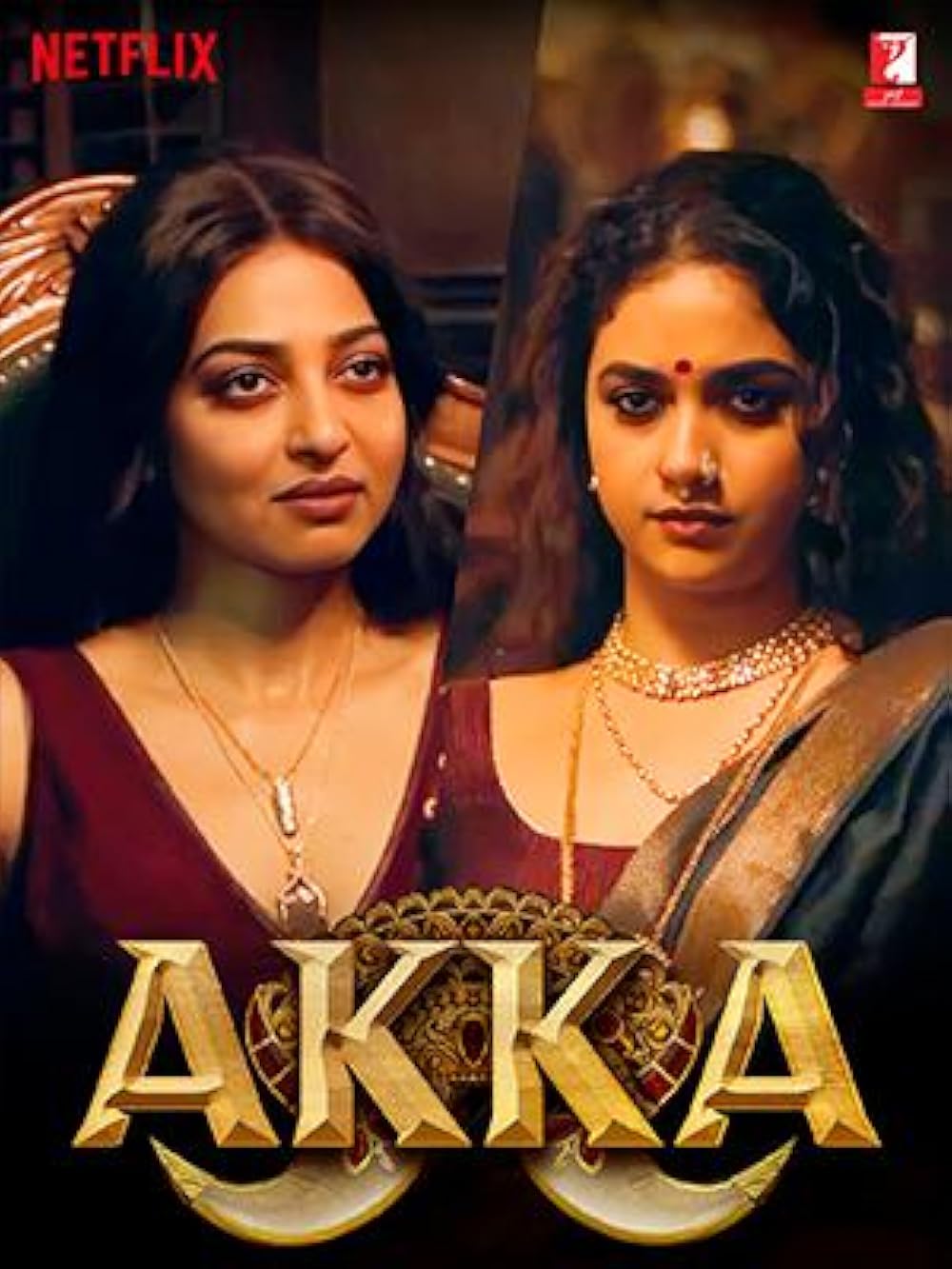
Imagine injecting a T20 specialist in a Test setup, only for the player to have wild slogs on a seaming wicket before being dismissed. The idea of testing the concerned player might be promising, but the end result is a recipe for a disaster. In the same breath, the new Hindi show Akka is that same player! I must admit that I was floored with a palpable concept of matriarchy onscreen – something that instantly reminded me of the 1999 Hindi Film Godmother. It is a very specific genre to flaunt; a gangster setup featuring a stellar ‘most’ female cast members! It is glorious also when roles are reversed in a genre that is largely occupied by alpha males, only for one of the males of this universe to be reduced to the kitchen as his introductory shot. The switch is impressive on paper but with a massive issue in hand – the show is run by males who think that women would think in a certain way when injected in a male-dominated setup. It is a major flaw, something that derails the entire show in its entirety – wherein the gender swap is the USP, while effectively applying the problematic brains of men suffering from the privilege of patriarchy.
Written by Dharmaraj Shetty, the world of Akka has an intriguing premise, despite the use of AI slop to depict a promising backstory. The kingdom of Pernuru was adopted by the three ‘Akkas’ (Sisters) of a king who disappeared, only for the tradition to continue through the modern-day setup of the early 80s in the South of India. The writing also briefly touches upon the partition period of the 40s, wherein a proposed Government merger doesn’t perturb the Akkas from continuing to rule the land. The descesdants now rule three regions – Malemar (house of fields), Perplady (house of seas), and Herkada (house of mountains). They trade in gold and country liquor, while bumping off their male counterparts. So far so good!
The writing though immediately falters post its world building, never fully utilizing the fresh concept in play. Imagine taking a matriarchal setup, swapping genders effectively, and repeatedly reminding the viewers of the customs in play – often through the phrases of ‘marriage’, ‘women’, ‘power’, with patriarchy lurking in the corner. It is a very specific problem to have, given how it treats matriarchy as a direct answer to patriarchy. This, whilst the women of the world suffer from the same problems as the problematic patriarchal men who are repeatedly called out through my reviews. The issue is specifically with the gaze that treats women as problematic men – without quite boasting of redeemable qualities of compassion, instead having an overdose of mafia in the most sketchy way possible.
The characters remain equally sketchy here – be it the protagonist Bhavani (Keerthy Suresh) who doesn’t have an identity of her own outside her clan’s virtues of no marriage, and no inheritance of the title of Akkas without a girl child. Or her antagonistic counterpart Rudra (Radhika Apte), a slingy dressed devil with a past link to the kingdom who wishes to extract revenge on the clan, ironically using the men in her vicinity as shields – including an outcast Amar (Anshumaan Pushkar), doubling up as their competition. Somewhere embedded is a commentary on a superior traditional outlook over a modern westernized leaning, but that remains buried deep within the skeletal framework of the world.
The writing is woeful in rehashing the vengeance plot to a series of sequences – an alcoholic male instigated to kill a girl whom he thinks isn’t his daughter, a further instigation of the males of the world who seem like even more sketchy characters having an intellect of a solitary peanut, a murder of a matriarch, a potential face-off between a matriarchal candidate and a patriarchal candidate with no prizes for guessing who loses (no, I am a feminist – trust me; it ain’t me, it is the show), a random skirmish, a random flashback subverting themes of an upper-caste privilege or the abandoned parallel warrior clan, and a final face-off. The upper-caste privilege wasn’t any different from the one showcased in infinite movies as an issue – except here for majority of its runtime it flaunts it, only to try and cover ground right at the end.
The problem isn’t on either of these subplots but instead the refusal of the screenplay in indulging in any buildup whatsoever. For instance in a scene, you witness a host of characters of the protagonist’s tribe being shot and killed randomly – without necessarily allowing the viewers to have an inkling or a foreshadow of this major event. As a result, the event itself is emotionally hollow while heavily leaning on gore to prove its sensationalism. The Telugu film The Paradise (2026) says high – while this remains another instance of a specific male gaze veiled as a female one!
There are major plotholes in the narrative, particularly with regards to the motivations of the characters that makes no sense in the context of the drama. For instance, an entire plot of vengeance for a character who wasn’t even born at the time of her relatives fleeing from the scene! How was the generational seed of revenge planted in the said character continues to remain a mystery. As the famous dialogue from Welcome (2008) goes – ‘Yeh Raaz Bhi Ussi Ke Saath Chala Gaya’. This, even as other characters literally come and go in a heartbeat.
The tepidness of the writing also extends to its ultra-simplistic final act – that features……you guessed it, a shootout! Male gaze wins, almost like the authorities of this country – even though the actions are committed by the women of the world. It increasingly made me wonder on how this would still have fetched the same results, if the genders were swapped. And that made me further wonder on how underutilized the concept of matriarchy was in this world – the one that remained largely unexplored. So with the glittering concept thrown out of the window, what was left was a mindless slog – even as my wonder made me wonder, what was the purpose of the show? And the sequel-bait is real!
The dialogues by Abbas Dalal and Hussain Dalal also suffer from the algorithm-syndrome, adding a sense of campiness to the proceedings – whilst probably being briefed to keep highlighting the innovative concept of matriarchy to the viewers. Lines like ‘Men Prefer a Wh*re and Not A Queen In Bed’, or ‘Women Prefer Being On Top, Both Inside And Outside The Bedroom’ are pretty cringe, even in the context of a show – almost resembling a poor Hindi-dubbed version of a South Indian film. There is also a metaphorical take on a cockfight wherein a character links it to s*x; further highlighting the hollowness of the concept it wishes to weaponize. The issue wasn’t entirely with the writing but the briefing too!
The BGM doesn’t do enough to elevate the stature of the unfolding sequences, emotionally or otherwise. The cinematography comprises of frames that follow a similar suit, never fully realising the fabric of the world that it wishes to highlight. The focus remains on gore and violence, at times without enough context – wherein sensationalism precedes over a set of emotions. And both these technical aspects are linked to a larger issue of some rather woeful editing!
The editing pattern is disastrous in a drama that doesn’t want to pause at any instance. It feels like a heavily-edited show in the first place, never developing any arcs to any characters in question – while seemingly jumping from one subplot to another in a matter of a couple of scenes. This reel-style of editing is extremely damaging to the long-form of content that is otherwise designed for a patient viewing. You can’t have that T20 player swinging every ball in a Test match, no?
Director Dharmaraj Shetty fails to mount the show owing to its weak structure, leaving the final execution decidedly woeful. His approach struggles to establish any immersive sense of place, resulting in a hollow world-building effort that lacks atmospheric depth. Rather than weaving a cohesive narrative, the direction allows half-baked subplots to meander without satisfying resolutions. Furthermore, the characters remain poorly fleshed out, moving through scenes as flat archetypes rather than compelling, driven individuals. His idea to traverse from one sequence to another without any dramatic buildup remained a concerning aspect of the drama, that drowns in ita own sea of mediocrity.
The performances are pretty mediocre by the members of the cast owing to contrived character arcs that suffer from an identity crisis. The likes of Alka Amin, Veebha Anand, Chhaya Kadam, Mahesh Manjrekar, and Anjali Patil have hardly anything substantial to do here. Kiran Karmarkar, Ashish Sharma as Manjaya and Dinesh Prabhakar as Babu are mounted on such sketchy characters with fickle motives that the impact of their performances just isn’t there. Monika Panwar and Tanvi Azmi essaying the younger and elder versions of Muthakka deliver dignified acts that are letdown by poor and abrupt characterization.
Talented performers like Anshumaan Pushkar as Amar, and Vishak Nair as Nanda are pretty much wasted here, despite both of them trying their best to salvage a decent performance with almost nothing to play with. The only character who completely shines is Pooja Mohanraj as Deju who has a proper backstory to play with, while using her physicality to such great effect in delivering an impactful act. Her physical strength remains her asset, and she uses that perfectly in a couple of combat sequences. Poornima Indrajith as Devaki and B Jayashree as Duggamma struggle from an identity crisis in a show that doesn’t utilize them well at all.
Radhika Apte as Rudra turns in a mediocre performance that leans far too heavily into unintentional comedy. Rather than crafting a menacing or calculated antagonist, she plays the villain with an exaggerated, campy energy that makes the character feel like a bizarre parody. Her over-the-top mannerisms and theatrical execution clash violently with the show’s intended tone, reducing what should have been a formidable threat into a caricature. Again, the issue was with the brief (see the pattern of the perennial male gaze?).
Keerthy Suresh as Bhavani follows with a pretty flat performance, failing to bring any real emotional depth or nuance to her role. Her dialogue delivery remains frustratingly monotone throughout the show, draining the narrative of the urgency and tension it desperately requires. While her series presence is compelling with a good use of her expressive eyes, her mediocre portrayal feels stiff and uninspired, something that never warrants an emotional investment.
The first season of Akka reduces an intriguing concept to an absolute slog, undermining its potential with insipid performances, petty character arcs, and rushed, woefully executed subplots. Instead of meaningfully exploring its matriarchal themes, the narrative is flattened by a prominent male gaze that relies on sensationalism and gore rather than substance. The show fails to distinguish itself, opting to flaunt its unique premise through mediocre, tried-and-tested tropes that left me with a splitting headache. This, while the feminist in me felt it was a wonderful opportunity wasted! Available on Netflix.