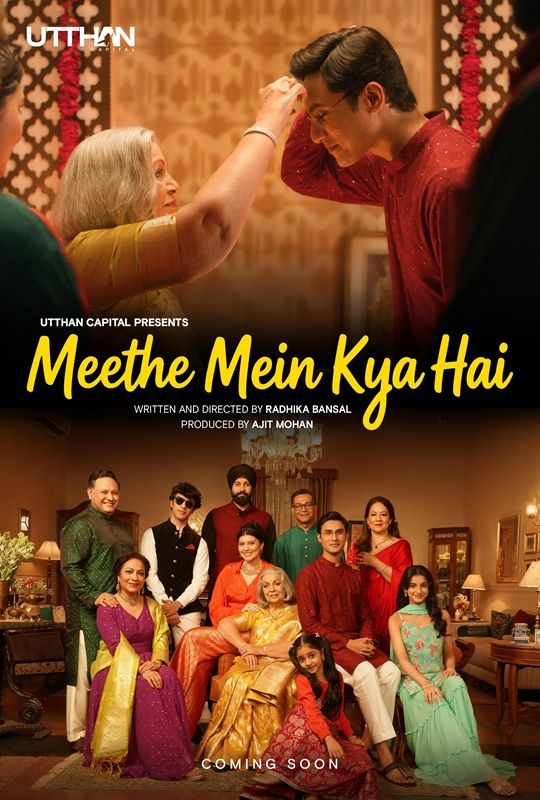

There is an air of contrast that christens the premise of the new Hindi film Meethe Me Kya Hai. The setting remains that of the pre-Diwali season, something that one associates with family-time and togetherness. But one glimpse into the life of the protagonist Jai (Ritwik Bhowmik), and you know that festivities remain phrases that don’t exist around him anymore. There is a definite outline of Charles Dickens’ A Christmas Carol, particularly with the chsracterization of the protagonist, who in another world would resemble The Grinch; a brooding, cynical individual known to ruin the joys of the festive season. But a closer look at the protagonist gives you a deeper outlook into his grieving mental state – of having lost his wife Tara (Kanikka Kapur) in a car accident, only for his life to remain a blur since. It was Tara who probably brought the festivities in his life everyday, only for his life to turn into a spiralling monochrome – something that is symbolic of the piece of land that he wishes to sell off, as a means of escapism veiled in the form of moving on!
Written by Radhika Bansal, the core theme of Meethe Me Kya Hai is tapped early on, with the help of a catalyst – when the protagonist is forced to participate in a family reunion in Lucknow, in order to help his sister Sana (Dalai) to break the news of her ‘impulsive’ marriage; Karam (Vikram Bakshi), the one belonging to a different faith, a divorcee having been married previously, and also having a young daughter. All in the same breath! But little does the protagonist know that his reluctant reunion would offer him a first chance of experiencing warmth in two years – a form that is largely forgotten in families, in the modern setup. And aren’t we thankful for festivities acting as valid excuses in bringing family together!
There is a definite vibe of Kapoor And Sons (2015) with the smaller everyday conflicts amidst a whiff of characters that are as vibrant and colourful as the festivities. For instance, be it the playful sibling duo of Amrita (Ayesha Raza Mishra) and Rishab (Abhay Kaul) who discreetly wish to sell off their matriarchal mansion owned by their mother Nani (Rohini Hattangady). Or their respective spouses – Ajay (Gaurav Sharma) and Preeti (Tarana Raja) who remain warm entities in the setup. Or the Gen-Z cousin of the protagonist Sid (Ayuushman Ghai) who brings a different dimension of freshness to the family setup. Clearly, the embedded theme of togetherness is multi-generational – a recurring theme that christens the alignment and judgment of majority of the characters.
One of the most crucial characterization remains that of the teenager Meera (Shivika Rishi), a character that could be a companion piece, literally and figuratively to the protagonist. Just like Jai, the thirteen year old has also experienced loss in the form of her father quite early on in life – a case that acts as a pivotal meeting point for the two characters. You see a hesitant protagonist slowly opening up to Meera, even as the differences in their age come to an unfamiliar meeting point in a scene wherein they interact with each other for the first time in a kitchen.
It is interesting on how it is Meera who acts as a platonic means of escapism for the protagonist, who had previously lost his ability to sketch post the demise of his wife. There is a hint of familiarity in a pivotal scene wherein Jai decides to leave the family reunion in a bid to sell his house in Ladakh – only to stay back after spotting Tara. In another world, they could have been Sid and Ayesha from Wake Up Sid (2009), but for the massive age difference – even as the protagonist helps her write songs for a play, and she delightfully calls him PC (Prince Charming). The dynamic is sensitive, without crossing the boundary in a problematic territory.
The generational difference in thinking is presented in the form of subtle bouts of humour – even as the protagonist has to tackle his mother Amrita into accepting the new-found relationship of his sister. It is almost as if the festivities act as an unsaid agony aunt, in presenting the case of Sana and her hubby Karam – the latter who hilariously helps setup the lightings of the house, or helping out with the household chores. In another world, he could have been Rajesh (Govinda) from Hero No.1 (1997), particularly with the comedic zest that he invariably brings to the table – including an unperturbed night of gummies that sends him into a ticklish world of trance – following a misunderstanding with the family. In the same scene, you also witness Amrita opening up to her son-in-law for the first time – terming him as the only person who understands her without yelling at her.
The drama here is subverted with humour in the form of togetherness. Be it a couple of characters betting on, and getting the best gifts for their wives in a sequence that is mixed with humour in its unadulterated heartwarming form. Or a party sequence involving a bunch of characters trying to setup the protagonist with some potential matches – something that transcends boundaries in the most ticklish way possible through a series of misunderstandings. Or simply the feeling of togetherness that you feel in moments of characters dining together – that at times compensates for the lack of depth in some parts of the drama.
Amidst this, you notice a shift in the initial mundane arc of the protagonist – one that goes from moments of solitude to a celebration of togetherness and healing; a case wherein every family member comes together to resolve an issue; pretty much highlighting the importance of a joint family. The resolutions are sensitive, even the one between the protagonist and Meera, something that is handled with extreme care. It is hence quite ironic on how the relevance of the title is reminiscent of one of the sweetest memories of his better-half – gloriously being spoken amidst the festivities at a family reunion. The screenplay is heartwarming and does enough to gently touch the strings of your heart.
The dialogues are conversational while keeping the vibrancy of the festivities in check that is perfectly blended with the subtly of the emotions in store. The music and BGM perfectly compliment the differential moods of the drama, particularly when viewed through the POV of the protagonist. There is a lovely arc on offer here as far as the music is concerned, one that goes from a sense of emptiness to wholesome bouts of togetherness – sprinkling bouts of kindness and humour in smaller moments to follow.
The cinematography comprises of frames that lean heavily into the warm, inviting tones of a festive Lucknow, utilizing a soft palette that beautifully frames the historical, old-world architecture of the central family bungalow. The camera glides gracefully through crowded family rooms, using gentle tracking shots and intimate close-ups to highlight the shared glances amidst the festive chaos. It also allows Lucknow as a city to play a pivotal character, focusing on local culinary delights and traditional treats. Overall, the visuals establish a tangible, lived-in texture that grounds the underlying themes of grief and healing.
The editing pattern employed is that of a slice-of-life narrative that organically structures the multi-generational family gathering sequences, without losing sight of the palpable emotional core of the drama. Director Radhika Bansal successfully captures the sweet and messy reality of an Indian family reunion. Inspired by several classic holiday films, she keeps the storytelling grounded, creating a cozy and relatable festive world. Rather than forcing heavy melodrama, the direction accounts for restraint, balancing laugh-out-loud comedy with quiet, tender moments of healing. By focusing heavily on casual household conversations and local flavors, she creates a gentle, heartwarming experience that feels like coming home. And the emotional core in the drama is intact throughout the narrative, signifying that the direction is wonderful to witness here.
The performances are genuinely heartwarming by the members of the cast. The likes of Twvinkle Kapoor as Mamta, Rameshchandra Pathak as Shantaram, and the littel Kiara Chouhan as Anya have their moments to shine, and each one of them are impressive to witness here. Kanikka Kapur as Tara has a radiating presence onscreen, while delivering a wonderfully understated act – something that forms a sort of an unsaid connective thread similar to the character of Barun Sobti in Babita Singh Reporting (2026). Both these characters die already, but still their presence is felt throughout the narrative.
Ayuushman Ghai as Sid maximizes his screen time by infusing the household with a relatable, easygoing youthful energy. His effortless body language and sharp comedic timing bring a necessary lightness to the family’s underlying tensions, making him a highly endearing presence in the ensemble. Dalai as Sana brings a fierce, headstrong energy to the younger sister’s sudden rebellion, contrasting beautifully against the rest of the household. Vikram Bakshi as Karam complements her brilliantly, playing the unexpected groom with a mixture of earnest charm and delightful comedic timing. Together, they navigate their character’s complex relationship dynamics smoothly, providing some hilarious moments in the narrative.
Gaurav Sharma as Ajay, Tarana Raja as Preeti, and Abhay Kaul as Rishab operate as a seamless ensemble unit, breathing authentic life into the extended family unit. Each actor finds their own distinct pocket within the narrative, shifting seamlessly between lighthearted festive banter and layered sibling politics. They capture the chaotic, fast-paced rhythms of close relatives exceptionally well, filling out the background with relatable tension and charm.
Shivika Rishi as Meera delivers a delightful and remarkably mature performance that injects the film with genuine heart and charm. Her expressive eyes and natural dialogue delivery bring an infectious warmth to the screen, capturing the perfect balance of childhood curiosity and empathy. She serves as a beautiful emotional bridge within the household, ensuring her character leaves a lasting and endearing impression.
Rohini Hattangady as Nani delivers an absolute masterclass in warmth, acting as the irreplaceable emotional anchor of the entire narrative. With a perfect blend of matriarchal authority and endearing gentleness, she transforms the screen whenever she enters. Every small glance and dialogue delivery feels steeped in natural, real-world comfort, making her house feel like a genuine home. Her performance radiates a generational grace that highlights the beauty of unconditional love within an eccentric family structure.
Ayesha Raza as Amrita adds a brilliant, high-energy spark by nailing the archetype of a nagging mother<span;>. She balances the comedic weight of her character’s anxiety with a rich, protective maternal warmth that keeps her instantly likeable. She shines brightest during the film’s many conversational dining table clashes, delivering sharp comic timing while remaining deeply sympathetic. And her ability to use her body language through the conflict of her character, was a pattern to study throughout the narrative.
Ritwik Bhowmik as Jai anchors the emotional core of the film with a deeply moving and nuanced portrayal<span;>. He brings a quiet, internalised sense of sorrow to the screen, expertly capturing the vulnerability of a young man trapped in his own grief. Instead of relying on over-the-top dramatics, he plays his character with a delicate restraint that makes his eventual emotional breakthrough feel entirely earned. His presence adds an essential layer of gravitas, grounding the surrounding festive chaos in genuine human feeling.
Featuring heartwarming performances, Meethe Mein Kya Hai is a vibrant, feel-good holiday drama that beautifully subverts themes of grief and healing into a celebration of togetherness. Its wholesome narrative effortlessly delivers fuzzy, resonant moments that left a lasting smile on my face and a deft tingle in my heart. It is a deeply comforting, heartfelt watch that promises to leave your heart completely full. Available on Netflix and Highly Recommended (particularly for this holiday season)!