

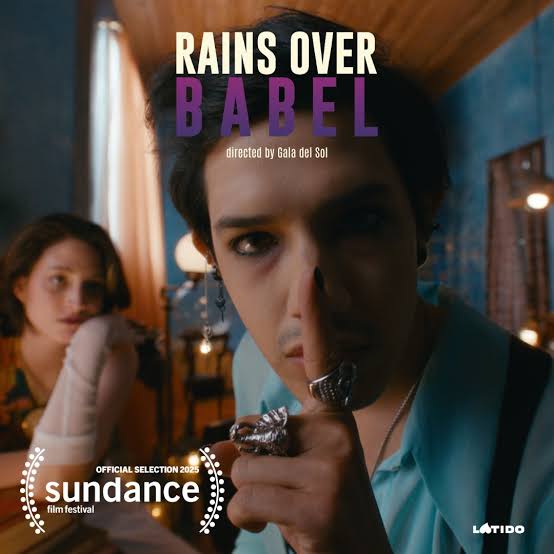
It is interesting on how the film Rains Over Babel, Colombia’s Official Submission to the Oscars of 2027, uses a couple of its characters as active metaphors in the narrative. When you are first introduced to the couple – El Boticario (Santiago Pinedo Prado) and Erato (Sofia Buenaventura), their contrasting appearances provide a foreshadow about the metaphorical setting. The latter remains a mute character, christened with a calming angelic presence that defines her persona. The former has a devilish outlook, often indulging in darker shades of punk while resembling a persona of an observant evil. Both these characters remain metaphors for a guardian angel attained by divine intervention, and an observant devil doubling up as a bartender in an underground club called ‘Babel’ (notice the name) – that models itself on the liminal space similar to the physical boundary in Dante’s Inferno, but with a modern tropical-punk twist. In the same breath, even the city of Cali offers to be a futuristic town of sorts that blurs the boundary between hell and heaven, almost being an uncanny companion piece to Babel – except that societal judgments plague this world far more than the one underground. And ironically, the marriage of Erato and El Boticario indicates the neutral framework of the world – wherein good and evil co-exist in order to keep this limited space alive.
Written by Gala del Sol, the relevance of the title Rains Over Babel can be understood on a physical and spiritual level. In the physical form, rains act as pivotal metaphors in cleansing the environment, and invariably the souls of men. But in the context of the drama, the significance of the same is laced with a deeper biblical metaphor – the one of torment that mirrors its purpose in Dante’s Inferno; the one that juxtaposes its very existence of a heavenly act, while subverting itself as a ‘conflict’ on rigid man-made dogmatic structures.
It is interesting on how Babel can also be used as a safe haven of identity, despite housing physical and meta-physical spirits of troubled and disoriented individuals who may have been judged on earth, but have found a liberating voice underground, often also getting a chance to gamble on their lives in games supervised by the Grim Reaper, the Afro-Angel of death La Flaca (Saray Nohemi). The magical realism indicators in the narrative remain in the form of a talking salamander that is equated as a searing metaphor for the guiding light, or even a poisonous serpent that acts as a medium of danger. Both these creatures offer a contrast that perfectly represents the setting of the underground club.
One of the main aspects of the writing remains its characterization, something that further defines the world of Babel too. For instance, you are introduced to two similar characters Uma (Celina Biurrun) and Timbi (Jose Mojica), each of whom is connected by the Karmic cycle of protecting their loved ones, thereby teaming up to seek the disappearance of a punk-singer. Uma wishes to gamble the years of her life in order to extend the years of her ailing daughter’s life, whilst Timbi hopes to protect his father – the owner of Babel, from the loan sharks, following the disappearance of the lead singer of the band. The subtext remains that of unity for the sake of humanity, something that pushes them to the brink of exploring the ‘outer circles’ of hell.
In the same breath, you are also introduced to similar yet contrasting characters – Dante (Felipe Aguilar Rodriguez) and Monet (Johan Zapata), each of them representing the straying confused state of spirits in the mix. For instance, the former remains the assistant of La Flaca, being on the cusp of losing his contract of collecting lost souls, the day we are introduced to him. His purpose remains to excavate and tap into the memories of his past life, before time lapses for him. As far as Monet is concerned, he remains a character who has freshly died of a drug overdose, only to come to wage a race against time in order to get back into his body which would decompose soon. The writing introduces time as a variant without any static variables, recreating a dimension that is free of attachments inside the club. The subtext is similar to time as a variant in the afterlife, that is independent and liberated from the real world.
The writing also emphasizes on the character of Jacob (William Hurtado), the son of a pastor suffering from an identity crisis revolving around his s*xuality. It is the closest character that circles back to the title of the film – even as the writing challenges the traditional religious dogmas through a searing conflict that he shares with his father. It must be noted on how Jacob aspires to be a drag artist that itself challenges the fundamentals of religious beliefs in the eyes of his father.
Ironically, it is the setting of Babel that gives Jacob bouts of solace and recognition – something for which he is weirdly judged in the outside world. The writing is quick to blur out the concepts of hell and heaven through this little passage – emphasizing on how religion and identity remain man-made concepts, even while christening the narrative with the queer celebration of liberation in many ways.
The proceedings also emphasize on his waves of suffering, almost resembling a Christ-like figure who would have to make his way through the outwardly problematic realms of humanity, in order to convey a message of self-acceptance to humanity. Ironically, there is another character named Magdalena too – a contrasting trans-woman who remains a symbol of challenging the religious dogmas of the church too.
It is ironic on how the game of dice, featuring a streak of gambling represents the unsaid power granted to the misfits, that also challenge the rigid outlaws of the outward world. For instance, Uma is allowed to challenge her own existence for her daughter – a trade-off that otherwise wouldn’t be possible. In a way, Babel as a purgatory setting is also a direct counter to the rigid outlines of the real world – allowing some sort of flexibility to the characters in question.
Be it a case of ‘body’ and ‘character’ swapping, or a wave of trance offered regardless of the outwardly worries of the outer world that is sprinkled with deceit, betrayal, and a collapsing currency in the wake of the religious dogmas; the latter being represented through neon-lit crosses that are juxtaposed on events of BDSM, or a ‘p*nis’ being used as a gear in the outer circles of ‘hell’ – both depicting the provocative nature of the drama.
And yet, the screenplay emphasizing on the idea of queer celebration and acceptance that subverts the larger theme of misplaced souls seeking their identities in the afterlife – providing an option of a door to salvation, or simply allowing them to linger in a liminal space that is a blurred space between heaven and hell. The screenplay is wonderfully well written while effectively formulating its own interpretation of Dante’s Inferno.
The dialogues are sparingly used, but there is a rhythmic outlook maintained that effectively highlights the various themes of the narrative. The soundtrack uses fast, heavy salsa beats and raw punk rhythms to match the characters’ frantic race against time. It acts as the literal heartbeat of the Babel nightclub, drowning out the despair of the outside world. This loud, high-energy score transforms the purgatorial dance floor into a celebratory space of queer endurance.
The cinematography comprises of a visual style that relies on intense, high-contrast neon hues slicing through pitch-black underground rooms and rain-slicked streets. This creative lighting creates a striking clash between traditional holy symbols and leather textures, that forms the core of the central theme of co-existence in the drama. The frames also capture a trance-like ambience that intensely subverts itself from the tropical downpour – another metaphorical setup that compliments its central theme of the drama.
The editing pattern remains frantic with its pacing, while holding the narrative together with its rhythmic beats while seamlessly transitioning across his various subplots and timelines. Director Gala del Sol does a fabulous job of executing a fearless, hands-on vision that seamlessly blends magical realism with provocative queer celebration. She heavily relies on symbolism to illustrate her world while challenging the fundamentals of the outside world through a lens of acceptance and endurance. The direction remains spectacular, depicting a frantic concept with rhythmic emotional beats.
The performances are wonderful to witness by the members of the cast. Luis Enrique Valencia Charry has his moments to shine, as does Roman Escobar as Roma. Jhon Bayron Quintero Valencia adds flamboyant energy as Darla Experiment, enhancing the film’s vibrant celebration of queer expression. Jacobo Velez radiates authentic musical electricity as El Callegueso, anchoring the film’s spectacular and chaotic climax. Johan Zapata as Monet is wonderful to witness here, adding streaks of humour to his act that captures his desperation against time rather accurately. John Alex Castillo infuses Gian Salai with a frantic, desperate charm as a club owner buried under high-stakes supernatural debt. Jhon Narváez delivers a rigid, compelling performance as Don Alfonso, effectively capturing the dogmatic traditionalism that drives his son’s spiritual conflict.
William Hurtado provides the film’s emotional heart through his deeply vulnerable portrayal of Jacob. He masterfully navigates the inner friction between strict religious expectations and the liberating, transformative nature of his drag debut. Felipe Aguilar Rodriguez grounds the surreal narrative as Dante, bringing an intense, smoldering focus to the role of Death’s weary assistant. His portrayal beautifully balances a desperate quest for personal redemption with the gritty survival energy of a soul running out of time. Sofia Buenaventura shines as Erato, conveying an immense depth of emotion entirely through physical expressiveness and soulful glances. Serving as a mute guardian angel and omniscient guide, her expressive presence provides a poetic counterweight to the chaotic nightlife surrounding her. Santiago Pineda Prado as El Boticario brings a sense of edginess to his demeanor, while putting forth a deliciously dark and mysterious act.
Jose Mojica as Timbi, the frantic son of the nightclub’s severely debt-ridden proprietor, Gian Salai accurately balances high-stakes terror with urgency. Celina Biurrun as Uma commands her scenes with an intense, emotionally grounded drive, portraying a mother fiercely willing to risk years of her own life to secure a miraculous cure for her gravely ill daughter. Saray Nohemi delivers a commanding performance as La Flaca, effortlessly embodying a tropical-punk personification of Death. Her presence anchors the high-stakes atmosphere of the purgatorial nightclub with a captivating blend of devious charisma and razor-sharp authority.
Colombia’s Official Submission to the Oscars of 2027, Rains Over Babel is a dazzling, surrealist exploration of spiritual survival, identity, self-acceptance, and endurance through a provocative lens that subverts the dogmatic structures of the hellish world into a vibrant, queer celebration backed by solid performances, culminating in a wonderfully thought-provoking watch. The film is screening on Thursday, November 5, at Instituto Cervantes in LA, and on December 5 at the Museum of the Moving Image in New York City. Highly Recommended!


