

There is a dash of Stanley Ka Dabba (2011) that you get with the premise of the new Hindi film The Great Grand Superhero. The setting remains that of a classroom that is witness to the introduction of a new kid Deepu (Mihir Godbole) in the mix of things. Like Stanley, Deepu also suffers from a loneliness paradox, particularly given how he is forced to make new friends at school, once every few months. The subtext remains the frequent transfers of his father that has never quite allowed him to settle and form bonds with kids from school. And hence like Stanley using foods as a means of breaking the ice, Deepu uses his imaginative storytelling to woo his classmates. In his words, it remains his best hack – forming a means to intrude the established circles of kids, even the latter remain envious of his brainy abilities in the classroom. Keeping that in mind, he spins a tale of his grandfather being a superhero – a sort of a folklore dipped in his imagination that is reserved for kids under the age of 18 – given how his grandfather’s superpowers will be evaporated otherwise. It remains an ardent and heartfelt peek into the fertile psyche of young minds that put instantly put a smile on every young adult.
Written by Manish Saini, The Great Grand Superhero remains a film about children for most parts of its runtime. So while for Deepu, the goal remains that of negating his loneliness at school, his little secret only brings about a bout of curiosity amongst the kids of the school. For instance, the most influenced of the lot remains Laddu (Shivansh Chorge) who instantly remains in awe of the story. In a fleeting moment when you see him say – ‘Gangadhar Hi Shaktimaan Hai’ (Gangadhar Is Shaktimann), you instantly are aware of his sources of inspiration. But typically what that character does is create an intriguing question in the minds of the viewers too – is Deepu’s grandfather Jagdish (Jackie Shroff) actually a superhero?
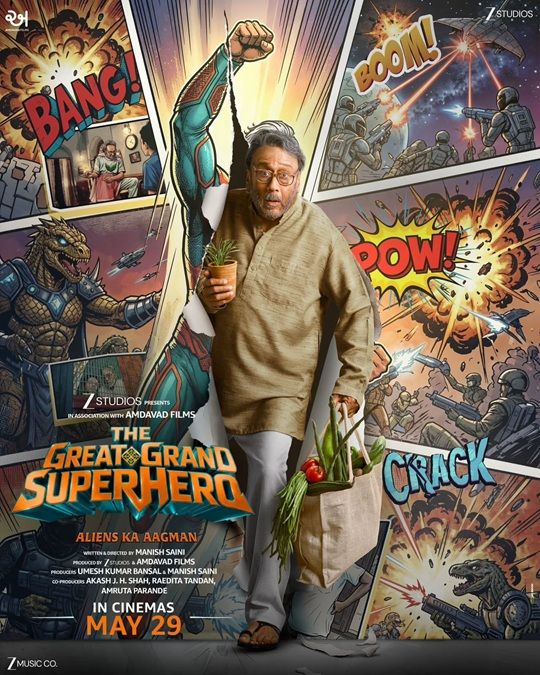
The character of Jagdish is at once fascinating too – almost christening his traits with meta-ness, given how he loves plants (you see Jackie Shroff with a plant in his hand always during his public appearances), along with specific traits of awkwardness. For instance in a scene, you see him being afraid of lizards – an immediate trait that isn’t typifying a superhero at all. The subtext remains on how Jagdish could be our very own Captain Planet in the making, given his love for nature, except that his superpowers would only come in handy when there is an alien attack – in the words of his grandson.
At its core, the emotional hinge in the drama remains the bond that Deepu (and his friends) shares with Jagdish. It is interesting to note on how the wavelengths between these generations often meet at an eyeline – one on their upward formative years, and the other in their downward spiral. The middle generation formulating adults are often too busy with their work to flaunt any kind of imagination, or just too consumed with the world that has established their beliefs. Hence when Jagadish comes out in the open and says that he indeed is a superhero, it remains an immediate extension to the story of Deepu – with the former probably using it as a medium to also get acquainted with the little humans of his wavelength.
There is so much to like with the writing here, particularly with respect to the gaze of the kids here. It is interesting on how young fertile minds often borrow traces of their imagination from the surroundings. Hence here, much of the concept of the superhero for the kids stems from their version of the Gods in a society that portrays them as superbeings – through comics, animated avatars and also instances on celluloid. Hence in a scene, you see Laddu giving eatables for free to his ‘superhero’, almost hilariously telling his helper on not to hand over cheap quality goods, given his services.
The same applies for Deepu also who isn’t amused with the softer version of the story narrated by his grandfather – asking him to amp up the intensity, indicating on how people love violence these days. Or when he echoes the sentiments of his grandfather with the drive – Swatchh Dharti Yojna, an immediate political spin-off of a famous phrase that eventually died out. Even the form of obstacle occurs in the form of a kid whose father is a reporter, and has made a living by asking questions. In an ideal world, that is perfect – thereby further establishing on the cultural and meta influences of kids in the vicinity.
The issue that I had with the narrative was letting go of its simplicity, while allowing the things to be literal in the purest sense. So while the narrative even scores with two alien-looking creates (Sahaarsh Shuklaa and Kumar Saurabh) who hilariously take objections to the representation of aliens on celluloid, the idea of literally waging an alien war towards the end skewed the messaging of the drama with regards to the environment. The gaze definitely shifted from the kids to the adults, thereby losing out on its original charm that the film stood for all along.
As a result, the final battle felt sloppy, tonally off, and underwhelming too, thereby lowering the impact of the drama. But even then, the emotions do land well – be it a young character crying for the fate of an elderly character, or another character terming his father as a superhero, or even a hilarious little race involving oldies to prove their individual superhero skills. The screenplay is warm and affectionate despite a few hiccups.
The dialogues are simplistic, and that exactly remains the contributing factor of humour laced with innocence in the narrative. The BGM also compliments the streak of innocence by being representative of the setting and the characters im the mix – gently aiding the emotional core in the drama too. The cinematography barring the VFX-slop at the end, is pretty gentle and pleasant to the eye – with frames that keep you emotionally connected to its characters. Ironically, the drama scores the best when the gaze remains fixated to children – allowing the viewers to explore the world through their vision.
The VFX may appear a little sloppy earlier, but it felt almost like an extension of the borrowed surroundings of the kids. That said, the one involving the final sequence lacked the depth and the budget to make things grand! The editing pattern scores for most parts of the drama, almost creating an illusion of an episode of Malgudi Days with its cuts that create an affectionate and palpable environment of kids. The only hassle takes place during the final face-off when the cuts get ambitious and pacy, while deviating from the core.
Director Manish Saini manages to impress with his simplicity in terms of his world building and characterization. In times when the world is moving rapidly, he refreshingly opts for a grounded narrative that feels real and affectionate, without compromising on humour or its messaging. There is a streak of sincerity injected in his narrative style that remains affable, even during the most vulnerable phase of the film towards the end, that felt tonally off. The emotions do land, and that tells you a thing or two about the direction which is pretty good.
The performances are wonderful by the members of the cast. The likes of Prateik Smita Patil and Bhagyashree have their moments to shine. Sharat Saxena, Durgesh Kumar and Vinod Bhanushali have streaks of comedy engrained in their personalities, and they successfully manage to tickle your funny bone. Sahaarsh Shuklaa and Kumar Saurabh are exceptional here with their one-liners that are crisp and quirky, even as both of them remain hilariously stoic with their expressions.
The kids are exceptional here! Asmi Deo as Chingy has an affectionate charm that automatically transitions into sincerity with a little surprise at the end, that was a joy to witness. Jihan Hodar as Chakanya is wonderful to witness here – nailing his one-liners and expressions like a pro, while always contributing to the comedy quotient in the narrative. Shivansh Chorge as Laddu is adorable, almost taking you on a journey of being the wide-eyed boy filled with curiosity. He balances his comedy ably while maintaining a strong hold on the emotional core of the character, something that had me in awe on the kind of talent that he showcased at such a young age. Mihir Godbole as Deepu is simply effortless with his craft here. His dialogue-delivery is fluid while keeping the underlying emotions and humour in tact, while delivering a brilliant performance along the way. He is confident and flawless with his performance that is absolutely on-point.
Jackie Shroff as Jagadish exudes of sincerity and earnestness, almost being a meta-representation of his real-life nature loving persona. There is a gentle aura that he brings to the table, filled with honesty and innocence that instantly makes him affable. And hence, you are always emotionally invested in his journey. Also in a way, this remains an arc to savour from Hero (1983) to The Great Grand Superhero (2026) – and he has been brilliant as ever along the way.
Despite its flaws in the second hour, The Great Grand Superhero is sweet little family entertainer that remains a breath of fresh air. It is an affable and heartwarming superhero drama with a heartfelt message that makes it one of those rare films with a big heart. Available in a theatre near you.


