

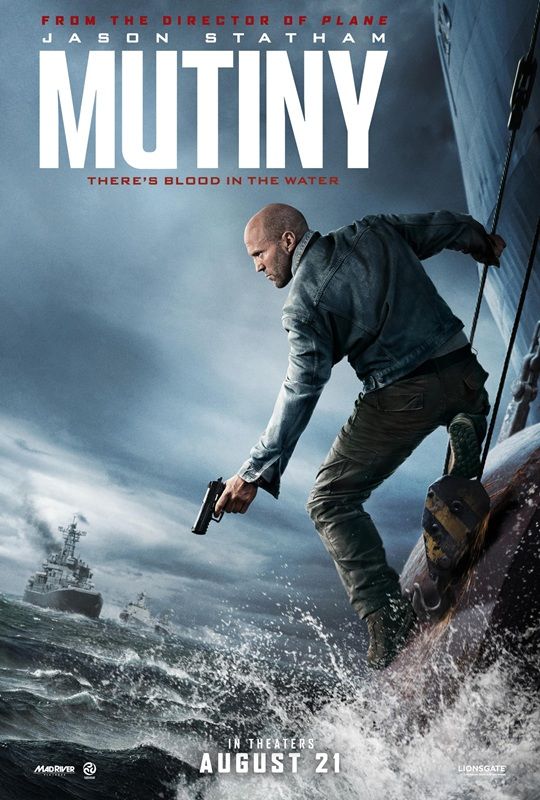
The derivative nature of the inherent drama in the new English film Mutiny, is evident right at its start, even as you are tactfully introduced to its characters in the most uninspiring way possible. There is an early dynamic of friendship between Cole (Jason Statham) and Tibu (Ramon Tikaram) – two characters who have a relative class difference to boast of. While the latter remains a head honcho of a shipping company, the former is his head of securitied – wherein their dynamic is almost reflective of the one in a film like The Intouchables (2011). But this film isn’t about that. There is another dynamic in play between Tibu and his son Kameron (Chaneil Kular), wherein the unsaid disagreement between the duo is evident through facial disapprovals unlike in a film like Animal (2023). But again, the film isn’t about this dynamic either. The pattern that you notice is clear; the film does shift goalposts at the start, only to settle into a Die Hard (1988) kind of a narrative that relies on a wafer thin plot, choosing to emphasize on its action set-pieces instead. But there is a catch to this predicament too – it all is too simplified and repetitive in its approach, without letting go of its derivative nature.
Written by Lindsay Michel and JP Davis, Mutiny follows a piece of writing that doesn’t only wish to go from point A to point B in a jiffy, but also feels like two different movies stitched together in one. If it is the assassination of one of the characters in the first act that prompts the protagonist to investigate the proceedings in order to clear his name and serve the loyalty to his ‘friend’, the setting shifts inside a cargo ship that holds a burning secret. It is here that a crucial plot-point forms an interesting companion piece to the recently released Hindi film Awarapan 2, just that both these films abandon the human/child trafficking sub-plot far too easily.
For instance in a scene, you notice the protagonist entering a container and finding it filled with humans, essentially refugees who are being illegally trafficked to another location. A fight sequence later, they remain on the brink of escaping until a roadblock prevents them from doing so. So far so good – but from this point, you hardly get a glimpse of the bunch, until briefly at the end. What ought to have been an emotional hinge in the narrative, felt merely like an abandonment – much like how the protagonist could have chosen to abandon the ship (and plot) at some point in the narrative!
The lack of characterization hurts the narrative here, something that chooses to coat the characters in the most stereotypical fashion. For instance to give protagonist company is Angie (Annabelle Wallis), the ship’s third mate who is assigned duties at the nth hour, while having to reminisce the presence of her daughter from whom she is away. It is fine to introduce the trait of a single parent in the mix, but what is ita purpose if the same doesn’t necessarily tie itself back in the narrative? The feminine presence felt nothing more than grabbing eyeballs in an alpha-male dominated universe – given how the relevance of the character remained a significant question..
The same applies to the antagonist in the narrative too – a seemingly shady character being stereotyped with a generic trope of authority, but hardly being intimidating in his approach. The flip side to these cardboard characters would also mean that a lot of emphasis lies on the action set-pieces to score. And that itself remains a double-edged sword here. The action set-pieces do threaten to explode, at times scoring well in specific instances like in a narrow ally that is witness to a brief skirmish, or in a gun-battle that slightly raises your bar of interest.
But my mind immediately wandered to the relentless action set-pieces in films like Kill (2024) or even The Furious (2026), wherein the stakes in the very set-pieces was elevated by the passing minute. In a sharp contrast, the action here was restricted to mindless gun-fights with a sense of lull in the middle that not only got tiring, but also felt increasingly repetitive. The searing commentary on capitalism and human trafficking almost felt like members of a feature cast in a big summer blockbuster, even as the narrative felt increasingly flat and stale, despite an interesting setting of a cargo ship. The late twist never really felt unexpected, rather abrupt with the exposition and the final round of vengeance – something that accurately sums up a screenplay that had its (brief) moments, but ultimately drowns in a sea of mediocrity.
The dialogues feel increasingly flattened out, without having a spark to lift the narrative at any point. Additionally, the lines are stripped off any emotions that would otherwise had been crucial in investing in the journeys of the characters (but who am I kidding? This is a Jason Statham film, that sh*t ain’t applicable here). The BGM tries its best to elevate the drama with its claustrophobic sound traces that compliment the narrow surroundings of the cargo ship. But what it lacks is a rhythmic outlook to the action set-pieces, something that would have elevated the impact of a sequence choreographed in sync with the BGM.
The cinematography stands out in a couple of action set-pieces – one being in the narrow alley of the cargo ship, and the other being a tense gunfight in the second hour. I liked how the frames capturing the interiors of the cargo ship added depth to the proceedings too. If anything, the frames are devoid of the (forced) emotional turmoil of the characters, that add to the plasticity of the drama. The editing pattern remains crisp and sharp, but in hindsight, it doesn’t provide a happy breathing space for the drama to build on. It just feels one-dimensional, and abrupt in a few places – particularly towards the end. And the lag in the second act was a reality that could have been avoided too.
Director Jean-Francois Richet chooses to play it safe with a setting that could have really elevated the stature of the action genre. Instead, the tropes remain familiar here – a wafer thin plot, sketchy characters, a wobbly conflict and some tempered down action set-pieces. The direction lacked that punch to spice things up, almost giving in to the relentless sea of mediocrity in which the proceedings drown, eventually.
The performances remain a mixed bag too by the members of the cast. The likes of Chaneil Kular as Kameron and Ramon Tikaram as Tibu have hardly anything to do, even as the plot either eliminates them early on in the narrative, or partially forgets about their existence until the very end. Roland Mollar as Marko doesn’t possess that spree of intimidation that was crucial with regards to his character. Instead, his apparent approach is understated but far too generic with his demeanor, that doesn’t allow the appropriate emotions to land. Annabelle Wallis as Angie has a good screen presence, amd does a decent job. But my issue was with regards to how sketchy her character was – something that I would equate to the character of Disha Patani from Awarapan 2 (2026). As a result, the impact was drastically nullified!
Jason Statham as Cole scores fairly well in a couple of action set-pieces, but he doesn’t do enough to provide emotional gravitas to his act. His stoic expressions further sink any chances of an emotional connect, a trait that wasn’t a major issue with some of his best films in the past. Even his baritone voice was enough to entice me, something that compensated for the lack of emotions in the narrative. But I can’t help but think that he finds himself in creative jail – of having to restrict his creativity in the name of entertainment, so much so that all his roles are appearing to be the same. Here, he wasn’t as disinterested as in his previous outing like Shelter (2026), but still it wasn’t enough to save a sinking ship.
Mutiny functions as a tepid action entertainer that consistently fails to soar, delivering underwhelming set-pieces and flat emotional beats that ultimately drown the narrative in a sea of mediocrity. While the film remains baseline watchable, it suffers from a pervasive lack of tension and unimaginative choreography that fails to elevate the dramatic stakes at any critical juncture. Because it refuses to take bold creative risks, the story plods along a thoroughly predictable path, resulting in a thoroughly uninspired and entirely forgettable viewing experience. Available in a theatre near you.


