
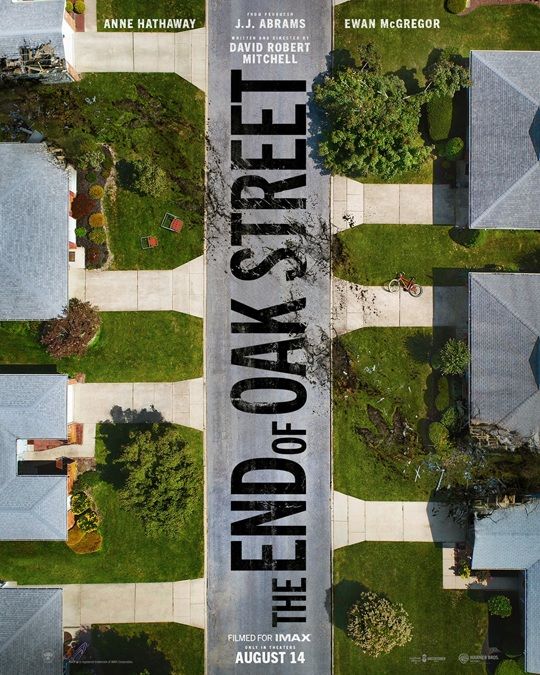
In a rather weird manner, the new English film The End Of Oak Street can be termed as a collective coming of age tale. This is oddly true given the marital estrangement of the characters of Denise (Anne Hathaway) and Greg (Ewan McGergor). At the start, you notice a very specific exchange between the characters, even as Denise is quick to point out to her husband leaving for ‘work’ that they had decided to celebrate ‘Family Day’ – a specific ritual to bring the family together. Unknown to Denise, Greg silently resorts to drinking while taking up an odd job of pizza delivery after being laid off. And unknown to Greg, Denise was writing a ‘fictional’ novel that had an eerie resemblance to her own life. What felt like a dose of extra information with regards to the characters, had an interesting subtext on the concept of togetherness – particularly given the crisis that would follow, something that would contribute to the eventual fabric of the drama, while testing their plight of ‘togetherness’.
Written by David Robert Mitchell, there is a touch of Steven Spielberg’s Jurassic Park (1994) that is tactfully injected in the core ‘survival’ theme of The End Of Oak Street. There is a specific Shakespearean streak of omen through its set of symbolisms at the start – be it the inexplicable cause of ‘sudden’ global warming, or the presence of an unnamed ‘prehistoric’ tree that Denise spots in her neighbour’s backyard, or a literal pile of p*op that seems amusing to begin with – before the eventual calamity hits the town. The symbolism encircling these specific instances remains a giant white ball of light that flashes suddenly, and to blinding effect – essentially doubling up as a portal that marks the entry of a variety of flesh-eating dinosaurs!
The setting remains a virtual companion piece to the Scream franchise, with a masked killer chasing a bunch of characters. The only exception being that the masked killer is replaced by flesh-eating dinosaurs that would stop at nothing. In other words, it is a mashup between Jurassic Park and the Scream franchise – particularly, as you witness the characters taking cover while having to figure a way out of this mess. And some of the best moments of the film are reserved in the events unfolding – be it a character being aimlessly chased by a dinosaur, or a character trying to shoot them down before perishing on his own roof. Or even a giant anaconda-esque hybrid of a dinosaur tactfully entering the household in order to prey upon the survivors in the most chilling way possible. Or even the endless loop that the bunch of characters are caught in – all of which results in some campy, unhinged fun.
I must admit that some of the events began to get slightly repetitive, given how the focus remained just on the survival spree – as opposed to exploring the concept around the white-light-flashing-time-portal. But what is genre-defining is the entertainment quotient, wherein the writing doesn’t miss a chance to have some fun. Be it an unexpected moment involving a couple of characters marvelling at the mating sight of two dinosaurs (something that Spielberg would be proud of), or a moment involving a character jumping at the portal, only for the portal to close down moments before he enters it – causing him to crash. The campy humour forms a definitive thread that makes the proceedings enjoyable. This, along with the family dynamic that forms and closes the arc from the start of the film – with even a slight nod to elevating the stakes in the narrative.
My gripe with the writing remained in its final act, something that not only felt too convenient, but also filled with loopholes. There is a very specific loophole with regards to ‘cloning’ that remained unanswered, even as the writing hit the finishing line in a rather cliched manner. Yes, the 80s and 90s nostalgia was there to be witnessed, but it should not have come at the cost of an abrupt ending that is not only convenient but also filled with loopholes. The impression that I got was that maybe the writer wasn’t sure on how to end it – conveniently labelling the film as a happy ending. But having said that, the screenplay does offer moments of intrigue and entertainment that are well worth your time.
The dialogues have traces of quirky, campy humour that often (and refreshingly) cuts through the horror tropes in the narrative. The BGM is enticing, ably complimenting the dual nature of the drama in terms of its horror and humour. In fact, the sound design specifically contributes to the inherent dark humour in the narrative at multiple instances – tactfully building upon a crescendo of silence before a hush of sound to provide a jump scare. The cinematography comprises of frames that are nothing short of a visual delight. Given my IMAX viewing, the frames allowed me to be a fly on the wall – quietly providing moments of intrigue and horror that cut through the chaos unfolding through the narrative. And it felt even more grander on the biggest screen possible.
The editing pattern is crisp and sharp, ably holding the narrative together. As a result, there isn’t a single dull moment that would bog the narrative down. The ultra sense of crispness is a bit of a bane too towards the end, abruptly nipping the drama that could easily have gone on for another 20 minutes. Director David Robert Mitchell tactfully constructs a world that remains a companion piece to Jurassic Park, while adding a whiff of characters with contrasting personalities to grace the narrative. Despite a repetitive streak in the middle and a cop-out ending, he does manage to string together several moments that are intriguing while also being laced with dollops of dark humour. The direction although flawed, does create and ensure several entertaining moments in the narrative.
The performances are pretty good by the members of the cast. The likes of Anne Gee Byrd as Mrs Huddleston, P.J. Byrne as Mel, and Emily Kuroda as Mrs Valcour are contrasting cogs in the narrative that contribute to bouts of humour and intrigue in the narrative. Jordan Alexa Davis as Jeanette has her moments to shine. Maisy Stella as Audrey and Christian Convery as Brian are a lot of fun to witness, often matching the pitch of their performances with the kinetic pitch of the drama. Both of them are a treat to witness here, lacing the narrative with dark humour throughout the narrative.
Ewan McGregor as Greg is sincere and earnest while subverting an arc of his own – from silently opting for a part-time job to support his family, to readily putting forth his dad duties that included a very specific sacrifice at a juncture in the narrative. Anne Hathaway as Denise plays a pivotal role in maintaining the tempo in the narrative, while ably traversing the varied themes and tones of the narrative. This remains a well measured act, particularly given the subtext of dark humour that isn’t overbearing for the specific horror tropes that her character is subjected to. She was a treat to witness here.
While The End Of Oak Street suffers from a slightly repetitive midsection and an abrupt, cop-out ending filled with loopholes, it ultimately succeeds as a highly entertaining narrative. The story delivers a heady, intoxicating mix of dark humour and genuine horror, positioning itself as an informal, albeit lesser, companion piece to Jurassic Park. It never quite matches the brilliant, cinematic heights of Spielberg’s masterpiece, but its sharp wit and tense pacing keep the audience thoroughly engaged. Available in a theatre near you.


