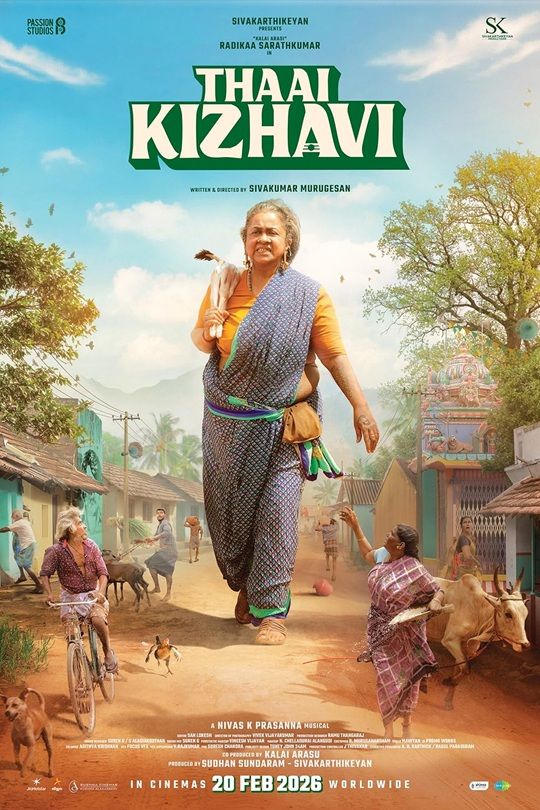
When you are first introduced to Pavunuthaayi (Radikaa Sarathkumar) in the Tamil film Thaai Kizhavi, she instantly reminded me of Sohrab Handa from Everybody Loves Sohrab Handa. She is loud and brash while having no qualms about blatantly collecting money loaned by her from the members of her village – almost flaunting an unapologetic outlook to her persona. Needless to say that this trait of her character has already made her unpopular amongst the villagers – with a character even praying to his deity for her downfall. The subtext in the setup remains an interesting theme – a matriarch on the lines of the Godfather (Thaai Kizhavi literally translates into Godmother) is ruling a village, a norm that goes against the basic principles of a patriarch who isn’t by nature and privilege designed to bow down to her. It remains a short-lived but important dynamic that sets precedence in a dramedy that focuses on humour to lay out its relevance.
Written by Sivakumar Murugesan, Thaai Kizhavi has shades of Baghban (2002) engrained in its DNA, particularly with the chain of events that follow after its cold open. You are witness to the protagonist falling ill inexplicably, even as subtle bouts of celebrations ensue in the vicinity (given how dominating she had been until that point). In the midst, you see the protagonist being taken care by her daughter Suruli (Raichal Rebecca), who is a single mother herself after her husband decided to leave her following an argument with his mother-in-law. And yet, the Baghban-effect takes shape in the form of Pavunuthaayi’s sons – namely Uppuliyaan (Singampuli), Vijayan (Aruldoss), and Selvam (Balasaravanan), all of whom aren’t on talking terms but suddenly have to work together to find the location of the stack of gold hidden by their mother before she passes away. It remains an interesting subtext of greed that supersedes the idea of “taking care of your ill-parent”, a trait that is a direct uno-reverse card on the KJo mantra in K3G (2001).
The proceedings are sprinkled with humour that isn’t always palatable to begin with. Personally, I took a while to warm up to its tone that is wacky, loud but also absurd to begin with – primarily revolving around the situations that the colourful characters find themselves in. For instance in a scene, you see a character being a huge fan of Kamal Hassan – so much so that he has a song ready for every moment, from his idol’s filmography. Even the idea of applying sandalwood paste on the tattoo of the superstar remained an interesting bout of humour that progressively got better over a period of time.
The drama unfolds like a treasure hunt with the characters of the sons trying every option in their playbook to find the location of the coveted piece of treasure. It is clear that greed remains a driving force, joining hands with a local Pennycuick (Munishkanth) whose only aim remains to earn a sovereign for his long pending marriage. The vested interests formulate and drive the narrative here, even as the motley group have to deal with another obstacle of steering clear from Rendu Idly (Muthukumar), the son-in-law of the protagonist who would go onto vye for the same treasure.
The comedy might feel slightly uneven in parts but credit to the writing that sticks to the wacky tone of the proceedings. Be it the protagonist’s weird hand gestures that causes the sons to call a sign-language interpreter, thereby resulting in a hilarious moment. Or a sequence at the hospital wherein one character who doesn’t understand a word of English, interprets the words of the doctor incorrectly, thereby resulting in laughter at the most serious situation. Moments like these are enough to showcase the fact that the black comedy is fully functional in a narrative that caters to a serious dramedy, with the writer showing exemplary control with the proceedings.
There are subtle bouts of convenience sprinkled in the writing too. For instance, a particular incident involving a dead body transforming a character’s outlook towards his own mother. I would label it as convenient given that the switch takes place over the course of two scenes. But such are the emotions in play, that I couldn’t help but think that the filmmaker had his heart in the right place. This, while never really allowing the drama to be melodramatic at any instance, immediately mixing the proceedings with bouts of humour.
Without giving out spoilers, the crux of the drama remains the financial independence of women, often having seen the kind of savings employed by my grandma back in the day – a small trait that went a long way in securing the finances of our family. And this formulates a rather heartfelt final act here that speaks about women empowerment, and how women remain the driving forces of a family as far as the finances are concerned. But in the same breath, it highlights an important feature of financial independence for women, particularly in the rural setting who often find themselves in the shadow of their male counterparts for the money. It remained a rather progressive thought to end the drama summing up a screenplay that progressively gets better with every passing minute.
The dialogues might seem to be slightly on the louder side to begin with, but once you settle into the tone of the drama, there are joyous moments of laughter to be had, along with heartfelt moments unboxed through the lines. The BGM is rustic and perfectly encapsulates the setting, while also accounting for the humour and emotions in the narrative. The cinematography allows the various settings – a village, a hospital, a secluded and grim house – to play a significant character in the narrative. The perks of shooting at real locations adding a depth to the proceedings might be a cliched line, but it still holds true here. Also, the frames keep you engaged with the emotional core of every character, thereby allowing you space to invest in their journeys.
The editing pattern is pretty crisp, often maintaining a rhythm to the proceedings that in turn also contributes to the tempo of the humour in the narrative. The drama doesn’t allow you time to think while constantly throwing punches at you, and that had a lot to do with a pacy edit that allowed the humour to unwind without compromising on the emotional core of the drama.
Director Sivakumar Murugesan shines in his directorial debut, using comedy as a medium to delve into a relevant social themes, while showing great control with the emotional core of the drama. He captures the rooted nature of the drama with his impeccable setting while infusing it with colourful characters that drive the narrative. And care is taken here to never make the drama preachy, while maintaining a strong emotional core through the frequent bouts of humour. The direction is really good here.
The performances are wonderful to witness here in a drama that exhibits an arc of its own – starting with quirky bouts of humour to engaging with its viewers on an emotional level. Ilavarasu as Gold Kumar and George Mariyan as the sign language interpreter remain a couple of the colourful characters in the setup that manage to tickle your funny bone effortlessly. Muthukumar as Rendu Idly has a sinister streak to his character, while exhibiting it with subtle bouts of humour – something that makes for a wonderful watch. Munishkanth as Pennycuick has definitely shades of grey to his character, but his goofy mannerisms and demeanor are so affable that you invariably root for a happy ending for his character.
Singampuli as Uppuliyaan, Aruldoss as Vijayan and Balasarvanan as Selvam are wonderful casting choices wherein the driving force of every character is greed mixed with humour. But deep down, they still have a flame of emotions burning within them that gives each of them a worthy arc. And they cater to this arc wonderfully well. Raichal Rabecca as Suruli is wonderfully understated and subdued while speaking volumes with her eyes. She remains the only character who truly cares for her mother, and her sincerity reflects in her actions and expressions. She was a treat to witness here.
Radikaa Sarathkumar as Pavunuthaayi delivers an unhinged and unabashed performance with a tinge of heart here. Her character is consistently progressive while being unapologetic of her words and actions – and Radikaa completely endorses this trait with a certain amount of flair. Her body language and expressions are spot on, and her dialogue delivery is filled with a lot of wit, only to detour towards a heartwarming finale towards the end. She was brilliant as ever, and an absolute treat to witness here (even when her character was bedridden and barely there).
Thaai Kizhavi is a heartfelt dramedy powered by solid performances that makes for a wonderful watch. It is witty, quirky and heartwarming while also providing you moments to ponder upon. Available on JioHotstar.