

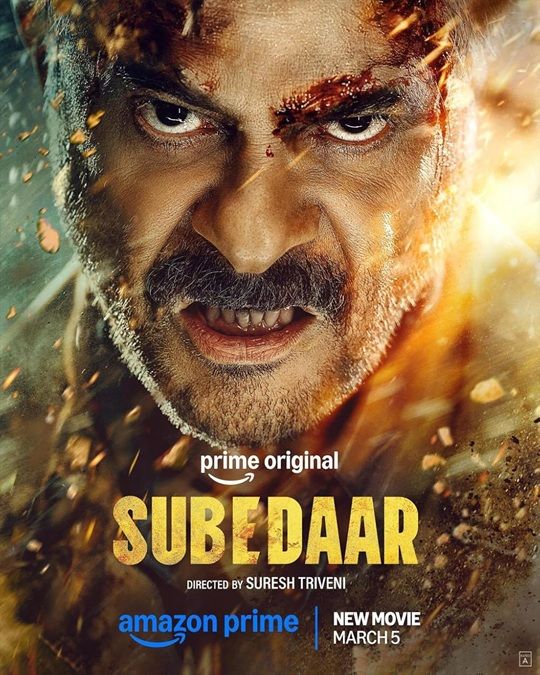
The departure of the ‘Angry Young Man’ from the 70s has been one of the talking points of the Hindi Film Industry. This isn’t because the society hasn’t found a suitable candidate (read: actor) in the fray, but more so to do with the political climate ruling the roosts lately. People are either brainwashed into believing that everything around them is fine, or the new norm involving a comparative analysis with countries that are way below the ones in question. Hence in reality, the Angry Young Men of the 70s and 80s have had a metamorphosis of their own – only to return as Angry Old Men on celluloid. If you notice with actors like Sunny Deol or even Anil Kapoor now, they are the same alphas who have a simmering rage in today’s times on celluloid. In that regard, the new Hindi film Subedaar follows the same trope of Sunny Deol’s films like Gadar 2 (2023) or Jaat (2025) – wherein a raging ‘hero’ is pitted against some younger baddies!
Written by Suresh Triveni and Prajwal Chandrasekhar, Subedaar opens like a neo-Western with the setting of the dusty bylanes of a fictional town of Kokh welcoming you. Instantly, you are acquainted with the sand mafia namely Prince (Aditya Rawal) and his sister Babli Didi (Mona Singh) who along with the goon-turned-mafia Softy (Faisal Malik) rule the roosts. In a scene, you see oppression at its peak when Prince is shown to shoot down a character protesting the death of his brother, only to later capture the character of the mother and hold her captive. It is the kind of politics that is increasingly familiar in the wake of power that is known to start wars of its own.
The entire episodic drama can also be viewed as an inverted meta-take of the film industry, given how the real-life ‘outsiders’ are ruling the arena here, whereas an industry insider in the form of Anil Kapoor essays the role of the outsider Subedaar Arjun Singh. And the early glimpse of the characterization really gave me hope with respect to the drama to follow. So you have an increasingly stoic army man progressively questioning his patriotism while being a victim of a system that is so fractured and oppressed, that it is beyond repair. Yes, the parallels of Subedaar Arjun and Jaat (Sunny Deol) cannot be ignored too – both are essentially outsiders from the army background who get wrapped in a game of power and one-upmanship featuring an impulsive antagonist (Prince) doubling up with the main ‘queen-pin’ (Babli Didi).
It also helps the texture of the drama when you note that Subedaar is suffering from a sense of loss and has an estranged daughter Shyama (Radhika Madan) – another reference to last year’s Sentimental Value. In fact, the real meta-ness of the film industry can be viewed through Shyama’s journey – a potent outsider herself pitted against goons like Ranveer, Ranbir and Kaushal. In other words, the drama here has all the ingredients for a lip-smacking face-off including references to Chekof’s gun namely the red gypsy and an actual gun that double-up as key emotional references of the past with respect to its characters.
But this is where it all begins to go wrong for the film. Firstly, the episodic nature of the drama felt far too distracting more than having me immersed in the narrative. What the structure of the drama was guilty of, remained jumping from one event to another – a sort of a Daldal of its own (or should I say Dull Dull), that increasingly had me frustrated and distracted. The issue remained in the writing of positioning the drama on a thin character-driven plot that neither felt personal enough, nor was it playful enough.
The same can be better understood by two examples – Jaat (2025) was on the playful side to begin with (yes, that disintegrated too in the second hour) wherein all the protagonist wanted was a ‘sorry’ from the protagonist. John Wick (2014) on the other hand, was an emotional journey of a mercenary whose last standing memory of his wife in the form of a puppy is killed by a bunch of thieves. That is where Subedaar falters – it is neither here nor there. I couldn’t care less about the protagonist’s red gypsy being repeatedly rammed in a particular scene. Or even Shyama’s half-hearted struggles with her ‘evil’ classmates that felt like a build-up to Tara Sutaria’s Apurva (2023).
After a point, the nuance of the setting gives way to the familiar tropes of a commercial potboiler. There are cases of vandalism, kidnapping, escape, shelter and every flex in the book of a commercial superhero. In fact, the events also flirt with unintentional humour particularly in a flashback scene wherein you see the protagonist in the middle of a war zone carrying a mobile phone that is supposed to indulge in an emotional aftermath. For me, that was a ‘Matlab Kuch Bhi’ moment given how the whole mission could have been compromised if logic was added in sprinkles.
Even the finale took wild swings with the proceedings in play. Like Shyama’s conflict being resolved in a jiffy to Subedaar’s portions getting a Uday-Majnu twist that felt inspired from China Gate (1998). It all felt too cliched and too convenient to even bother having a discussion around it. And the twist of the Angry Old Man trope easily beating the pulp out of the bad young guys, felt hard to digest in a drama that increasingly flatters to deceive.
The dialogues get the dialect of the setting right but the power that was needed to create a stir, is woefully missing here. This also made me realise on how tonally inconsistent the drama is – neithet fully going the commercial route nor dwelling fully in the neo-Western space. The music and BGM contribute to the rustic nature of the drama and proceedings, doing what is asked of it. The cinematography opens with a bang by creating an ambience of a Western thriller before completely going in self-destruction mode with the excessive use of slow-mos and extreme close-ups. In fact, the latter also exposed the shoddy job of the make-up department – wherein in a scene I could clearly distinguish between red paint and prop blood.
The editing pattern is a huge suspect here given how structurally, the drama is divided into chapters. Whilst the intrinsic cutaways are relatively seamless (a technique employed in the show Daldal too), the broader structure felt distracting for a film, given how a similar pattern is employed for a webshow. It was distracting and increasingly frustrating. Director Suresh Triveni misses the mark here after showing promise early on in the film. If a director scores with the world building and characterization then more often than not, the grip in the narrative is intact. But it is a clear exception here wherein the familiar tropes of a Western are bartered for commercial tropes that didn’t land at all. As a result, the drama is a complete mishmash of sorts in a narrative that slides after a point. And that then remains a red mark in the report card of the director.
The performances are pretty good by the members of the cast. The likes of Snehalata Siddharth as Ranju, Amit Verma as Babu, Vinod Goswami as Avdes, and Karan Mishra as Guddu have their moments to shine. Khushbu Sundar as Mrs Maurya is sincere while managing to impress. Faisal Malik as Softy looks stoic and intimidating in his spectacles, and delivers a wonderfully restrained performance. Mona Singh continuing her good form as Babli Didi is menacing and once again smashes it out of the park, although I couldn’t help but feel on how underutilized her character felt. Radhika Madan as Shyama packs a punch but again her character felt more conveniently penned more than anything else. Saurabh Shukla as Prabhakar nails his character while playing perfect foil to the protagonist. Aditya Rawal has got to be one of the finest young talents at the moment. As Prince, he showcases his eccentricity with a hint of flair while also being very measured with the flamboyant intensity of his character. This powerful performance was a departure from his recent outing in Daldal which was nuanced and delicate, wherein he showcased his range as a performer to the full hilt.
This brings me to the interesting case of Anil Kapoor who essays Subedar Arjun Maurya with mixed results. In a couple of emotional scenes, he brings all his experience to the fore by extracting a nuanced act. But in scenes involving high-voltage ‘dialogue-baazi’, I missed the kick that someone like Sunny Deol would create – through his mannerisms and body language. Being stoic isn’t always enough if the attempt is to go in full commercial mode. Had this been a brooding Western drama, this same body language exhibited by Anil Kapoor would have then been effective. It makes me wonder on whether there was a gap in briefing him for the role, but either way, the performance exhibits mixed results.
Subedaar is essentially one ‘dull dull’ after another in Anil Kapoor’s version of Jaat and John Wick that starts well but then flatters to deceive, ultimately resulting in an average watch. Available on Amazon Prime.


