

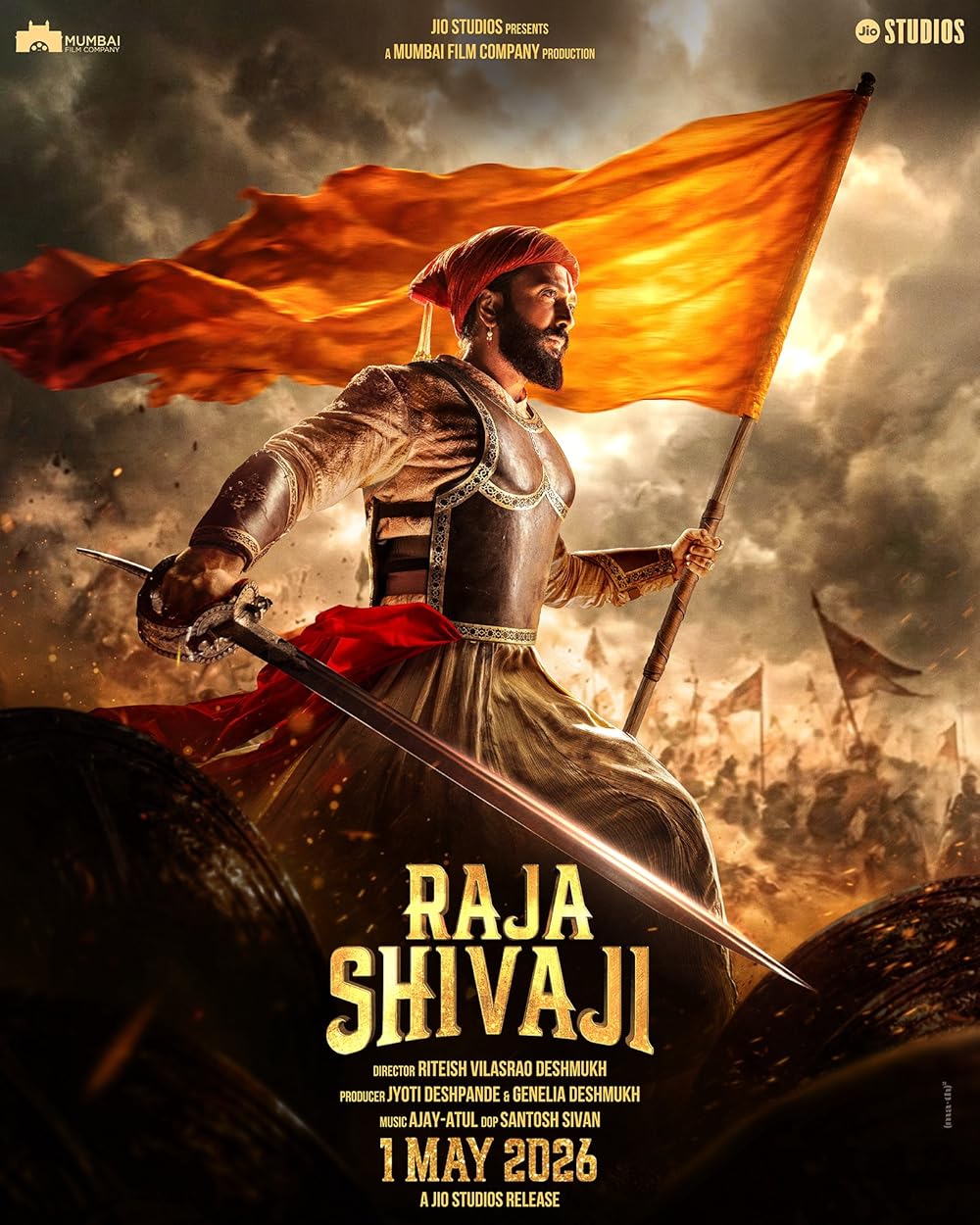
When you do pick the life of a few historical figures to be represented on celluloid, it essentially becomes a two-way street. One responsibility lies with the audience to analyze the source material, match it for the historical accuracies, and then lap it up or criticize based on their findings. And the second and primary onus lies with the filmmaker, to get as close to representing the historical figures as possible. Remember the filmmakers are paying a tribute to these figures too – hence, the representation remains the single most important feature here. Hence when it came to the Marathi film Raja Shivaji, I am skeptical on two accounts – one being the quality of the film that seemed significantly compromised with a mass masala treatment to one of the greatest maratha kings Chhatrapati Shivaji Maharaj, and second being that the film would be critic-proof. The latter basically would mean that people would anyway go and watch the film based on the name associated with the film, ignore the flaws, and instead target the ones criticizing it. Religion remains a personal entity until you use it as a shield to overlook the flaws being pointed out. And yet, I have to be honest with my job – and so here are some of the most respectful points of criticism that you will find in the film. I know my history, but history ain’t the problem – the representation is!
Written by Prajakt Deshmukh and Riteish Deshmukh, Raja Shivaji chronicles the life of Chhatrapati Shivaji Maharaj from his birth in 1630 AD to his ultimate face-off with the general of Mohammaed Adil Shah, Afzal Khan in 1659 AD. The one important thing that the biopic touches upon initially (besides its binary take on the communal politics set in that era) remains the concept of Swarajya – an important terminology of the Maratha legacy. In a scene early on in the narrative, you see the young protagonist curiously asking his elder brother about this concept – at a time when the Deccan region was governed by Adil Shah (Amole Gupte), with even the Mughals eyeing on the territory. The historic accuracy is intact, even as the Maratha king Dadoji Kondadeo (Sachin Khedekar) is frequently told to side with either of the two stakeholders. The Marathas themselves did not hold a legacy up until that point – which essentially forms the basis of the premise here.
The issue that I had with the writing was with respect to its structure, something that felt too scattered for my liking. In fact, the design of the screenplay did not fully allow me to settle down in the first place. Be it the introduction of Afzal Khan (Sanjay Dutt) that resulted in a tragedy, or even the presence of VFX-driven elephants, or episodic passages of villagers fueling a sense of angst in the young protagonist, or even the fadee presence of Shah Jahan (Fardeen Khan) against the backdrop of a Taj Mahal wallpaper – the events were fragmented, and the distractions were real. In all of it, the greatness of Chhatrapati Shivaji Maharaj did not find a representation – something that felt synonymous in other Marathi films like Pawankhind (2022), Sher Shivaji (2022), or even the Hindi film Tanhaji (2020).
The issue also extended to the characterization, or rather the lack of it. Let’s face it – the medium employed here was never going to be enough to cram in every little detail that one would find in History textbooks. Instead, what I looked for was a stronger emotional core – something that I only got fleeting inferences of. Be it Shambhaji Shahaji Bhosale (Abhishek Bachchan) being forced to side with Afzal Khan, only to be betrayed by him – resulted in a brief heartfelt moment, which was quickly superseded by an over-the-top action sequence that lead to the eventual betrayal. As a result, even the emotions feel compromised after a point – but what you get is a mass masala treatment of one of the greatest kings of the Maratha Kingdom.
Remember Chhaava (2025) and how it felt like a heartfelt journey despite the high pitch of the narrative that it catered to? That exact emotion was missing in the introduction of Chhatrapati Shivaji Maharaj (Riteish Deshmukh), something that felt less impactful – be it in the slow-mos, or the way he wields his sword, or the aura that the man possesses – nothing comes close to the greatness in reality. I am fine with people still lapping it up, but it is important to celebrate the aura of an individual, only when it is represented correctly. On a side note, the interactions with his wife Rani Saibai (Genelia D’souza) also felt awkward, as opposed to a deep sense of longing followed by grief.
I was momentarily invested during the events of the final act, when the politics in the drama was tapped into. Be it the mind games employed by Chhatrapati Shivaji Maharaj on a fate-fearing Afzal Khan, almost boosting and later challenging his ego through his messenger Pant Gopinath Bokil (Jitendra Joshi), or the eventual turnaround in the form of a tussle wherein Raja Shivaji would use the Wagh Nakh to eventually kill his nemesis – it briefly felt that some ground was recovered. But a surprise cameo at the end followed by the culmination of the tale felt slightly underpar, with the sequence being designed for whistles and hoots. I am all for the latter but it shouldn’t supersede the pride and the emotions which remain far more important ingredients. The screenplay isn’t the best here, and that didn’t sit well with me.
The dialogues do have a fiery pitch tagged to them but the emotions aren’t always conveyed through the lines. Remember Chhaava (again) and how the character of Vicky Kaushal charged up his troops to the point that I had got goosebumps? A similar scene here, and I felt nothing really – something that drives home my point. If there was this one feature that the film really scores in, then that would be the music and BGM by Ajay-Atul which is pulsating and absolutely thumping. It won’t be wrong to say that Ajay-Atul understand the Maratha culture so well, something that reflects in their beats – a point that was missing in a film like Chhaava wherein the music I had found to be good, but now that I have a reference – it sure felt underpar in hindsight. If it wasn’t for the powerful BGM and music, the film would probably have sunk even deeper.
The cinematography is not the best by any stretch of imagination. Barring the one action set-piece wherein the mocobot camera follows the principal character in the thick of things, the camerawork in every other set-piece is half-baked. It doesn’t also help on how the frames become a caricature in a few instances – be it in a scene wherein a character casually holds a war cannon. It just felt really superficial. The VFX is really bad, at times giving the feeling of a fight taking place against a wallpaper – something that needed to be chalked out in pre-production as opposed to fitting it in post production. It was pretty tacky. The costumes though are spectacular, and deserve the praise here for their accuracy.
The editing pattern is pretty choppy too – the worst affected in the first 50 minutes. The episodic nature of the drama (divided in chapters) felt like an aftermath of Dhurandhar – but that specific reason didn’t allow me to invest in the drama. Even the editing in the fight sequences is so patchy, that it left no impact on me.
Director Riteish Deshmukh doesn’t always leave a lasting impression here, as far as the filmmaking is concerned. You can sense the rawness with a lack of vision, particularly when you see him mounting such an ambitious project on a shaky foundation. The emotions remain a hit and a miss here, but he falters big time in adding scale and grandeur to the proceedings. The lack of characterization (around the protagonist) was also not ideal for a biopic of Chhatrapati Shivaji Maharaj – wherein every character had a role in play in reality. The direction misses the mark for me.
The biggest letdown for me remain the performances, particularly given how the casting was carried out for the film. The idea to choose friends over actors who would ideally fit the part, will go down as the worst creative decision here – something that lowers the impact of the drama significantly. The Salman Khan cameo as Jeeva Mahale is awkward and is only designed to bring hoots in a packed theatre. The likes of Boman Irani as Peer Baba and Fardeen Khan as Shah Jahan have very little to do. While the likes of Jitendra Joshi as Pant Gopinath Bokil and Sachin Khedekar as Dadoji Kondadeo impress, the likes of Bhagyashree as Jijabai and Amole Gupte as Mohammed Adil Shah falter. The latter particularly hams his way through the narrative, and it probably had to do with the briefing given to him other than his acting (which ia generally good otherwise). Vidya Balan as Badi Sahiba is shrewd and essentially plays the role of Lady Macbeth, being subtle with her scheming ways in a male dominated universe.
Genelia D’souza as Rani Saibai is visibly uncomfortable with her lines and demeanor, while failing to rile up any emotions. Abhishek Bachchan as Shambhaji Shahaji Bhosale isn’t as agile in his action set-piece, but does a swell job in an emotional scene that remains one of the highlights of the film. Sanjay Dutt currently is omnipotent, available in any and every film doing the rounds currently. And while he isn’t bad as Afzal Khan, he is still Baba – and how Baba would act as Afzal Khan (if you know what I mean). He remains just an extension of SP Choudhary Aslam from Dhurandhar, but in a different era.
This brings me to the curious case of Riteish Deshmukh who doesn’t score as Chhatrapati Shivaji Maharaj. The man lacks the aura of someone like a Sharad Kelkar or even a Vicky Kaushal who seemed like better alternatives for the titular role. He falters in action set-pieces, and misses the mark even with his expressions in what felt like an act that lacked a certain aura. His emotional scenes are a suspect too, wherein he is clearly out of his depth as a performer. And that made me realise that he wasn’t best suited for the role here.
Raja Shivaji made me realise that Chhatrapati Shivaji Maharaj needed a better biopic here. It features a riveting score by Ajay-Atul, but the shoddy VFX and even the subpar performances lower the impact of the drama. But the film is critic-proof already, so what do I know? Available in a theatre near you.


