

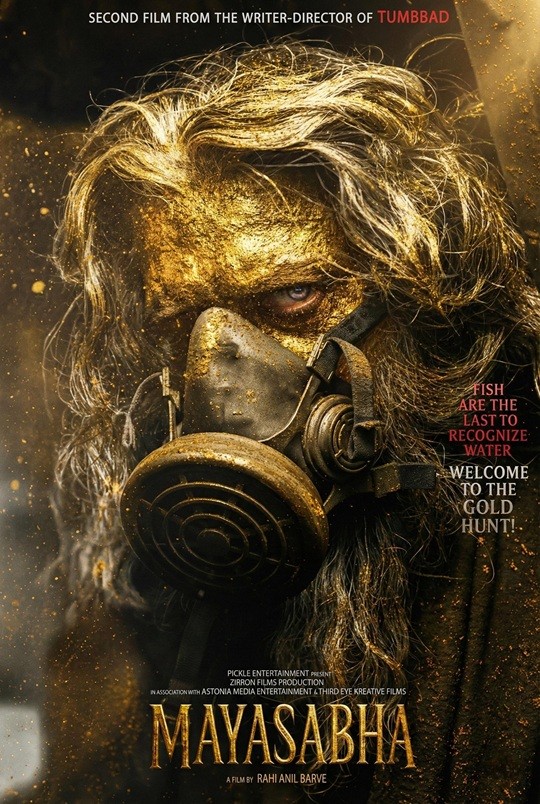
It is interesting on how the central location of the film, more specifically an abandoned movie theatre is named ‘Mayasabha’. It is similar to a dystopian world within a dystopian world where most of the drama unfolds. It is also interesting on how the setting itself translates into a ‘Hall Of Illusions’, a literal and visceral take on cinema wherein the identities of the real and reel world begin to blur. Hence, it you look closely – Mayasabha acts as a direct satire on cinema through the character of Parmeshwar (Jaaved Jaaferi), a once-upon-a-time famous film producer who is currently backrupt. He has been living with his son Vasu (Mohammad Samad) at an abandoned theatre while often controlling his actions and keeping him ‘protected’ from the outer world. It can directly be corelated to mythology wherein Parmeshwar is the protector of sorts, while Vasu remains cursed to be born again – a significance that emerges from Parmeshwar’s past.
Written by Rahi Anil Barve, Mayasabha often creates an illusion with its characters too. It is learnt early on that Parmeshwar has been hiding gold in his abandoned ‘home’, the only thing that he could save from his failed marriage. It is interesting on how Parmeshwar uses his past to create an illusion of truth, something that has been repeated so many times in his head that he believes it to be true. It is similar to his journey as a film producer – making films, telling stories and living in a world of illusion until everything disappears. Ironically, the place that he chooses to reside and hide the gold is also a hall of illusion, a direct reference to the Mahabharata. The place represents the cluttered mind of the protagonist, decaying in the garb of his past – again represented by a decaying Rolls Royce that was a part of his stature previously.
One of the recurring themes exployed here is that of greed, just like Rahi Anil Barwe’s previous spectacle Tumbbad (2018). And the same is represented through two ‘outsiders’ – Ravrana (Deepak Damle) and his sister Zeenat (Veena Jamkar) who befriend Vasu just to get to the gold. Here I must add that the ‘gold’ in question isn’t always the end destination – even if it made to believe through the course of the film. The location of the treasure is predictable but the subtext is always more beautiful in this context – the pot of ‘gold’ that draws direct parallels to Tumbbad. The location again isn’t coincidental but a more specific problem hinted at, wherein the decay lies from deep within in search of materialistic pleasures.
The proceedings unfold like a Shakespearean tragedy wherein the blank screen of the abandoned theatre, is witness to the drama and chaos unfolding in front of it. In that sense, Mayasabha can also be looked as a film within a film, or the decaying state of cinema that was once in its prime but is now at its lowest, even as greed has set in. In a scene, you see Parmeshwar telling Ravrana and Zeenat on how they can take the gold given how finders can be keepers, even while setting his priorities right with respect to Vasu. The idea of corruption is tactfully handled in the same breath too from the POV of Zeenat and Ravrana, even as the former begins to cook stories thereby triggering her own storage of illusions.
There is a sniffing cynicism with respect to star power too – as noticed from the life of Parmeshwar who still wishes to hold onto his past while creating an illusion of a blur himself – wherein he often fumigates the place to fight mosquitos. The latter is again a commentary on the leeches that exist in the business, known to suck blood but have very little to contribute to cinema in general. And the gold perhaps maybe his last strand to hold onto his fame, along with his son Vasu who holds a strong connection to his past. In many ways, Parmeshwar can be viewed as the God of cinema too – faintly holding on to his ‘golden’ days whilst being in his most decayed state yet (and maybe breathing his last). Yep, the context could also be interpreted as freedom of speech.
One of the other themes in the narrative is that of psychological warfare, wherein the character of Zeenat can be a direct extension of some female characters written by William Shakespeare. The mood is sombre but also tragic, given how the game of one-upmanship is in play – something that is implied to destroy the setting, in this case cinema in general. Corrupt storytelling forms a searing trait for Zeenat who isn’t truthful but rather dishonest with her stories, another metaphor in itself. There is a reference of a poetry of Kabir on how humanity’s eventual destination is ‘mitti’ (earth), despite having illusions of materialistic wealth around them.
The drama can also be viewed as a character study of sorts wherein character views their ‘wants’ differently. For Parmeshwar, it is his want to hold onto his past, for Ravrana and Zeenat, it remains their want for wealth while fuelling their greed, for Vasu, it is his want for freedom subconsciously away from his over protective father. In fact, you see him most excited while meeting new people and wanting to tell them about his ‘secrets’. But he is the most fragile at the end when he bids a final goodbye to the place. That is the paradox of his character and the screenplay too – it is like watching a film in a theatre, investing emotionally in its illusion only later on, to step into the real world. Therein lies the satire on life which can be viewed through the character of Vasu. The screenplay has such nuggets infused through and through in what makes it an absolute winner.
The dialogues are integral to the plot here given that this is a dialogue heavy film. In fact, the proceedings unfold like a stage play often being housed in a single location, wherein most emotions of the characters are conveyed through the lines. So it is important to pay attention in order to dissect its subtext, and the easter eggs that double up as vital symbolisms in the narrative. The BGM is haunting while exuding of Shakespearean vibes, often signalling a tragedy that is lurking in the corner. The cinematography beautifully encapsulates a mini dystopian world of sorts by being committed to the idea of showcasing symbolism through its frames – be it the fumes of air, or the emotional arc of the characters.
The editing pattern is leisurely, allowing the drama to unfold without any abrupt jump cuts. Both the editing and the cinematography work on the atmospherics of the drama wonderfully well. All eyes were on Rahi Anil Barve after his debut film Tumbbad which went onto become a cult. And that would often come with an added sense of pressure. But here, he deviates beautifully into symbolisms – allowing his illusioned world to do the talking, while handling the personalities of his characters wonderfully well. His focus remains on the subtext along with trusting the intelligence of the viewers to decipher it, a form of storytelling that I adore given how it helps tick my mind. He doesn’t spoonfeed or underline key moments, he just allows his drama to linger in a psychological space that is hard to shrug off. He remains a special voice that needs to be preserved and studied! The direction is excellent here.
The performances are wonderful by the members of the cast. Deepak Damle as Ravrana shows hints of his sinister presence while often allowing his traits of impulsiveness and greed to drive his character. Veena Jamkar as Zeenat is such a visceral ‘Shakespearean’ character who probably might be oblivious of the extent of corruption that her mind is subjected to. Her morals are skewed even as she indulges in a psychological warfare, showing false sense of empathy and putting forth a commendable act along the way.
Mohammad Samad as Vasu is an epitome of youth and exuberance, often repressed and shackled by the society. He has such an innocent outlook to his character, something that is symbolic through his eyes and expressions. The amount of emotions that he brings to his character towards the end is wonderful to witness, in what remains another brilliant outing in his young career.
Jaaved Jaaferi is that one actor who can be termed as underrated, with the Hindi Film Industry only using his flair for comedy at various junctures. There is more to the actor, something that we see here. As Parmeshwar, he possesses an eccentric trait of holding onto his past, while being controlling in many ways. The amount of pain buried inside him is insurmountable, often left to decay by the society too. The portrayal itself felt complex, often touching upon various shades of uneven territory that would be reflective of his decaying state of mind too. This remained an incredibly brilliant act of the highest order, and I could not have been more happier for him!
Mayasabha is a niche and demands your patience. But if you choose to invest in its symbolisms here, you will realise that the themes of greed and trauma are explored in a searing ‘Shakespearan’ satire on cinema, and life in general – in a drama that makes for a brilliant watch. Available in a theatre near you and Highly Recommended!


