

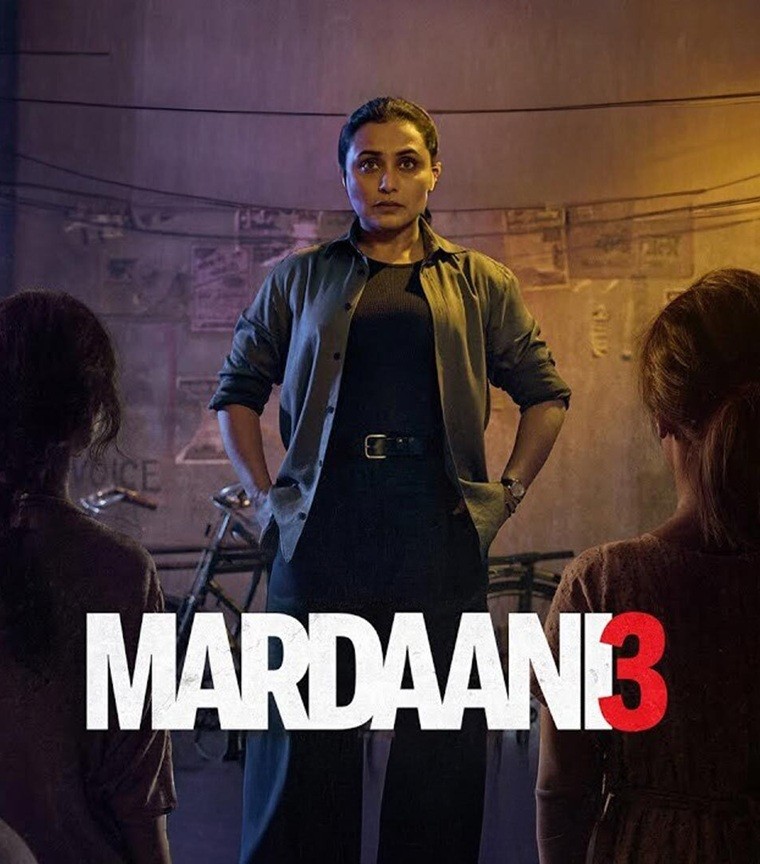
It can be deduced immediately that (at some levels) Mardaani 3 can be a companion piece to last year’s Delhi Crime Season 3. The parallels are crystal clear here – a female cop investigating the disappearance of young girls, only to unravel the kingpin of the racket who also gets to be a female. This, while both the protagonists get their respective introductions in the eastern part of India (well, Shefali Shah was introduced in the North-East to be specific). One of the early forms of criticism lay in this very (re)introduction of Shivani Shivaji Roy (Rani Mukerji) wherein you see her taking down the gang members of a drug-trafficking racket in the Sunderbans. If I had no previous knowledge about the character, the entire sequence could easily have been mistaken for one of the spy introductions of the YRF Spy Universe. But that minor stutter aside, the grip in Mardaani 3 is maintained through its cold open wherein we get to witness the kidnapping of two young girls who would form the basis of investigation for Shivani. The events are tense and a nod to the third season of Delhi Crime, even though shockingly, the end result of mediocrity remains the same too.
Written by Aayush Gupta, Deepak Kingrani and Baljeet Singh Marwah, Mardaani 3 works on its gritty atmospherics really well at the start – almost allowing the greyish blue and yellow filters to dictate the unpredictability of the drama. It remains a metaphor of the wild goose chase undertaken by Shivani who is tasked with investigating the disappearance of the daughter of an Indian ambassador, even while his servant’s missing daughter is discounted. The early form of social commentary based on hierarchy is evident, something that would again be reminded by the antagonist later on in the drama – the cops are active only when a high profile victim is at the receiving end. It is an interesting paradox for Shivani who also begins her trail from this point, even whilst being shackled into even having to care about the other girl.
The character of Shivani here is designed to be local Sherlock Holmes in many ways. In a scene, you see her reconstructing the events at a crime site – drawing her conclusions to the T on how the crime may have been committed, along with the struggles of the victims. But I also liked how her character is seemingly more vulnerable here – she is unable to distinguish between a pre-recorded video at the metro station, she isn’t quite able to prevent an attack on her loved one, she also falters at a few instances during the investigation. Unlike the alpha males of the same genre, Shivani isn’t a superhero – she has her flaws, and she is only human afterall.
The biggest USP of the Mardaani franchise (other than Shivani Shivaji Roy) has been the set of villains introduced, relatively unknown and anonymous with their demeanor who have later gone on to make names for themselves. If it was the cold-blooded capitalist in Mardaani (2014) who would encash on his sinister demeanor, or the brutally intimidating light-eyed bald figure in Mardaani 2 (2019) who would send chills down your spine – the antagonists remained a crucial talking point in the drama. The situation here remains slightly skewed and a bit of a letdown from the writing department.
The character of Amma (Mallika Prasad) is designed to be chilling through her looks and mannerisms. But if you look closely, her character just seems like a regular run-of-the-mill kind of an antagonist who works in binaries. Even the addition of another antagonist in the fray may have felt like a promising proposition on paper, and despite a familiar twist in the pre-interval sequence – the character just did not outgrow the flaws of the writing, instead making the character quite underpar and hardly intimidating. And much of it is exposed in the cliched second hour.
I am not going to lie – I was quite invested in the investigative part of the drama in the first half, that despite minor squabbles, had me on tenterhooks. But the convenience crept in later on, something that can best be described as the ‘curse’ of the second hour. The idea of manipulation in order to go from point A to point B is clear as day and night here. So when the antagonists are inexplicably arrested early on in the second hour, it did tell you a thing or two about the blank canvas that was ahead. And it did take another character to frequently switch sides to fuel the narrative – a subplot that was so predictable that it could easily be listed as ‘convenient’. The foreshadow of abruptly halting a sequence only to circle back to it later, did not help its matters too. Somewhere beneath, there lay a faint commentary on the perception of the character based on religion – an angle that the drama never dared to explore during its runtime.
There was something about the polluted air of Delhi-NCR (where two-thirds of the drama is set) that made the proceedings gritty and tense while acting as a metaphor for uncertainty in the drama. But the convenience of the plot can be further accentuated in the second hour wherein proceedings shift to Colombo – an unintentional reference to the Ramayana, something that felt as needless as shifting the climax of Khuda Haafiz 2 (2022) to the Pyramids of Giza.
Previously, I was a little forgiving on the convenience of clues that paved the path for the protagonist, but this literally sealed the deal. This momentum or rather the lack of it, was evident in the lacklustre face-offs at the end too – something that felt not only cliched but largely underwhelming. And that quite literally was the trajectory of the screenplay here – tense in the first hour, loosening its grip in the second and falling flat at the end.
The dialogues are massy to the point that Shivani Shivaji Roy can easily be a distant cousin of Lt Fateh Singh Kaler (Sunny Deol) from last week’s Border 2. The nuance is clearly bartered for some in-your-face lines that weren’t always in sync with the understated tone of the drama. The music is pulsating but also emphasizing on style over matter. The BGM does enough to maintain the levels of intrigue in the drama, even during times of creative turmoil in the second hour. The cinematography uses the gritty shades of blues, greys and yellow to create an ambience of tension early on – but these gimmicks don’t always work consistently unless the writing is equally gritty in nature. The mood was definitely set well, but sustainance was the issue here.
The editing pattern is good here, trying hard to employ the foreshadowing technique to add layers to an otherwise predictable set of events that unfold. Director Abhiraj Minawala shows glimpses of brilliance early on in the first hour by wonderfully setting the gritty ambience of the world of Shivani Roy. The issue though lies in the second hour wherein he isn’t fully able to mask the convenience in the writing, instead loosening his grip on the proceedings and ultimately accounting for a lacklustre finale. The direction remains a mixed bag here.
The performances are decent here while heavily relying on the stature of the protagonist to sail through rough waters. The likes of Adesh Pandit as Pinku, Jimpa Sango Bhutia as Jimpa, Jisshu Sengupta, Jaipreet Singh, and Eendraneil Bhattacharya as the Indian ambassador range from good to decent in their respective roles. Janki Bodiwala is usually a fine actor but as Fatima, she is less effective here. Her dialogue delivery isn’t as powerful to match up to her co-star, and in the same zone, I did feel that someone like Yukti Thareja did a better job in Delhi Crime season 3.
Prajesh Kashyap as Ramanujan boasts of wooden expressions that are hardly effective here. The impact that the character needed to have is just missing here, and much of it had to do with his polished body language and blank expressions. Mallika Prasad as Amma starts off as being menacing and while she does a solid job, the writing of her character is so mediocre that it remains almost frustrating in many ways. Much of the job of heavy-lifting lies of the strong shoulders of Rani Mukerji, and she is impressive as Shivani Shivaji Roy. Rani holds years of experience to realise on when to push the envelope of massy lines, and when to take a step back. Barring a few loud misfires, it was her performance that made this drama immensely watchable while putting forth a commendable act. Notice her act in the interval block wherein she mouths a monologue without blinking. That was something worth admiring and studying.
Mardaani 3 is one such thriller that suffers from the curse of the second half. It is intriguing and tense to begin with, but slowly tapers off in the second hour due to its cliched writing that eventually makes this drama middling in many ways. But then maybe ‘middling’ is the new form of ‘brilliance’, so what do I know? Available in a theatre near you.


