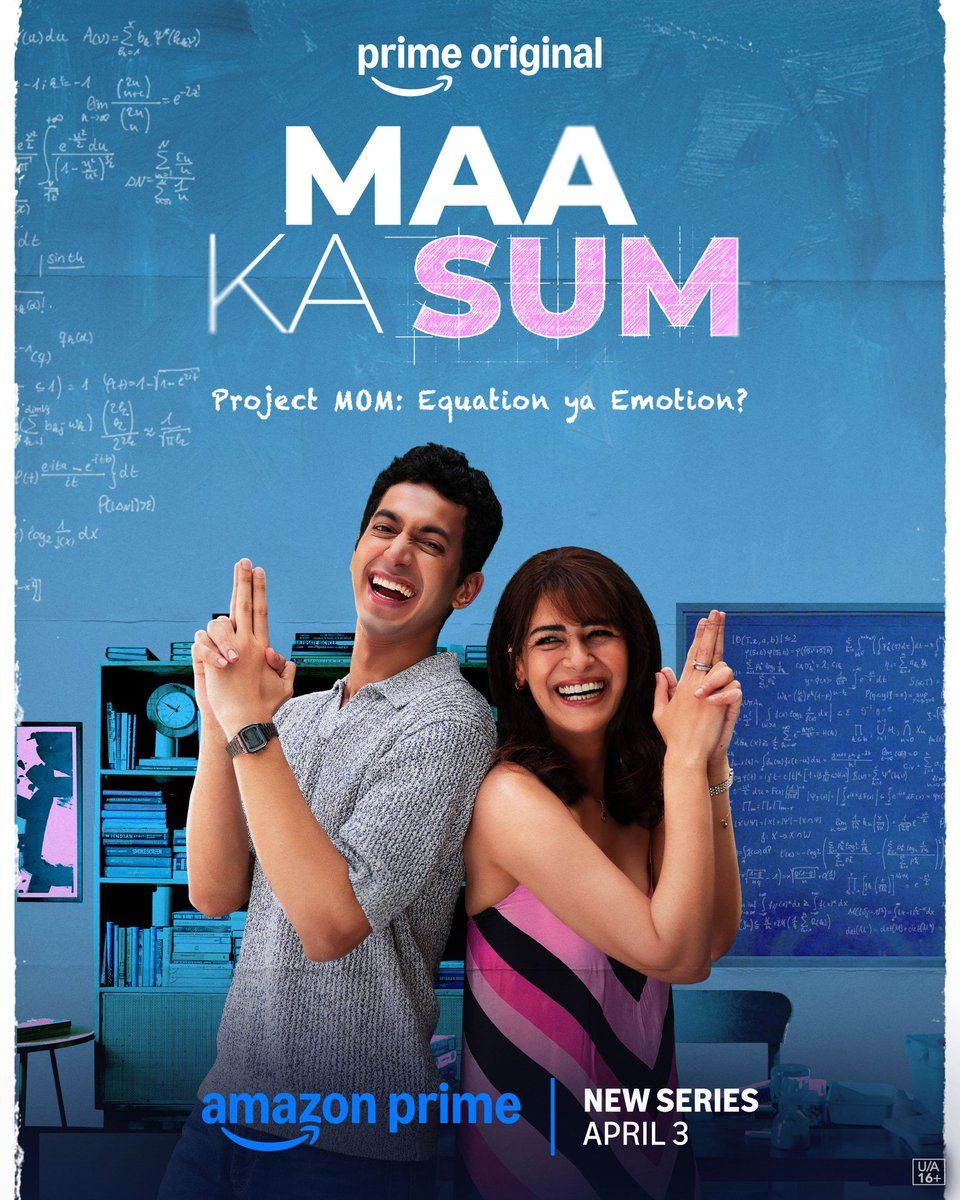

The cold open of the new Hindi show Maa Ka Sum is as gimmicky as its title – both of which reek of mathematics, a recurring invisible character on the show. If the title tells you a tale or two about a mathematical spin-off on the age-old Hindi word Maa-Kasam, the cold open involving the protagonist Agastya aka Gust (Mihir Ahuja) using an array of mathematical jargons to save a heartbroken character from committing suicide, almost felt like an early algorithm-induced hook that most OTT platforms are guilty of. The hook is definitely prevalent here, but also gimmicky before quickly shifting focus to a warm but unusual mother-son dynamic that forms the heart of the algorithm here. In that sense, a drama about algorithms is seemingly written by algorithms in a way that algorithms perceive Gen-Zs and Young Millenials to be – divided by age but united by the idea of love, something that forms the basic skeleton of each of the two protagonists on display. And quite honestly, this remained the only algorithm-driven concept in the entire show that I really enjoyed. Everything else was nothing short of a blur!
Written by Sumrit Shahi and Ravinder Randhawa, the first season of Maa Ka Sum has an interesting concept at the start, something that refreshingly reflects on its characters too. When you are introduced to Gust, you perceive him to be a Math prodigy, a teen-wiz who has an affinity for algorithms and then some more! In fact if you were to view the world from his gaze, you would often find vibrant numbers and Mathematical formulae popping off from the walls, even as he remained an ethical hacker that is hooked onto his monitor(s) minus the black hoodie.
Gust is almost like a teenage math-variant of a man-child in the Ranbir Kapoor man-child cinematic universe – living life on his terms while soon planning to shift out of his home. But before he does, he must find a right match for his single mother Vinita (Mona Singh) – a petite millenial who has almost given up on her failed dating life. So what does Gust do? He devices an algorithm to tweak the already programmed dating algorithm to find the best matches fir his mother. But the moment it is the turn of emotions to creep into the drama, the algorithm fails, and so does the drama!
One of the biggest criticisms for me remained the character of Gust, and how confused he felt outside his mathematical prowess. In a scene, you witness him throwing a fit after discovering his mother’s inclination towards a man called Abhimanyu (Ranveer Brar), whom she met offline. In fact a scene prior is enough to tell you the controlling qualities of Gust – he asks his mother to go on 11 dates for the ‘data’ while diligently asking her to rate each one of them out of 10 for the algorithm to work smoothly. And why I say this is a problem is because it automatically weakens the character of Vinita who is treading a journey of her own. It doesn’t give her a voice, much like the character of Afsha (Tripti Dimri) in O’Romeo (2026) being hijacked by the gaze of Ustara (Shahid Kapoor).
The confused nature of Gust is evident through the people around him too. He often finds himself in a ‘protective’ zone with his ex-girlfriend Annie (Celesti Bairagey) who finds it convenient to hide her pregnancy scare from Gust rather than confront him. But at the same time, the situationship of the duo doesn’t translate into anything substantial, even in the context of the drama. Similarly, Gust’s equation with his good-looking professor Ira (Angira Dhar) having freshly graduated from Harvard University, remains a daze too! The idea of seeing her as his soulmate given the ticks of the algorithm, remained a rather muddled idea given how nothing seemed established in between.
The curse of the algorithm comes back to haunt the drama, even as the writing never transitions into real emotions. I can see the intent behind this shortcoming, reverse engineering the proceedings, and reminding viewers that algorithms cannot define our love life. But in doing so, it disconnects you to no bounds – even as the writing never fully justifies any of the four characters – Gust, Vini, Ira and Annie. In fact, the drama remains a slave to the OTT algorithm too – it aspires to branch out into something dark with respect to the anxiety-issues of a particular character. But each conflict is met with such a simplistic resolution that the ‘transition’ doesn’t quite leaves the frothy space. And multiple subplots and resolutions later when you get to the end of things, you do feel that it all amounted to nothing substantial. Oh and did I mention about a tone-deaf party sequence that literally stuck out like a sore thumb? That was the final nail in the coffin!
The dialogues are light and frothy while being catered to the Gen-Zs, but I was more interested in the explanation of the mathematical algorithm in play – something that can easily be classified as convenient given how logic isn’t incorporated in the lines. The BGM remains a mixed bag too – formulating for the cutsie moments with understated notes but mismatching the narrative with semi-classical themes to represent a matured relationship in play, when the relationship itself was a non-starter to begin with. The cinematography allows vibrancy to creep in through the setup with frames that are sanitized and polished, to an extent that made Delhi pollution look like a work of AI. And that isn’t necessarily bad because the frames look beautiful in certain instances. That said, I never really felt emotionally invested in any character – perhaps that was deliberate but either way, it hampered the overall impact of the show.
The editing pattern is slightly faulty given how it doesn’t fully account for the transfer of emotions from one scene to another. The issue lies in the transition that is either abrupt, or completely devoid of emotions. Director Nicholas Kharkongor starts off on a good note with the world building and characterization, but seemingly tapers off after the first act. The events are partly muddled even as the conflict (even with respect to the characters’ past) doesn’t quite add up, thereby further making a case for the drama to slide. After a point, the drama goes around in circles that made me realise that the core concept wasn’t elevated at any point either. Overall, the direction isn’t the best here – but it may also have to do with the lacklustre writing that spreads itself thin.
The performances are decent at best with no real standouts in the narrative. The likes of Puja Banerjee and Nikhat Khan feel utterly wasted here. Ishank Saluja, Yuktam Khonslla, Ismeet Kohli and Hetal Gada remain understated with their acts but the writing doesn’t offer any of these characters to bloom. Ranveer Brar as Abhimanyu has a pleasant personality onscreen but he remains inconsistent with his expressions that range from subdued to partly loud in a matter of scenes. His dialogue delivery could have been marginally better too. Celesti Bairagey as Annie does a fairly good job although her character remained confused between a protector and a partner.
Angira Dhar as Ira definitely beholds a spark that makes her character enticing. She is remarkable in a role that was largely one-dimensional while never quite having an arc to remember. Mona Singh is omnipresent at the moment, and it makes me so happy that finally a searing talent is met with recognition. But as Vinita, this isn’t her best performance in recent times. While she is good with her expressions and body language, her character remains largely under the shadow of Agastya, which in turn doesn’t allow her character to fully bloom. No fault of hers, but the writing lets her performance down. Mihir Ahuja as Agastya is affable at the start but doesn’t stick to a definite personality, something that hampers his performance too. There was no real takeaway for me with respect to his act that felt decent, but lacked the nuance of communicating his deteriorating psyche through his expressions or body language.
Despite a fairly promising start, the first season of Maa Ka Sum is an algorithm-driven misfire that fails the numbers test, thereby resulting in a forgettable watch. Available on Amazon Prime.