

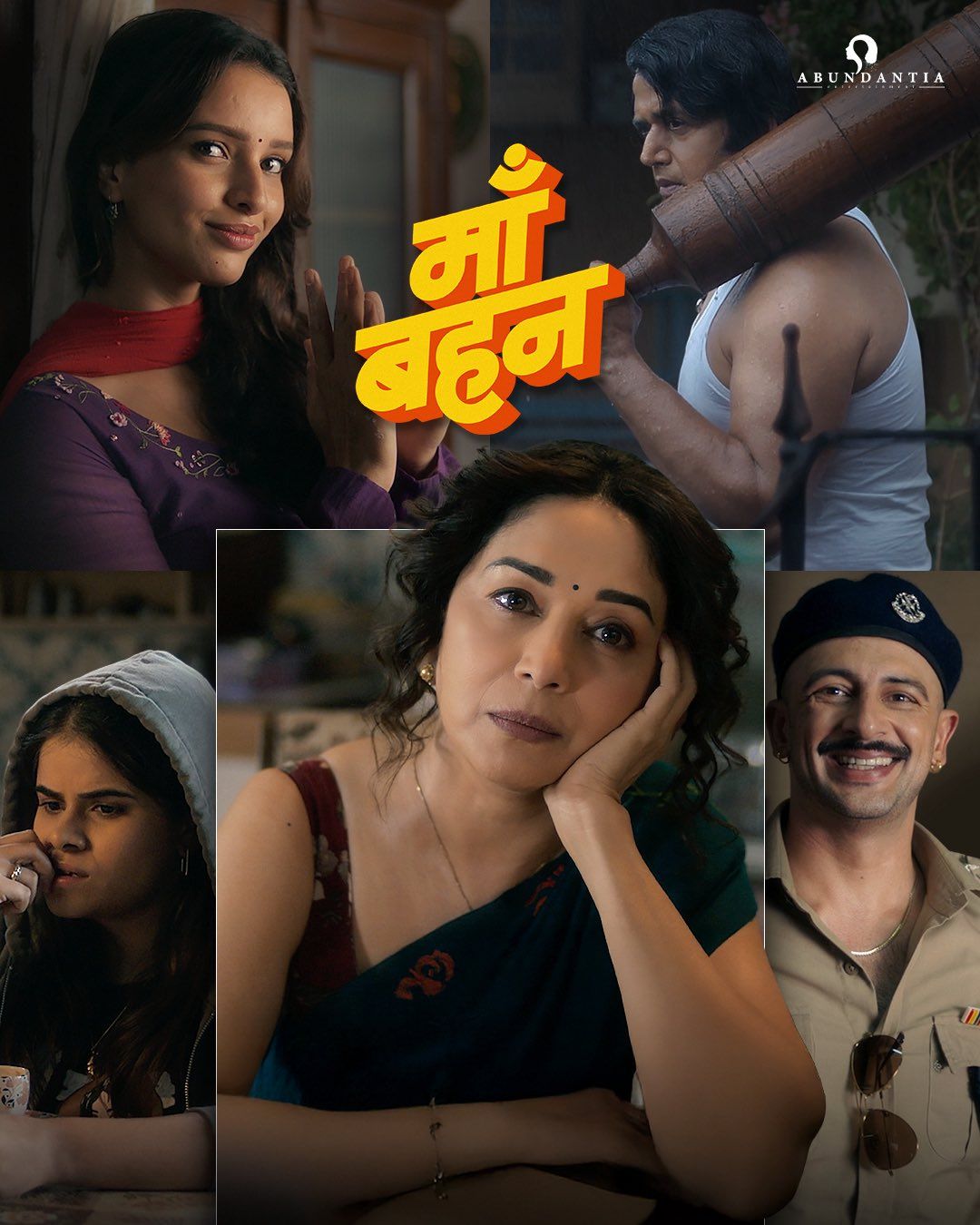
Just like the recently released film Shape Of Momo (2026), there is a clear subtext of patriarchy at the start of the new Hindi film Maa Behen, almost distinguishing the reality of the characters from the perceived reality of the society. In a scene, you see Jaya (Triptii Dimri) quietly making way to a clinic, in order to opt for an IVF procedure without her husband’s knowledge. Rekha (Madhuri Dixit) remains a women of solitude, quietly living a life of loneliness even while willingly flaunting a sleeveless blouse against the roving eye of the men around her. Sushma (Dharna Durga) is an influencer known to make some rather ‘bold’ content with her brother-in-law Manas (Shardul Bhardwaj) in order to get views, only to get trolled by a certain section of the comments’ section. There is a quiet prevalence of patriarchy in each of the three tales – one involving a voracious independent voice being curbed in a conservative middle-class society, the other ‘prominent’ voice being controlled and silenced inside a conservative household, and third being the centre of ‘lustful’ attention for the middle-aged men of the society, given her status of being single.
Written by Pooja Tolani and Suresh Triveni, Maa Behen utilizes the technique of a black comedy to explore its themes of feminism inside a dysfunctional household. The setting remains that of a humble household of Rekha, that houses the ‘body’ of her neighbour Gupta ji (Ravi Kishan). It is a classic setting of a closed door whodunnit, except that the tone remains dark and frothy – even as Rekha asks for help from her daughters, Jaya and Sushma. The deliberate ad jingle wordplay notwithstanding, the immediate theme remains that of a dysfunctional household – given how the three protagonists never find themselves on the same page. The idea remains to dispose off the body before anyone takes notice, except that a twist of fate includes a wedding in the neighbour, involving the daughter of Gupta.
There are deliberate pulpy tones to the narrative, further accentuated with the frequent ‘local news’ being played out in the form of sensationalism. The meta-ness is in play given how the news itself plays out like a parody of a real-life news show (having the same anchor), that further highlights the roots of hierarchy. And that includes Rekha being a seductress who killed off her husband, had another affair, seduced a neighbour, killed off a bunch of people and buried them in her garden, all while painting her as a witch. The same pulpy nature extends to Sushma and Jaya too – one being that of deliberately creating ‘adult’ content for views, while the other, literally poaching a marriage proposal for herself. Notice how the men in each of these tales have immunity, and are literally painted as saints. So Gupta or Manas have no ill-intentions in the lives of these ladies, only working for the betterment of patriarchy….I mean society.
The character of Rekha instantly reminded me of Rani from Haseen Dillruba (2021), a meta-commentary on how her perception felt eerily similar to the plot of that film. The same can be said for the character of Jaya that felt like the rendition of the wife (Nimisha Sajayan) from the Malayalam film The Great Indian Kitchen (2021) – a character being controlled and suppressed in the name of cooking and taking care of the household activities. And the character of Sushma could be extended to any female influencer who is objectified by the internet, all in the name of views.
A bunch of other characters formulate the fabric of the drama too – a wife who refuses to put the blame on her husband’s antics, a daughter who is on the fence about being married, whilst even doubling up as a troll. A green-flag cop who is just too naive (and madly in love) to understand the dynamics of the characters. So when the focus shifts on the chaos and confusion surrounding the body, there are bouts of laughter in store – particularly, given how the audience remains on the same level as the trio who hold every little secret in the household. The events do get a little convoluted with a subplot involving a stack of cash and a random appearance and disappearance of a character in the middle, but largely, the events are funny and intriguing.
It is interesting on how men are portrayed in this universe – Gupta remains a lecherous figure who wants to showcase to the world that he opposes the idea of infidelity and attraction, whilst discreetly holding to the idea of being seduced by her neighbour – doing his bit also to blackmail her with regards to an FIR or the property in question. Manas on the other hand, is mounted on the idea of entitlement – almost roaming around shirtless in the household to flaunt his privilege while doubting his wife Jaya of having an affair with her childhood friend and cop Maheshwari (Arunoday Singh). And his demands never end – from wanting his wife to cook chicken to expecting her to deliver a boy, even when his sperm count is low!
It is interesting on how the drama accounts for the collective arcs of the protagonists. From being dysfunctional and fragmented at the start to literally joining forces to counter patriarchy – that was an arc in itself. The subtext also remained an important talking point in patriarchy – on how patriarchy thrives and crumbles on fear, where the word fear is interchangeable for the two genders. The moment you call out patriarchy, it loses its foundation, and the moment you don’t, it tries to control your voice.
The same is reflected through a hilarious series of incidents in the final act that centers on this fundamental thought. And so in hindsight, the ‘body’ itself is a metaphor for patriarchy that would always continue to wake up until women take the matter in their own hands. It is pulpy and really well showcased in a screenplay that excels in bouts of black comedy.
The dialogues are quirky and pulpy while presented a handful of sequences that are dipped in laughter, while adding authenticity with the dialect being employed. And yet, the theme of patriarchy often forms a connective thread here – even as a female character tells another on how she continues to wear sleeveless blouses at this age. The deep rooted traits of the say are gently explored through the lines. The music needed a significant upgrade to have an impact on the proceedings, even though it does the playful element of the drama right. The BGM though does its bit to create an ambience of intrigue and mystery, while also holding onto the quirks with respect to its humour.
The cinematography has a deep focus on the chaos that ensues inside the vicinity of the household, and the neighbour of the characters. It uses a dual lighting technique of keeping things bright in the events that transpire in broad daylight – portraying a clear picture of the patriarchy being engrained in every household. This, while balancing it with pulpy shades of darkness amidst the shadowy household of the protagonist. The duality represents the dual themes in play – one of patriarchy and the othet that of pulp fiction.
The editing pattern is frantic, always keen on moving the needle of narration ahead by employing faster cuts that cater to a smaller attention span. And despite some moments of lag in the middle when even the writing gets a little convoluted, but the idea of keeping the themes of the drama intact along with its set of emotions from one scene to another, meant that the editing was pretty good.
Director Suresh Triveni approaches the narrative style like a small experiment – often balancing the themes of patriarchy with pulp fiction, and infusing his characters in situations that are hilarious while being christened with dark humour. I liked how he maintained the tone of the drama that could so easily have gone awry. Yes, things did get slightly more convoluted for my liking but the direction remained assured for most parts of the runtime.
The performances are wonderful by the members of the cast. Paresh Rawal, Jatin Sarna, Arpit Singh and Vijay Maurya have their moments to shine. Shrivardhan Trivedi playing a meta-version of himself is hilarious to the core, and a classic case of a great casting choice. Rrama Sharma as Goldie has a solid screen presence while acing her one-liners with an unbeatable comic timing that had me in splits. She is tremendous to witness here. Geetanjali Kulkarni as Guptayein is a delight to watch, possessing the snoopy traits of a neighbour while brushing the antics of her husband aside. The humour lies in this very trait of hers, and it makes for a lovely watch.
Arunoday Singh as Maheshwari and Shardul Bhardwaj as Manas are characters on the opposite side of the spectrum of patriarchy. While the former is affable and has traits of a green flag, the latter has a deliberate annoying quality that christens his character. Both of them manage to impress here, while delivering wonderful performances. Ravi Kishan as Gupta is a snarly character with malicious intentions, and he adds shades of smugness and a sinister energy that effectively conveys his plight. There aren’t many redemptions to his character, and that is also reflective of a wonderful performance by an absolute veteran.
Dharna Durga as Sushma makes a confident debut here while accounting for several bouts of humour rather effectively, while being an accurate representative of her age demographic in the film. And given that she is an influencer in real life too, it remained another smart casting decision.
Triptii Dimri as Jaya has a tremendous screen-presence with a natural flair for comedy that reflects ably in her effortless act. Her ability to understand the degree of humour while also accounting for a strong emotional core pertaining to her character, meant that this performance remained powerful. Jeez, this remains her best performance since Bulbbul (2020).
Madhuri Dixit as Rekha is a character perceived and modelled as a femme fatale by the society, and she flaunts that persona wonderfully well. There are layers to her character – even as she remains flawed and isolated, but possessing a specific trait of caring for her two daughters. And she uses her body language and expressions to great effect in communicating these traits, even while acing in moments of intensity and humour that are sprinkled through the narrative. She is brilliant as ever here, even when she doesn’t fully get a chance to flash her iconic disarming smile!
Featuring solid performances, Maa Behen is a heady mix of patriarchy and pulp fiction, which mixed with subtle bouts of dark humour and unapologetic moments of chaos make for a wonderful watch. Available on Netflix!


