

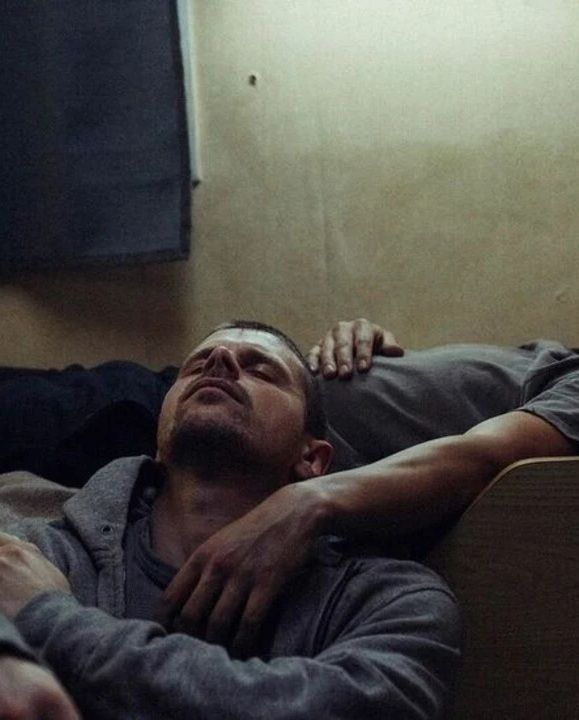
There is an air of stillness at the start of the film Labrador – Autopsy Of Silence, something that is calming and deafening at the same time. So when you are first introduced to Alupa (Christopher Angatookalook), you see him hunting a seal in a setting of ice that remains a metaphor of isolation. For him in hindsight, it would mean escapism from everything that he may have faced up until that point – almost isolating himself in a setting that remains in sync with his purpose. It is a meditative start in many ways that offers only moments of respite for the protagonist, even as the viewers are blinded of his previous action – probably just being presented with his whiff of grief along the way, even as you witness a scene involving the cops present at his door step. The crime isn’t known, but what the viewers are subjected to is a heavy atmosphere that is symbolic of his mindset, even as another character asks him to ‘tell them the truth’ – the truth that is stranger than fiction, in this case.
Written by Rodrigue Jean, Labrador – Autopsy Of Silence plays out in reverse chronology, wherein the cold open is followed by a change of setting – specifically a ship that also acts as an epitome of isolation. The sea of uncertainty acts as a prelude, even as you are (re)introduced to the characters, Alex (Alexandre Landry) – the ship’s cook, Michelle (Gabrielle Poulin) – the first officer, Dhaliwal (Jassinth Thiagarajah) – the assistant cook, and Alupa – a ship mechanic belonging to the Inuit community that are a part of an indigenous tribe of the far north. The cultural bias plays an important role in defining the hierarchy of the ship, although the subtext remains unsaid at the start.
The core dynamic in focus remains a lustful triangle between Alupa, Michelle and Alex. A scene in the first act is enough to establish the same – wherein you spot the closeness between Alupa and Alex in what is seemingly a queer relationship, before Michelle imposes her attraction on Alex. There is definitely an air of authority that engulfs the character of Michelle, even while she enforces s*xual favours on Alex during multiple instances, even while Alupa remains sidelined. In a scene, you literally see her sending a character out of the room on the pretext of his help needed elsewhere, just so that she could enforce a s*xual encounter with Alex during the period. The power dynamics is aptly hinted at, during this phase.
The setting almost reminded me of the Agatha Christie classic ‘Death On The Nile’, wherein the core conflict remained a whodunnit. The trajectory of the drama takes a different turn here, almost treating this whodunnit as a subplot – particularly after the apparent murder of Alex, while willing to focus on the systemic and racial bias towards a particular character. The writing is designed to tap into the underlying bias of the viewers too – almost allowing the viewers to form a judgment towards a particular character, just based on his stature and cultural background, much like the cops who do the same without searching for real clues.
The proceedings are a slow burn, and they will demand your patience. But this isn’t necessarily a flaw given how it allows you to account for every ounce of emotions on display, with respect to a character who continues to silently carry a mountain of grief without allowing his emotions to come to the fore. This includes enduring a torturous interrogation, even as you witness a searing commentary on the crumbling system of law that is designed to prove his crime rather than just seek for the truth. The lesser bias is also towards Dhaliwal who also doesn’t spill the beans, given the power dynamic that he is accustomed to. Hence in many ways, the metaphor with respect to the title extends to all its characters – all of whom know the truth but each one is maintaining a bout of silence for varied reasons.
There is also a layer of secrecy that is maintained by Alupa, with regards to his queer relationship with Alex – particularly given the plight of his cousin sister (Arsaniq Deer) who is ostracized by her community, while living under a bridge. You see the protagonist being isolated, much like a ship in the middle of a sea – surrounded by water (read: obstacles), and nowhere to go. In the meanwhile, the whodunnit element is fairly predictable, and probably designed to be so – just so that the larger context of a racial bias amidst a sea of power dynamics is even more prevalent. And hence by the end of things, you feel a sense of hollowness and empathy towards a particular character, even while realising that the cold open at the start is actually the ending of the film – even while the character is immersed in a sea of grief. The screenplay is well written here.
The dialogues are designed to be unhurried while being in sync with the meditative tone of the drama, only meant for driving conversations and setting subtle bouts of context to the proceedings. The BGM uses silence as a means of grief, unwilling to fill the white noise with notes of melancholy, while putting relying on the immersive mood to convey the heaviness and the grief of the protagonist.
The cinematography comprises of beautiful wide-shots with hues of grey that act as a metaphor for endlessly bouts of isolation and grief, without a light at the end of the tunnel. There is a hint of sadness presented amidst the meditative frames, that carves a sense of hollowness within you. The editing pattern is deliberately unhurried, something that demands your patience in order to feel a sense of melancholy that is in sync with that felt by the protagonist. Having said that, I couldn’t help but deliberate on a minor sense of lag that could have been accounted for, in order to serve up a crisper runtime given the format.
Director Rodrigue Jean presents a world with hopeless possibilities, even while christening it as a whodunnit. The deeper set of emotions offer a dimensional depth to the proceedings, even as the filmmaker keenly explores the waves of grief with respect to hia protagonist in what felt like a character study of sorts. There is purpose mixed with precision to his craft that allows you space to invest in the fractured journey of the protagonist, while ending up with a hollow feeling at the end. The direction was brilliant here.
The performances are wonderful by the members of the cast. Arsaniq Deer as the protagonist’s cousin is dealing with issues of her own, and in a way finds herself in an alternate battle of grief and identity. She remains understated while putting forth a fine act. Jassinth Thiagarajah as Dhaliwal has a grounded presence, in a character that wishes to use silence to his advantage, as opposed to doing the right thing. And the slender feeling of regret is wonderfully expressed in a sincere performance.
Gabrielle Poulin as Michelle has a sinister presence, while being an epitome of a twisted yet authoritive power dynamic. And she brings forth these complex emotions with a lot of restraint, while putting forth a commendable act. Alexandre Landry as Alex is earnest and tender, while often being a voiceless figure in the wake of absolute power on the ship. Alternately, he also is presented as a cutout of grief for the protagonist, and he brings some wonderful emotions to the table with a wonderfully lingering act. Christopher Angatookalook as Alupa is an emblem of grief in a different crisis of racial bias along with streaks of an identity issue. These were complex emotions to pull off, and he brings such finesse and restraint to his act, almost prompting you to invest in his emotional journey on cue.
As a part of our Tribeca Film Festival coverage, the Winner of the Best International Narrative Feature, Labrador – Autopsy Of Silence is a moving drama of grief and isolation disguised as a searing whodunnit. Featuring solid performances, thia film makes for a brilliant watch. Highly Recommended!


