

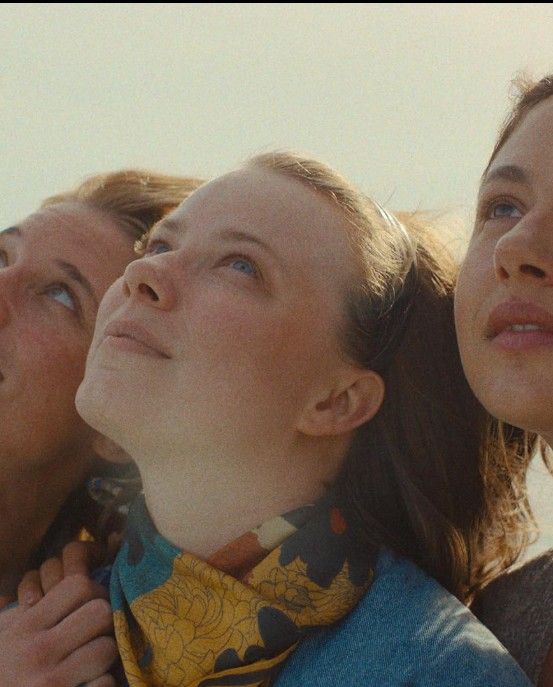
There is a streak of a strong female friendship that you witness very early in the film I Spy With My Little Eye, even as the younger version of the three protagonists sit under the blue sky while staring at it for hours. There is a hint of fulfillment – something that would be short-lived, even as you witness a strong bond that would ultimately be tested with time. In the same breath, the metaphor with respect to the title of the film also becomes evident with regards to the character of Solveigh (Merle Staacken). At various instances in the film, you see a happier version of her, atleast from the outside – something that successfully hides her fractured psyche. She remains depressed internally without really showcases it to the world, or even her friends and family – something that further fuels the irony of the title. Hence, the journey of coping after a sudden tragedy is largely restricted to folks around her including her two friends Lou (Svenja Jung) and Yalda (Soma Pysall) who are left to mourn in isolation, whilst having to decide on the legal future of Solveigh’s five year old daughter. This remains another contrasting theme employed in the narrative – a stark difference from its cold open, just as a reminder on how quickly life can change.
Written by Judith Rose Gyabaah, I Spy With My Little Eye acts as a deep examination of catharsis through the characters of Lou and Yalda, who are left to mourn the tragic suicide of their friend Solveigh. In fact, the setting is centered around clearing the house of their late friend – who has left behind a plethora of memories in a sea of grief. It is interesting to note on how life has odd habits of reminding you of the person, long after that person has left us. Be it a whiff of perfume, or an empty cot – each of which could be associated with a memory that invariably transitions into a bout of grief.
The screenplay treats Solveigh as a character study, presented her in apparently her happiest self while slowly peeling off the layers with regards to her personality. One instance remains that of eating disorder which is an early sign of her deteriorating mental space. But the primary dynamic is her rocky relationship with her mother, being emotionally distant with her as an undercurrent. In a scene, you see the character of the mother continuing to be detached during the burial ceremony of her daughter by saying on how she had only one daughter, and now nothing remains of her – without acknowledging the fact that she still has a granddaughter who is now parentless. This also explains the subtle and less evident rebellious streak of Solveigh in wanting to keep her child, after an affair with an exchange student – something that would invariably push her further into a bout of depression.
The writing also focuses on the dynamic between Lou and Yalda, who have grown distant with each other following the tragic incident. The primary conflict remains the custody of their friend’s five year old daughter that adds to the heavy burden of grief that both characters are subjected to. It is clear that grief is relatively new to both the protagonists, even as both are gently developing a coping mechanism of their own. Interestingly, the end goal of acceptance remains common but oblivious to them in the moment.
There is a pivotal moment in their relationship that is ably represented in a moving kitchen scene, wherein the breaking of a glass starts off with a confrontation only to lead to a resolution. Here, the scene itself acts as a metaphor of waking up from slumber and learning the art of acceptance and working together towards a feasible resolution. The subtext remains that of an unbreakable female bond that might be tested over a period of time, but always results in a bout of solidarity towards the end – even as both protagonists work towards an amicable resolution of being legal guardians of their friend’s daughter. The screenplay is moving and heartfelt in many ways.
The dialogues are minimalistic even while beautifully highlighting the themes of loss, grief and memory through its impactful frames, that speak a thousand words. The BGM wonderfully uses silence as a coping mechanism for the characters, while alao accounting for the emotional plight of the characters along the way. The cinematography ably uses frames to convey a sense of pathos. Be it the shadowy frames in the interiors of Solveigh’s home with the use of softer lights that showcases a mix of grief and memory, or the ghostly camera setup that offers a deep-dive into the psyche of the characters while transforming the viewer into a silent by-stander.
The editing pattern offers a lingering presence without interrupting the flow of the drama, even while successfully accounting a transfer of emotions from one scene to another. Director Alisa Kolosova gently weaves a tale of mourning laced with grief and loss, while also offering a sense of hope in a transformative writing arc of sorts. The non-linear narrative offers contrasting shades to the personalities of her characters, while also layering the drama with a deep sense of melancholy that is presented as a series of powerful memories. The direction ia quietly powerful while leaving a lasting impression.
The performances are wonderful by the members of the cast. Katharina Leonore Goebel has her moments to shine. Marlen A as Sina represents a young character that might be scarred very early in life, while being stripped off her innocence. And, she does a fine job here in representing the same at such a young age. Meret Becker embodies the emotional void and distance that her character possesses with regards to her daughter, with grace while putting forth a commendable act. Luise Landau as younger version of Lou accounts for naivety along with a deep subtext of emotions, and she does manage to impress. Saskia Rosendahl as Solveigh brings an understated gravitas to her character in terms of the turmoil and emotions, and she does a superb job here.
Soma Pysall as Yalda and Svenja Jung as Lou are similar characters dealing with similar emotions, but each of them have a different coping mechanism to deal with. Both of them are wonderfully understated while accounting for a deeper sense of emotions through their heartfelt expressions and body language that drive the characters. They are brilliant as ever in the drama.
As part of our Tribeca Film Festival coverage, I Spy With My Little Eye stands out as a heartfelt ode to loss, grief, and memory. The film beautifully captures the heavy weight of mourning, yet it is punctuated by unexpected streaks of hope. These uplifting moments turn a potentially heavy story into a poignant, bittersweet watch, proving that memory can heal just as much as it hurts. Highly Recommended!


