
The antiparallel themes are evident in the new English film Good Luck, Have Fun, Don’t Die with respect to yesteryear’s film Terminator 2: Judgment Day (1991). In an early scene, you are acquainted to an unfamiliar and unnamed Man From The Future (Sam Rockwell) who enters a diner only to have warning shots fired with respect to AI. He is distinctly different from the Terminator (Arnold Schwarzenegger), not having a commanding personality to invest in whilst resembling a person found on the fringes of the streets that you may walk past, unaffected. And funnily, the dark humour sprouted is in the opening act itself – with the humans being pitted against AI, or in specific words of The Man who tells you the kind of damage already carried out in future.
While the premise would resemble a picture straight out of Doctor Strange’s vision, on the permutations and combinations of tackling AI – particularly given how The Man asks for volunteers to help him out plugin a protocol and ‘Save Humanity’, the setting eerily represents the era of today. As things stand, even Thanos may have lost his job to AI who is staring right in the face of mankind, even as rules and regulations aren’t implemented and the fear of AI taking over the world has lead to major fluctuations in the geo-political setup of the world. Oh and no place for Aliens, and a random AI Summit too – that would feature an imported robotic dog. Oh my dog…ummm God (typo (hypothetically) courtsey: ChatGPT; would you boyco(o)t it too?), please save us!
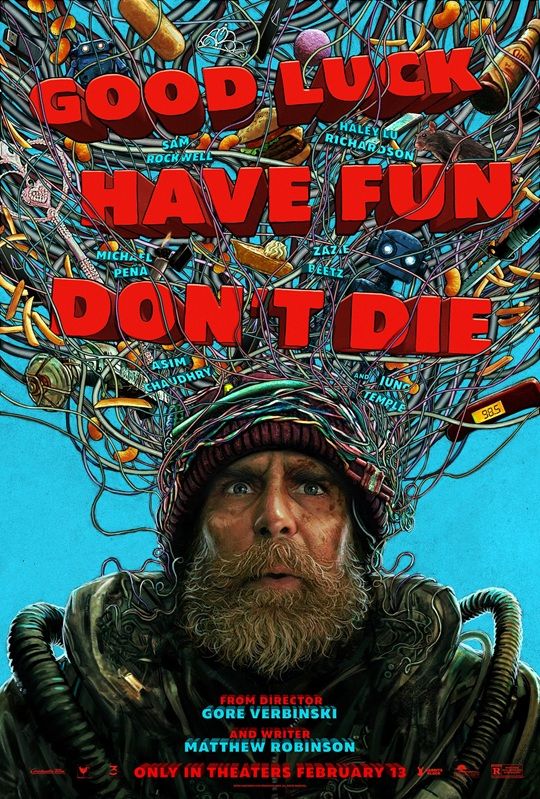
Written by Matthew Robinson, the title of the film Good Luck Have Fun Dont Die is a direct satire on the salutations you may have experienced in the gaming world. Instantly, the demarcation is carved in – on how human life exists between two worlds now, the real and the virtual world. And given that the latter is virtual in nature, much of the issues with respect to pain in the physical sense, or living in a cage is reduced – instantly forming a medium of escapism. And this form of escapism here is divided into mini-chapters with respect to individual characters, thereby resembling mini episodes of the show Black Mirror.
The non-linear flashback-flashforward kind of a narrative may have been a tricky proposition on paper, but the writing allows you to thoroughly invest you in the proceedings and the characters, whose lives are satires in the era of AI. For instance, Mark (Michael Pena) and Janet (Zazie Beetz) are teachers at a school wherein children are consumed by technology. In a scene, you witness robotic replies to the questions posed by Mark wherein not a single student wishes to apply brains in the AI-era. This, even as the teachers have been going on ‘sabbatical’ – a direct metaphor of AI taking over the education system.
Likewise when you are introduced to Susan (Juno Temple), she has just lost her son during a school shootout. But oddly, the parents having suffered similar bouts of tragedy casually offer her a reference of a company that would create an AI replica of her son. Moreover in another scene, you see Susan being witness to an odd story of a couple who had lost their daughter ‘twice’ during multiple shootouts – one of them being a clone which they re-replicated to make her ‘taller’, ‘Muslim’ and a ‘racist’, making you question their scale of morality whilst also making you ponder on the ability of individuals to look for quick solutions as getting to the root cause of the issue.
In that sense, both the journeys of The Man and Ingrid (Haley Lu Richardson) are personal – both having lost their loved ones to AI and the virtual world respectively. These specific set-pieces are sprinkled with dark humour in the current timeline, almost giving you a bird’s eye view of a video game wherein characters have to essentially go from Point A to Point B respectively. And in a way if I am comparing this to a video game like Mario filled with obstacles, then that is exactly the issue being addressed by the protagonist.
As per him, the virtual world headed by AI is essentially taking over the real world – with most heads being immersed in technology, almost similar to an endless bout of hypnotism that would disconnect us from the real world. Ironically, the bunch of obstacles also feel being pulled out of a video game and air-dropped in the arena – a giant man-eating cat, a bunch of masked thugs, an army of teenagers connected to their cellphones to name a few.
The film did minutely lose its steam in the final act that felt like essential leftovers from Tron: Ares (2025) featuring AI creating a hellish environment with wires, along with a boy controlling the events. The twists and turns are intact, even as the bodies keep piling up – but the zing resembling Everything Everywhere All At Once (2023) that was prevalent in the first two acts, slightly tapers out towards the end.
Nevertheless, the haunting outro offers another little layer to the proceedings – almost like a parting reminder to the havoc that AI has caused, and with its endless possibilities that it has to offer in future. It is poetic on how the only way to survive remains on detesting technology, much like Ingrid who suffers from an infection of sorts.
The dialogues are quirky, transforming tense moments of uncertainty into moments of laughter through the dark humour sprinkled in the narrative. In that sense, the proceedings could be termed as a horror-comedy too with streaks of sci-fi injected in the narrative through the lines. The BGM maintains the levels of tension while also catering to the bouts of uncertainty and unpredictability – two important cogs that drive the narrative. The cinematography offers two contrasting shades – each tagged to the flashbacks and flashforwards respectively. The flashbacks have a brighter tone to the frames, almost giving you an idea of the nascent stage of technology (ironically in one sequence, you see a character talking about the ‘missing’ sunlight too). This, while offering a greyish outlook to the current timeline almost depicting the harsh realities of AI while doubling up as a metaphor for its unpredictability.
The editing pattern on paper was a tricky proposition with frequent flashbacks and flashforwards incorporated. But the fast cuts tend to keep the flashbacks short and crisp while never losing sight of the broader issues on show in the current timeline. Director Gore Verbinski manages to maintain a firm grip on the narrative, that is eerily relatable, haunting and unpredictable in nature. His mastery lies in seamlessly transitioning through the varied tones in the narrative, without compromising on the larger conflict in play. As a result, the satire in place is delicious despite a minor stumble towards the end wherein the director leaves a lasting impression.
The performances are pretty solid by the members of the cast. Daniel Barnett as Bob and Georgia Goodman as Marie offer hilarious moments in their performances that are commendable to witness, despite a short screentime. Artie Wilkinson-Hunt as the AI Boy is intimidating while managing to put forth a wonderful act. Riccardo Drayton as Darren and Tom Taylor as Tim are first rate. Asim Chaudhry as Scott ably adds to the humour in the narrative with subtle bouts of intensity sprinkled in the narrative. Michael Pena as Mark and Zazie Beetz as Janet are sincere while complimenting the quirky tone of the narratively wonderfully well.
Juno Temple as Susan does a fine job here, representing her internal conflict of loss with a lot of flair. Haley Lu Richardson as Ingrid falls in the same category as Juno, whilst pulling off her character with a raw sense of energy while also accounting for bouts of restraint along the way. Sam Rockwell as The Man From The Future (notice how his name and identity remains irrelevant here in the AI era) plays to the galleries with bold and quirky swipes, while maintaining a playful yet urgent gaze to the unpredictable future that is staring right back at us. He is a bag full of energy whilst keeping his emotional conflict at play, thereby going all out with his raw but quirky body language. He was a treat to witness here.
Good Luck Have Fun Don’t Die is an insanely hilarious Sci-Fi comedy wrapped in a stellar Anti-AI narrative that makes for a wonderful watch with quirky undertones. Available in a theatre near you.


