

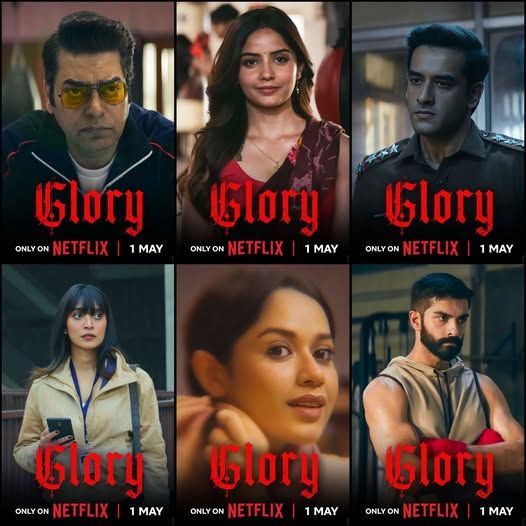
The contrasting genres are evident right at the start of the new Hindi Netflix show Glory, even as you witness a character getting ready for his boxing match in one scene, only for the focus to shift on an eloping couple in the next scene, brutally attacked by a group of masked men. The algorithmic spike is there for everyone to see at the start – he is brutally murdered, she is badly injured, and an interesting premise to kickstart the narrative. It is also interesting on how there is no context given to the world at the start – just a brief subverting genres of sports and mystery, something that forms an interesting concoction of sorts. This specific pattern is repeated throughout the narrative – with one genre paving way for another. For instance at the start, you see a family reunion of sorts featuring the two estranged brothers of the injured girl Gudiya (Jannat Zubair) – namely the calm and collected Ravi (Pulkit Samrat) and the hot-headed Dev (Divyenndu) who visit her, and in the process unite with their estranged father Raghubir Singh (Suvinder Vicky). It must be noted on how Raghubir is a national coach of boxing, running a center of his own to cultivate champions – except that his own children couldn’t cope with his methods.
Written by Karan Anshuman and Karmanya Ahuja, the first season of Glory has a hook similar to the other Netflix show Kohrra. Another interesting anecdote being that both Glory and Kohrra are set in the north of India – one in Haryana and the other in Punjab, but the setting remains diabolically distinct. You are witness to Haryana that is more on the lines of Kota on Kota Factory, except with a dash of steroids on offer. The red herrings and shaded hues welcome you on the streets that are showcased to be a factory for boxers. It is further reiterated through one of the characters who claims that 60% of Indian Boxers qualified for the Olympics are from Haryana. And yet, the core goal of Raghubir aspiring his sons to fulfill his Olympic dream, remains a distant reality. But ironically, a family tragedy is what has brought his children together.
The early vibe of Raghubir reminded me of Terence Fletcher (J. K. Simmons) from Whiplash (2014), who would stop at nothing in order to achieve his dream. So in a scene after his daughter has been tragically murdered by an unknown entity in the hospital, he still expects people to come in time for the training. In a way, Raghubir is a distant cousin of Major Iqbal’s Father from Dhurandhar 2 (2026; also essayed by Suvinder Vicky) who would repeatedly hurl abuses at his sons for their incompetence. In the same breath, his two sons have different personalities – the limping Dev remains hot-headed and spritely, often a shadow of Munna from Mirzapur with a lot more grit tagged to his persona. And in a sharp contrast, Ravi is the subdued one, often shown to be murmuring words to control his anger. And ironically, the three of them team up to get to the bottom of the mystery – the masked ‘unknown’ men who happened to kill their family member and her boyfriend.
It is interesting on how the writing uses the mechanism of one genre to drive the narrative of the other genre. For instance, the idea of Ravi getting back into action in the ring isn’t necessarily about his erstwhile suppressed aspirations, but a corridor into getting to the bottom of the mystery involving his sister. In the same breath, Dev’s wrath with regards to his past in the ring featuring his father, circles back to the present wherein he gets a chance to reconcile with him. In that sense, the family dynamics remains an important flame in the narrative, even as the protagonists traverse through the list of suspects in episodes filled with blood and gore.
The characters of this world add a spike to the narrative with their antics – a sincere cop leashed by the system trying to solve the case, his married femme fatale who is attracted to Ravi, a psychotic Don who chooses to flip a digital coin to decide the fate of his victim, a journalist who aides and eventually falls for Dev, a Sarpanch who is madly obsessed with his buffalo (ironically given the name from a minority community even while casteism prevails around it; hilarious😂), Raghubir’s nemesis who is competing with him for his candidate’s Olympic slot, Ravi’s competitor in the ring seething with a streak of revenge, another one awaiting his turn to get even after switching loyalties, and a long list of suspects (and their bodies) that pave a path for the protagonists.
There is a gritty undertone laced with subtle bouts of humour that often keeps you invested in the drama. The one missing link remained the politics of the land that felt diluted and sanitized, even while overlooking the obvious issues related to the caste and female infanticide. The latter is only briefly touched upon, when a character remarks on how she was sold from a neighbouring state by her uncle – a clear subtext of the issue in question, an argument that also could be extended to the lack of female boxers in the academy (as compared to their male counterparts).
There are definite twists and turns with an eye on cohesiveness in the narrative, that doesn’t allow the tonal inconsistencies with respect to the two contrasting genres to kick in (for most parts of the runtime). So even when the two brothers opt for different ambitions – one wishing to go after the murder trail, and the other wishing to fulfill his Olympic ambitions – the tone is evened out due to the cohesive inference that links the characters together. So Ravi isn’t as disconnected from the murder trail, and Dev isn’t too far away from the ring of action – often tied together by emotions.
The slight issue for me remained the revelation in the third act, one that felt simplistic and backed by a mere exposition dump – as opposed to a character stumbling on the truth. And in the same breath, the mystery itself is predictable – a link that can easily be traced back to the earlier episodes. As a result, the impact never spiked at any point. Another drawback remained the creative decision to intercut two parallel storylines – one inside the ring, and the other outside it. That specific sequence didn’t exactly work, while further widening the contrast between the events.
And even though the final revelation was once again spoon-fed to the viewers, I enjoyed the twisty undertones tagged to the same, which despite being predictable felt thrilling nevertheless. And the setup for the next season was a brilliant cliffhanger, thereby summing up the screenplay that is pretty well written.
The dialogues by Vaibhav Vishal add a fizz to the narrative with unhinged lines filled with expletives. Also, the Haryanvi dialect employed through the lines adds a streak of authenticity to the drama with respect to its setting. The music and BGM remain top notch, with notes that add to the zing in the narrative while accounting for the trippy and edgy undertones along the way. In that sense, the sound design adds texture to the proceedings too. The cinematography utilizes a good share of red herrings and hues, to elevate the visual impact of the drama. This invariably accounts for an edgy aftermath tagged to the varied personalities of the characters which in turn, accounted for a twisted emotional core too.
The editing pattern is wonderful with some good use of match cuts (one didn’t land though), and fast cuts that keep the momentum of the drama flowing through and through. This faster edit doesn’t allow you time to think, and steering clear from the potential distractions on offer. Directors Karan Anshuman and Kanishk Varma had a tough task of balancing the twin tonalities of the drama emerging from its contrasting genres. But their attempt to subvert genres is pretty impressive, even while ably ticking boxes with the world building and characterization. The direction while guilty of serving an exposition dump at the end, still manages to impress through the gritty tone it tends to employ – thereby keeping the viewers on their toes. The direction is pretty good here.
The performances are pretty good by the members of the ensemble cast. The veterans Zakir Hussain, Renji Panicker and Yashpal Sharma are a treat to watch, wherein each of the two brings shades of dark humour along the way. Vicky Dutt, Kamaljeet Rana Aankiet Moahan as Shamsher, Yugam Sood as Nihal and Abhishek Thakur as Sunny deliver knockout performances, while accounting for varied shades of intrigue through their performances. Bodhisattva Sharma as Kapil has an edgy streak mixed with caution that he puts to good use in a solid little act. Tanisha Sharma as Sonika, Aika Kumawat as Nishi, Durga Kamboj and Nikita Chandak as Surveen are fine performers, and all of them manage to leave a lasting impression.
Jannat Zubair as Gudiya has an immaculate presence onscreen, and she brings a sense of measured flair and innocence to her character. Sikandar Kher is a lot of fun to witness here, and his eccentric streak is something to watch out for. Ashutosh Rana as Viju is terrific here, although he remains a touch underutilized. Perhaps, his utilization will be better in the next season. Sayani Gupta as Joyna is understated and manages to hold her own, despite the writing not really allowing her character to shine. Kunal Thakur as Raka has a solid screen presence, and he definitely packs a punch with his performance. Manuj Sharma also manages to leave a mark despite a limited screentime.
Vishal Vashishtha as Arvind is sincere and earnest while putting forth a commendable act with twisty undertones. And the latter allows him to tactfully switch personalities (no this isn’t a spoiler) rather effortlessly. Kashmira Pardeshi as Bharti is understated with her demeanor, and she does a stellar job in using his expressions and body language – in a character that can easily be compared to Lady Portia with a wicked twist. She is a treat to witness here.
Suvinder Vicky is such a brilliant actor to witness, someone who always manages to get under the skin of his character. And as Raghubir Singh, he subtly unleashes his ambitious streak while delivering a memorable act that oscillates between being subdued, caring and aggressive. He was a joy to witness here.
Pulkit Samrat as Ravi is pretty good to witness here, particularly in scenes involving his physicality in the ring. He is found a little wanting in emotional scenes, but the impact of his performance is definitely there for everyone to see – in a character that demanded his sweat and blood.
Divyenndu as Dev is outstanding to the core – rather unabashed and unhinged with his demeanor and dialogue delivery, even while accounting for his physicality (read: limp) really well. He remains fiery and punchy with his act, maintaining a rhythm of sorts to maintain the intensity of his character, while managing to deliver a brilliant act.
The first season of Glory is a gritty thriller featuring commendable performances that lands strong punches, thereby making it a solid watch. Available on Netflix.

Review Text Coming Soon
Review Text Coming Soon
Review Text Coming Soon
Review Text Coming Soon
Review Text Coming Soon