

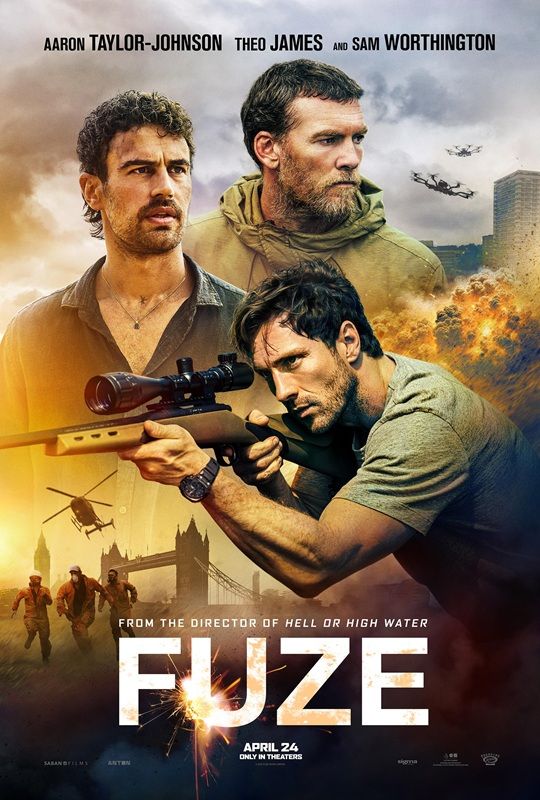
Ten minutes into the new English film Fuze, you understand that there are two movies in one hustling for your attention. One remains that of an unexploded bomb which is discovered at a construction site, and the other being a twisty take on money heist that formulates its share of tension. It is interesting given how both of these can be two distinct sub-genres – a survival thriller constructed right in the middle of a neighbourhood, and the other, a high-octane heist thriller that would keep you on the edge of your seats. Unfortunately, this is exactly the kind of identity-crisis that the film has too – it isn’t sure on which of the two it wishes to be. As a result, what you do end up getting are some cheao thrills – yes, but never a fully-baked thriller that would make you admire the filmmaking or the narrative style. I personally thought that an idea strictly focused on an unexploded bomb had a lot of potential to begin with, something that did not need a heist angle to take the narrative ahead. Imagine – a real-time setup of a discovery of a bomb leading to a survival-situation involving human stakes laced with racism and humanity. In the mix though, was the heist really necessary?
Written by Ben Hopkins, Fuze gets off to a bit of a flyer with a twisty camera zeroing on a construction site that is the ground zero location of an unexploded bomb. The urgency in the drama is palpable, even as the neighbourhood is shown to be emptied. And in many ways, the start is representative of a batter who gets his team to a flyer in a T20 cricket match, only for it to slowdown after the powerplay. The ‘slowdown’ here is more figurative in nature given the inclusion of a heist plot, even before familiarizing the viewers with the characters. And that for me will go down as a flaw with respect to the writing – something that didn’t really focus on the world-building and its characters before introducing a potential conflict. As a result, the emotional core is considerably flattened.
The drama truly peaks in its first act, atleast when the events encircling the bomb transpire. There is a streak of unpredictability around it, given how you are surrounded by many questions – what would be the potential impact of the bomb? How much damage will that cause? Will the people in the neighbourhood survive? These remained palpable questions even as I was acquainted to the characters of the film doubling up in the bomb squad – Tranter (Aaron Taylor-Johnson) and Dootsie (Saffron Hocking) to name a couple.
The idea of intertwining two ‘thrilling’ scripts in one, particularly during the first act meant that peak levels of tension were only restricted at the start. So structurally, the challenge always was to maintain the initial momentum in the drama, specifically after a chain of events that lead to the actual explosion of the bomb. That event also marks a significant turning point in the drama, given how the focus shifts completely to the heist in play – involving a group of men robbing valuables from a bank while using the bomb-scare scenario as a distraction. There isn’t an issue with it given how the writing is expected to structurally align towards a single goal (as opposed to two at the start) – but the deficit was in terms of the thrill factor that never matched up to the first act.
There is a wannabe ‘Money Heist’ streak in play, even as you are introduced to a couple of the characters looking to rob a bank – Karalis (Theo James) and X (Sam Worthington). The issue with each of these characters remains the loss of their identity, or in other words a flattened emotional core that doesn’t really provide you room to invest in their journeys. Remember Money Heist and how every character was memorable (yes that was a show but that doesn’t excuse a film from developing solid characters) ? That angle was missing, only to instead focus on a cat and mouse chase that results only in some cheap thrills.
The events are watchable but at no point was I driven by a high of wanting to know what happens next. And probably the writer may have been aware of this fact – given how he tries introduces a handful of twists, some predictable and others not quite, to maintain the momentum in the drama. But the twisted nature of the script doesn’t always reflect in the proceedings – even as character dynamics begin to change after every twist in play. Unfortunately because there is no emotional core tagged to any character, you don’t particularly root for any of them.
The narrative doesn’t wish to focus on the high-octane car chases which felt refreshing in parts, particularly with the amounts of tensions erupting from the exchanges between characters. But pivotal moments involving important characters dying, wasn’t met with smooth execution – almost underplaying the event to a certain degree. An Argo-esque third act was an even bigger issue here, given how the characters on the right side of the law ended up being mere sketches more than anything else. Somewhere in between, a potent issue around immigrants remained unanswered. And to top it, an epilogue at the end that felt tonally off and from a completely different film. Overall, the screenplay is watchable but nothing that you may have watched already – a solid start that is squandered after the first act.
The dialogues are conversational, and atleast the urgency in the drama is maintained through the lines. The BGM is punky while complimenting the ‘thrilling’ broad strokes in the narrative. It is pivotal in keeping the drama ticking, even with the writing slides. The cinematography comprises of frames that replicates the chaos and the tension pretty well. But if there is one thing missing, then it is the emotional depth, or the lack of it in the drama – particularly with the frames that never allow you to come in close proximity to its characters. As a result, you never get a sneak peek into their psyche, which was an important cog missing in the narrative.
The editing pattern is fast paced with fast interjecting cuts. But I wished the drama had paused in order to build on its world and characters, as opposed to the idea of switching from one event to another. There is a reason why I have labelled it as ‘cheap thrills’ because the thrills itself are hollow and forgettable. Director David Mackenzie delivers a mixed bag here – thrilling in the first act but slipping later on. I am never in favour of the director overlooking the crucial aspects of world building and characterization – something that is missing here, but if included, it may have resulted in a better impact. The idea of focusing on the thrills through and through felt hollow after a point, thereby lowering the impact of the drama. Certain action set-pieces are decent, but if pivotal points in the narrative are underplayed, so much so that their impact is diluted – then you do know that the execution has faltered along the way.
The performances are decent by the members of the cast. Elham Ehsas as Rahim ably showcases his sincerity through his expressions, while putting forth a commendable act. Sam Worthington as X, Shaun Mason as Y and Nabil Elouahabi as Z are decent with their performances, but the writing never allows the characters to fully bloom. Honor Swinton Byrne as Clareese, Saffron Hocking as Dootsie and Gugu Mbatha-Raw as Zuzana are used as mere catalysts in prolonging the drama, as opposed to each of them having something substantial to do. Theo James as Karalis has a solid screen presence while putting forth a good act, although the writing never fully allows you to invest in his journey. The same can be said for Aaron Taylor-Johnson who is decent as Tranter but again letdown by some patchy writing.
Fuze is a middling crime thriller that fails to explode. While it starts off on a promising note and is consistently watchable, the lack of a strong emotional core prevents it from fully elevating the drama, making the film a bit of a mixed bag. Available in a theatre near you.


