

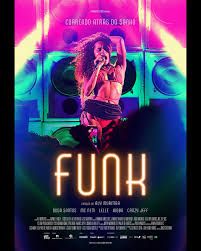
All the world’s a stage in the life of the protagonist MC Sabrina (Duda Santos) in the film Funk, something that you witness right at the beginning of the film. The glittery neon-lit favelas of Brazil being host to a hip adult party, is probably the ideal setting that you would get for a drama that centers around a potential rockstar. But almost immediately, there are layers to be explored while witnessing the protagonist – she is rebellious, free-minded, provocative with her art form and almost committed to extending her personality to her audience. And in the same breath, you would understand the prevalence of cancel culture that she would invariably draw her attention to – while penning some provocatively explicit lyrics of a song, even while enjoying a bout of queer s*x with her friends and acquaintances. In that regard, the start of the film is even more vibrant, while doing its bit to challenge the very notion that defines you – is it right to judge a free-bird who has all the makings of a star while just wanting to have a free-time catering to her own rebellious persona?
Written by Fernando Barcellos, Taisa Machado, and Aly Muritiba, one of the early metaphors of Funk remains the setting – a vibrant favela (houses built on raised structures like mountains in Brazil) that defines the personality of the protagonist. The subtext of poverty has not only made her resilient but also rebellious, challenging the notion of the society in a typical ‘push back’ mechanism. Hence at an instance, you also see her mentioning on her lyrics are even more provocative than her male counterparts – an underlying form of fighting the prevalence of patriarchy in a rather humble setup. For context, think Gully Boy (2019) but with a further provocative undertone of funk.
Sabrina instantly remains a resounding character to witness, given how she isn’t worried about using her art form to raise any pertinent social issues. Her goal is clear – to be rich and famous through her art form, and she would be willing to go to any length in order to achieve it. In a scene, she has no qualms about arguing with a customer and later quitting her job as a waitress, simply because she was racially abused. In fact, that fleeting scene is enough to tell you that her skin doesn’t define her, and she is pretty self-aware about that. You could also term her as an opportunist – a trait that you witness when she spots a famous DJ and a podcaster on a beach, while pitching herself to him in exchange for a video on social media that would help her grow. In another, you see her tactfully gate crashing into his party, only to sway the vibe of it, and make it all the more happening. She definitely remains a star in the making, opting for local gigs to begin with in order to grow.
The drama also focuses on the interpersonal dynamics between the protagonist and the characters around her. For instance, the dynamics between her and her estranged brother who already finds himself on the other side of the law, with MC Sabrina often running into trouble with the cops – even as nothing stops her from borrowing money from him. Or the more important ‘rocky’ bond that she shares with her mother MC Priscila (MC Nem).
It is interesting on how there is immediate friction between the duo – one perhaps due to the slight age difference, and second due to Priscila acting virtually as a mirror for the protagonist on what awaits her if she isn’t careful with stardom or her journey of a funk artist. It must be noted on how Priscila herself was a funk artist who happened to lose her way – thereby wanting to caution her daughter of the same, whilst also briefly being envious of her populatity. Their dynamic also forms a pivotal emotional hinge – from disagreeing to virtually being at loggerheads at each other, to eventually finding a voice of acceptance.
The drama minutely slips with its trajectory that is quite familiar and typical in many ways. This is particularly true in the second hour when the tone of the drama shifts, while focusing on the side-effects of popularity of an artist who is a rebel. My primary criticism lay with respect to its familiarity, as opposed to getting deeper into her psyche. Yes, it wasn’t a complete trainwreck given how the subtext remained that of the professionals of the industry wanting to control her image and tone down her songs – which inadvertently was linked to her identity.
So in a scene, you see Sabrina being held up for allowing street kids to sit in her car – something that would spoil her image. In another, you see the idea of sponsors threatening to pull out of a deal because of her work. In another, she is asked to part ways with her core team comprising of people familiar to her. In that sense, the finale can also be looked upon as a coming-of-age drama starting with naivety and ending with a sense of identity and realisation by the protagonist. The idea of switching the lyrics of the song towards the end, remained a pivotal event of understanding this very trait, while summing up a familiar but resounding underdog story that is provocative and vibrant in the same breath.
The dialogues are raw and often challenging the notion of the viewers with a handful of provocative lines that actually go well in sync with the drama. The music is pretty funky while transforming your screens into mini concerts, something that can also be uncomfortable to witness at times with the bold use of lyrics – but important to define the identity of the protagonist here. The cinematography comprises of frames that dwell on similar grounds – with extreme uncomfortable closeups and low-angle shots that layout the cultural significance of a scene in favela. This, while creating a trippy persona around the protagonist who is dripping wet in this cultural phenomena, so much so that she drives it in the most provocative manner possible. And yet, the frames don’t lose sight of the emotional core of the protagonist, often allowing you sneak peeks into her psyche. The core remains palpable while the exterior remains vibrant, with regards to the frames.
The editing pattern has a sense of urgency while also catering to the vibrancy of the drama. But the smaller form of criticism lies with the fact that the proceedings marginally get episodic in nature, even with the use of homages that showcase progress in the life of the protagonist. Director Aly Muritiba does a pretty good job in building a vibrant and provocative world that shares a symbiotic relationship with the protagonist. He doesn’t compromise on the tone – often maintaining a bold outlook to the proceedings, that are perfectly in sync with the character traits of his characters – thereby adding authenticity to the setting and fuelling the narrative ahead. And while the trajectory remains familiar, he manages to tap into the subtext of identity towards the end that continues to add purpose to the proceedings. The direction is pretty good here.
The performances are pretty good by the members of the cast, although most of the focus stays on the protagonist. The likes of Rafael Delgado as DJ Jorginho and Luana Oliveira have their moments to shine. Claudio Gabriel as the new manager in Sabrina’s life is quietly controlling and he showcases this trait rather well. Kibba and Lelle as the friends in Sabrina’s life are sincere and earnest while putting forth commendable acts. MC Nem as MC Priscila has a layered character with traits of jealousy, care and caution stationed for her daughter, and she uses her expressions and body language to wonderfully portray her vulnerability.
Duda Santos as MC Sabrina remains the star of the show. There is a natural effervescence to her persona that sets the pace of the narrative. She is bold, unhinged and vibrant – all in equal measures, while keeping a tab on her palpable emotional core with a streak of opportunism and uncertainty. The kind of synergy that she brings to her act is infectious, even while delivering a pretty brilliant act that often challenges the notion of the viewers. She was incredible to witness here.
As a part of our Tribeca Film Festival coverage, Funk is a bold, provocative coming-of-age drama that tackles identity with unhinged energy and brilliant performances, delivering a wonderful watch despite its familiar trajectory.


