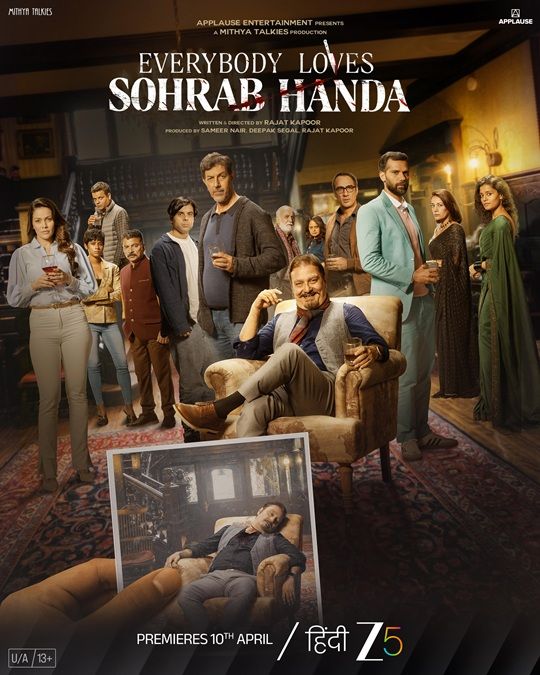

The satiating satire in the new Hindi film Everybody Loves Sohrab Handa is evident in the first two words of the title. If you focus on the second word ‘Loves’, it may give you a superficial evidence of the person concerned being popular. But the more deeper you dig into the narrative, you realise that the shape of love would undergo changes of jealousy, envy and rage, while even transforming into something completely opposite – hatred. The idea remains consistent when you look around in the society – most people in times of social media would ‘choose’ to love in a way that they could ‘hate’ the individual, a complex structure of emotions that always looks for a subtext. It is similar to stardom really – wherein most people admire an artist but are also deeply seething somewhere within. And the crux of this outlook is evident in the film too, that stages itself as a delicious murder mystery with a nod to Agatha Christie – a group of friends meet at a holiday home for a wedding anniversary celebration until one of them is murdered. And needless to say, everyone is a suspect.
Written by Rajat Kapoor, Everybody Loves Sohrab Handa has two versions with respect to its premise – a more conventional setup of a murder mystery involving a police investigation that would remind you of the popular franchise Knives Out. And the other being with respect to its themes and subtext that reminded me of a film like Rajat Kapoor’s Kadakh (2020) – a story involving a couple trying to hide the body of a friend who happened to accidently kill himself. The deviation to the second version is that this still remains a whodunnit – although the themes of a social satire are kept intact in the most unassuming manner possible. And that is wjat elevated the drama to new heights.
The characters make this setup colourful usually, and the screenplay fully rests on the shoulders of these characters. When you are introduced to Sohrab Handa (Vinay Pathak), your first impression of him remains that he is loud and brash. In a scene when asked to slow down, you see him deliberately jerking his car almost to ridicule his co-passengers – a trait that told you that he had a big ego, and didn’t appreciate someone correcting him. And yet, Sohrab remained an interesting character given how he remained the only one from the group to speak his mind, even at the cost of sounding politically incorrect – often calling out instances of pseudo-intellectualism or specific biases with respect to their profession. His behavior remains an aftermath of his traumatic past, while using his brassness as a shield in the present that is enough to annoy people around him. Hence, everybody loved Sohrab Handa on the surface while many (I would imagine) hated him too on the inside.
It is interesting on how the motley group of characters are more vested in praising Sohrab after his death, specifically given how they believe that that is the right thing to do after someone has passed away. Hence you notice traits of political correctness initially when the chief investigating officer Afzal Qureshi (Saurabh Shukla) pays them a visit. In that sense, the non-linear structure of frequently oscillating between the past and the present acts as a reverse engineering medium of opening a can of worms along the way – something that you would usually associate in a film like Monsoon Wedding (2001).
From a broader lens, the satire in play forms an important subtext of where the society stands today. In a scene, you see a face-off between Sohrab and his friend Madhavan (Ranvir Shorey) who happens to be a teacher. There is a clear difference in ideology driving the conversation, even as one character tries to impose himself on the other. The idea of agreeing to disagree is a thing of the past, even as the end of the argument is more in line with a distraction that transpires in the same scene. The further subtext of the argument remains a face-off between practicality and (pseudo) intellectualism wherein both parties are right and wrong in their own ways.
The approach here is never of a standard whodunnit, instead allowing conversations to brew between the characters. I liked how a psychiatrist essentially an outsider to the group Chandra (Rajat Kapoor) dons the role of an unassuming detective too – with sharp observations about the people around him. And through him, you explore themes of suppressed rage and generational trauma that is applicable to a few characters along the way – often sandwiched between multiple and overlapping conversations. And this is where the writer trusts the intelligence of his viewers, allowing them a space to decipher the subtext that is hidden beneath the conversational chaos doing the rounds – with every character speaking over the other, much like a general household.
One important criticism from the perspective of a whodunnit remains its revelation, that felt too bleak for me. And not to mention that it was abrupt, in a way that one could feel the writer’s block creeping in with its staging – without the idea of wanting to appear cliched. As a result, you are witness to a sudden reveal against the run of play – similar to how a set batter falls a little short of the finishing line. I did buy into the reason here, something that felt increasingly complex and fascinating. But the approach to get there wasn’t the best, thereby marginally lessening the impact of the drama. Having said that, the complexity of the journey is the one to savour in this satiating social satire that scores wonderfully well.
The dialogues comprise of brewing (and overlapping) conversations that add layers of authenticity to the drama, with a dose of dark humour that often takes the shape of a social satire. The sound design doesn’t overpower these conversations with sudden mood shifts, instead catering to the breezy nature of the exchanges often through the use of natural sounds. The cinematography had the task of incorporating quite a few actors in the same frame, thereby allowing the viewers to be a fly on the wall with them. And that is something that is managed expertly, even as the frames do their bit in familiarizing the characters to the viewers.
The editing pattern isn’t entirely smooth while switching between the two timelines. But the transitions didn’t bother me as much as they did with the other weekend release ‘Toh Ti Ani Fuji’ simply because the drama here wasn’t designed to emotionally invest you in any characters (and so it didn’t really matter if the transitions weren’t incorporated). It remained a case of immersing yourself in conversations which worked in the favour of the drama.
Director Rajat Kapoor has a very specific visual language to immerse his viewers through the conversations. Be it Kadakh (2020), Rk/RKay (2022) or even to an extent Aankhon Dekhi (2014), the idea remains on forming a hook through the exchanges while significantly finding bouts of dark humour or satire engrained in between. And here his approach is no different. He doesn’t wish to dwell in the past of every character that would have been a distraction of sorts. Instead, the focus remains in the moment – allowing the personality and backgrounf of his characters to shine here through the conversations that they have. That remained a tricky concept on paper, particularly with the criss-crossing conversations in play, but the prolific filmmaker does wonders with his control and craft without taking the intelligence of his viewers for granted. The direction was amazing here.
The performances are wonderful by the members of the incredible ensemble cast. Mallika Singh as Vijaya and Elgin D’Souza as Rohan have their moments to shine. Mahesh Sharma as Satya is natural to the core in what felt like a very organic act. Saurabh Nayyar as Amar showcases bouts of flair with his antics that subtly touch upon the corruption engrained in the society. Saurabh Shukla as Afzal shows restraint and is wonderfully measured with the exchanges that he is a part of. Kankana Chakraborty as Nazia and Waluscha D’Souza as Neha are such brilliant performers who hold their own, even when the focus isn’t entirely on them. Both of them have a commanding screen presence that just reflects beautifully here.
The veterans like Danish Husain as Kumar and M.K. Raina as Baba are important cogs to the fabric of the drama, and both of them manage to impress. Ranvir Shorey as Madhavan is solid with his outlook with deftly flirting with the pseudo-intellectual traits of his character. He was a treat to witness here. Sadiya Siddiqui as Suman is a veteran of Indian theatre, and it just reflects in the control that she possesses even when she finds herself in the middle of overlapping conversations. Sharat Katariya (Director of Dum Laga Ke Haisha and Sui Dhaaga) also makes his presence felt as Sandeep, making his awkward exchanges amusing to witness.
Rajat Kapoor is a fine actor himself and as Chandra, he is sharp and unassuming while formulating an interesting character that keeps the urgency of a whodunnit alive through his obsetvations (before the actual crime is committed). Koel Purie as Isha is subdued as well while often finding herself in the shadow of her husband Sohrab, a trait that remains consistent through her character. And she taps into this trait with aplomb. Palomi Ghosh as Jayanti is an absolute treat to witness through her effervescent smile and interactions that are impeccable to witness. And yet, there is a faint emotional restraint late in the narrative that flirts with the morality of her husband Raman. She was brilliant as ever here.
Neil Bhoopalam is such an underrated actor, but always on point as far as his performances are concerned. He remains sincere and earnest as Raman, making him umassuming in many ways yet filled with envy that christens his character. It is always a joy to watch Neil in full flow. In the sane breath, Chandrachoor Rai is a phenomenal talent too. And in an extremely complex character, he shines as Arun – exhibiting shades that are subtly dark, almost simmering with an energy that is hard to shake off. He is phenomenal here.
Vinay Pathak is such a versatile actor who can easily mould himself in any specific role. Be it the affable college professor in Hip Hip Hurray (1998) or a helpless dad in a film like Chintu Ka Birthday (2020), or even a wicked sinister character in a film like Emotional Atyachar (2010). Here as Sohrab Handa, he is magnificent to witness here. There are two facets to his character – one that is brash, and the other that questions and calls people out. Vinay finds a balance between both these worlds that invariably caters to the title of the film – everybody loves him like everybody hates him (a uno reverse of a famous song from Delhi Belly). And in times wherein questioning people is frowned upon, and powerful people want no accountability – Sohrab remains an interesting concept. Vinay Pathak is brilliant as ever and an absolute pleasure to witness here.
Despite a stumble at the end, Everybody Loves Sohrab Handa is a satiating social satire veiled as a solid whodunnit, and featuring incredible performances that make for a wonderful watch. Available on Zee5.