

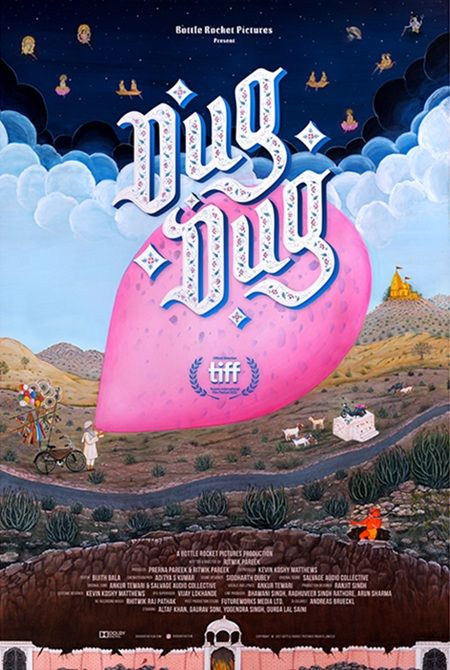
If the title of the new Hindi film Dug Dug were to go by, the central protagonist remains a Luna motorcycle thriving in a small town in Rajasthan. Somewhere in the first act after its master’s sudden death, you see montages of the Dug Dug reappearing at the place of the accident despite being moved, chained and locked up in prison. It remains a very specific instance of an inanimate object being jailed for a ‘crime’ that it was only a witness of – a slender metaphorical reference of how the victim at an accident spot is often heckled. But the indifferent take of resurrection is indeed godly and ghostly in the same breath, as far as the Dug Dug is concerned. In an alternate world, it would be the bike Kabir (John Abraham) committed crimes on in Dhoom (2003). Or even Tarzan The Wonder Car who would silently hunt back the perpetrators after having being haunted by its master in a ghastly but amusing tale of revenge. Or maybe if it were an animal (no, not the one directed by Mr Vanga), it would return to the same spot to wait for its master that ain’t coming back – like in Hachi (2009). Either way, Dug Dug remains a fascinating protagonist that adds mystery and amusement to the proceedings.
Written by Ritwik Pareek, Dug Dug hits the first gear at the start, almost acquainting you with its trippy world that it is set in. Inspired by an incredibly amusing true incident in Rajasthan, you are introduced to the character of Thakur Sa (Altaf Khan) stepping out of a bar on the highway – in what felt like an anti-thesis of a start in terms of its messaging. It is particularly interesting on how the voice-over reminded us of how lightness is aware of the location of darkness, even as the lights turn on at the Dhaba – a reverse arc of a drunkard who thinks he is stepping into light from darkness – a trait that is proved to be fatal. But more importantly, the world feels hypnotic and trippy with a dash of mystery and intrigue even as a motorcycle montage ends on a fatal note.
One of the core themes of the drama remains that of blind faith, a trait that still exists in rural India while being a key contributor to the current political air sweeping the vicinity. The mystery around the Dug Dug is palpable, but also amusing – even as you are witness to the brief histrionics of the villagers in action who begin to ponder upon the ‘mysterious’ existence of the bike, and its ‘pull’ towards its master. The tone remains that of a wicked satire, even as a religious flavour is added to the mix. Before you know it, the general consensus remains of setting up a shrine and pouring alcohol on it (similar to pouring milk on a specific religious figures) – just because the deceased Thakur sa is equated as the Man Of God who has been brought back into their lives to fulfill their promises in exchange for their devotion. It must be noted that Thakur was an alcoholic, breaking traffic rules of drunk driving, leacherous with his antics and a callous individual who died a dog’s death! But this country is all about romanticizing individuals – all in the name of religion I guess?
There is a streak of OMG (2012) from an era that had taught you to even question faith, as opposed to the current era that has taught to accept faith while keeping your eyes shut. The satire is sharp and hilarious – even as you witness the anatomy of a cult, something that is perfectly represented by a character inflating a balloon. The idea isn’t incidental – it is a reminder on milking the ‘business model’ to its absolute hilt while influencing the religious ideologies of people.
The writing effectively uses a series of montages to convey the amusing turn of events that ensue – right from the expansion of the Dug Dug Shrine to a full blown temple, a donation box that generates wealth enough to compete with the GDP of a few nations, the brand-building exercise that expands into daily usables like toothpaste, to full blown inaugurations of universities and schools – all of it ‘branded’ in shades of pink with a dash of blue. I guess pink is the new orange in this alternate world (and the fact that a lotus also has shades of pink in it, is completely coincidental).
From local politicians and businessman joining hands, to the full blown ritualism that would continue to milk the beliefs of the people, the air in the balloon has enough space for all stupidity to co-exist. As a slight form of criticism during this period, the writing did give me an impression that it was running too thin all along – given the over-emphasis on the montages that felt one too many, and a bit repetitive too – particularly as the core conflict was established already. But in its defence, it was entertaining – so, it doesn’t derail the narrative.
While I wished for a little more drama to accompany the narrative, the final act revelation felt as amusing as ever – thereby further emphasizing on the idea of superstition that would have emerged from some quirky instances. In the midst, the focus also shifts on a character who isn’t able to impregnate his wife, while fulling being accustomed to the turn of events around the Dug Dug. And yet, he remains an important figure in the mix given the ultimate transformation handed to him – often being engulfed by the herd mentality without questioning logic even once – and particularly given how he has known the truth all along. ‘Faith’ is a funny ritual if preceded by the word ‘Blind’, but then I digress. The screenplay acts as a reminder on what blind faith can do, even while people refuse to question anything odd that they witness around them. Tragically brilliant, I tell you!
The dialogues are used as fillers here given how most of the film unfolds like a montage, but from a conversational point of view, the lines do leave an impression. Also the idea of having the lines spoken in Rajasthani, adds a sense of authenticity to the drama too. The music by Salvage Audio Collection is trippy and hypnotic, almost contributing to the funky landscape of the drama. In a way, the jazzy beats offer a sharp contrast to the rustic setting, often being perfectly in sync with the core conflict that itself was wacky and quirky to say the least.
The cinematography comprises of frames accompanied by pink and blue hues, that forms a constant thread in the narrative. The frames are wild and hypnotic, but also catered to the quirky satire in play that invariably acts as a source of humour in the narrative. Be it the trippy montage immersed in shades of pink, or some spectacular wide angle shots that incorporates much of the drama in the vicinity – the cinematography is top notch.
The editing pattern is crisp and sharp too, intercutting different events and placing it together in a series of montages that maintains the momentum in the drama. If anything, a couple of montage set-pieces could have been left out on the edit table on the account of repetition, but nevertheless, the editing is pretty trippy here! Director Ritwik Pareek does an incredible job in his debut feature film – ably constructing a hypnotic world, lacing it with quirk, and ultimately stitching it together in a riveting satire. The one missing cog remained the lack of drama in the narrative, but the direction maintains a tempo in the narrative – something that reminded me of Wes Anderson, particularly in terms of the rhythm that you would associate with respect to the proceedings here. The direction is pretty good here.
Given that most of the film unfolds like a montage, the performances are also used as fillers here, and yet each one of them manage to leave a mark. And I am unsure if all the performers here are trained actors, but there is a definite flair tagged to them that make them feel real, and authentic to the world being created around them. Sarvesh Singh as the inspector has his moments to shine. Altaf Khan aa Thakur Sa is pretty solid with his body language, in what felt like an amusing performance that hits all the right beats. Yogendra Singh as Badri and Durgalal Saini as Manfool are terrific performers who manage to hold their own. Gaurav Soni as Pyaare Lal has a small emotional streak tagged to his character, and he uses his angst to good effect here.
Dug Dug features an anatomy of a cult wrapped in a sharp and hilarious religious satire filled with blind faith, that makes for a brilliant and thought-provoking watch. Available in a theatre near you from 8th May 2026 onwards.


