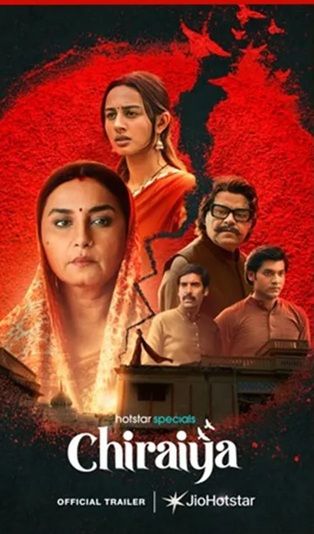

The new Hindi show Chiraiya is not a perfect show by any stretch of imagination. And you get a glimpse of its tone deaf narrative style right from the first frame that introduces you to the protagonist Kamlesh (Divya Dutta) who is shown to literally get into a physical fight for her brother-in-law. That particular scene instantly sticks out like a sore thumb in a drama that otherwise tackles an important social issue of marital r*pe, a topic that is not only ignored over dining table conversations, but also overlooked in the court of law. And yet because the subject matter itself is so relevant, I was willing to give the show a chance that had traces of a saas-bahu opera lacing the narrative for most parts of the runtime.
But to give devil its due, the only reason on how I could justify the melodrama here was the setting. With the drama being set in Lucknow – a tier 2 city seated in the North Of India, the geography becomes an important driving factor in laying down the mental conditions of the characters, wherein patriarchy is a birthright and women are essentially oppressed beings used as mechanisms of satisfaction. And in that regard, I was willing to take that plunge through the gaze of the protagonist who undergoes a metamorphosis of her own.
Written by Divy Nidhi Sharma, one strong trait from a screenplay writing perspective in Chiraiya remains the characterization of Kamlesh. Her name is a direct indication about the prevalence of patriarchy in an Indian household. In the opening reels, you get a stranglehold of her biasness towards her brother-in-law Arun (Siddharth Shaw), almost treating him as her own son. At the same time, you also get a glimpse of her conservative traits – in a scene, she inquires whether a character’s salwar always has a deep cut, or even frowning at the fact that a prospective bride for her ‘son’ flaunts her singing sings with an English song.
It is evident that Kamlesh is used to living in the shadows of her father-in-law (Sanjay Mishra) and her loving husband (Faisal Rashid), the two patriarchial males who have been running the family. The former is a celebrated author often associated with pieces of anti-establishment that gives him a superficial outlook of being a liberal. The latter is genuinely a caring partner, a character that reminded me of Deepak Kumar (Sparsh Shrivastava) from Laapataa Ladies (2023). In fact, there is a fleeting reference of how Kamlesh’s husband hasn’t proposed to her even once – an instance that immediately took me back to the scene involving Deepak gathering all his might to propose his love to his soon-to-be better half in the 2023 film. Hence it is hardly surprising that Kamlesh’s husband doesn’t want her to refer to him as ‘Pinky Ke Papa’.
The character of Pooja (Prasanna Bisht) always makes for an interesting watch. She is educated and has a mind of her own, but isn’t always resilient enough to withstand the s*xual trauma imposed by her husband. In a scene, you see her participating in an LGBTQIA activism drive that is centered around the tagline – ‘I Am More Than My Body’, but is a silent victim of r*pe in a society that normalized marital r*pe. Even when she gathers courage to tell Kamlesh about it, she is slapped across her face given how she has ‘crossed the line’. Oppression remains a pandemic that has engulfed the lives of women – some intentionally, and others with resent. In the same breath, you get a fleeting glimpse of how Pooja’a mother refuses to accept her in the household after marriage, citing s*x as a right for her husband.
It is interesting on how the gaze of the drama is shared between Kamlesh and her daughter Pinky. The latter remains the youngest character but often witness to the ‘crimes’ committed around her, much like the young boy who is witness to the crimes in Assi (2026). But the real metamorphosis takes place when the character Kamlesh has a change of heart, along with the objectivity of differentiating between right and wrong. It is interesting on how she goes from a character who frowns at the idea of being around a ‘libian’ (read : lesbian) to slowly warming up to the sensitivity of a character, and along the way being an emotional support for Pooja.
The issue with the narrative style remains on how it isn’t contend with its understated style that the issue demanded, but literally going hammer and tongs with its messaging. There is an instant flavour of a saas-bahu opera even with some of the antics of Arun, who invariably has no redeeming factors. Remember how the impact in a film like Thappad (2020) was more because Vikram (Pavail Gulati) was quinessentially a good guy while making an unforgiving mistake of slapping his wife? The impact lay in its subtly of showcasing the grey as opposing to being binary while backing it with broad strokes.
There are a couple of fleeting scenes of how a young Arun is witness to the ladies of the house dancing to some raunchy numbers. Or another wherein the morality of Pooja is tested in the wake of how a potential Dowry case can seal the deal for her in-laws particularly given how marital r*pe isn’t considered to be a crime in the eyes of the law. But these moments are sandwiched between tone-deaf layers of patriarchy with such melodramatic subplots that don’t always create an impact. It would be safe to say that the drama loses its sense of sensitivity along the way, making even the flourish at the end, abrupt and preachy despite having a fair impact. But still the subtext itself is so powerful and urgent that it invariably makes for a pondering watch despite its flaws.
The dialogues are slightly melodramatic and bordering on being a caricature, where the approach is always more is never enough. And I don’t quite think this remained the right approach, given the sensitivity of the subject matter. The BGM is decent but also in a way complimenting the melodramatic nature of the drama, as opposed to fully allowing a space to feel the trauma of the victim. Again, a shade of sensitivity was the need of the hour here. The cinematography has a dated tone to it, with frames resembling a saas-bahu opera. Having said that, the frames still fair better in communicating the pain and angst of the characters, providing enough pondering moments along the way.
The editing pattern is basic but it does its bit in keeping the crisp and sharp without any deviations with the subplot. As a result, the length of the drama is in check, something that maintains the focus of the subject matter without being overindulgent. Director Shashant Shah does a decent job in dealing with a rather sensitive subject matter. His biggest miss remains the tone of the drama that often crosses the boundary of melodrama in multiple instances. Maybe a subdued approach would have elevated the impact of the drama even more, but that isn’t the case here. At the same time, his characterization does the trick here in communicating the pain of the characters, and despite the drama being slightly loud, it acts as a crucial conversation starter. In that sense, the direction is pretty decent overall.
The performances are pretty good by the members of the cast. Anjum Saxena has traces of helplessness to her character on the back of years of oppression, and this takes the form of passive aggression here. And she communicates this trait wonderfully well. The same is true for veteran actor Sarita Joshi who is makes a lasting impact here. In a scene, you see her being interrupted for having wedding sweets by her son out of his ‘care’ for her. But the same can be construed as a controlling factor, something that perfectly results in her partially repressed nature. Tinnu Anand as Kamlesh’s grandfather has a righteous presence, and he does a fine job here.
Faisal Rashid as Kamlesh’s husband is understated while having his morals in check. There is a streak of affection that is synonynous to his character, and Faisal puts forth a sincere and earnest act. Siddharth Shaw as Arun will make your blood boil with his antics, something that tells you that he has done a good job here. He cuts out an infuriating and intimidating figure to the character of Pooja, and in that process, Siddharth does a good job here. Sanjay Mishra as Kamlesh’s father-in-law owns a power dynamic of the patriarch of his house, and in that space, you see the character having a commanding screen presence. He is often a character known to hide behind his words, and that remains an effective measure of adding layers to the character who values his power more than his morality.
Prasanna Bisht as Pooja is understated and subdued, often while being at the receiving end of the pain and trauma imposed on her. She uses her body language and expressions to such good effect here that you are always invested in her journey and her emotions. She is a treat to witness here. Divya Dutta as Kamlesh delivers a powerful act while accounting for her character arc filled with questions of morality. From being a blinded spectator to a catalyst for Pooja, the arc contains a plethora of emotions that are linked to the gaze of the drama something which can also be equated to the gaze of the society. Hence, her character is also important in being a conversation starter. And in that regard, she puts forth a commendable act that will double as a mirror for all men by the end of things. She was brilliant as ever here.
Boasting of solid performances, Chiraiya is a flawed social drama but an important conversation starter about an unsaid heinous crime that deserves to be watched and pondered upon. Available on Jiohotstar.