

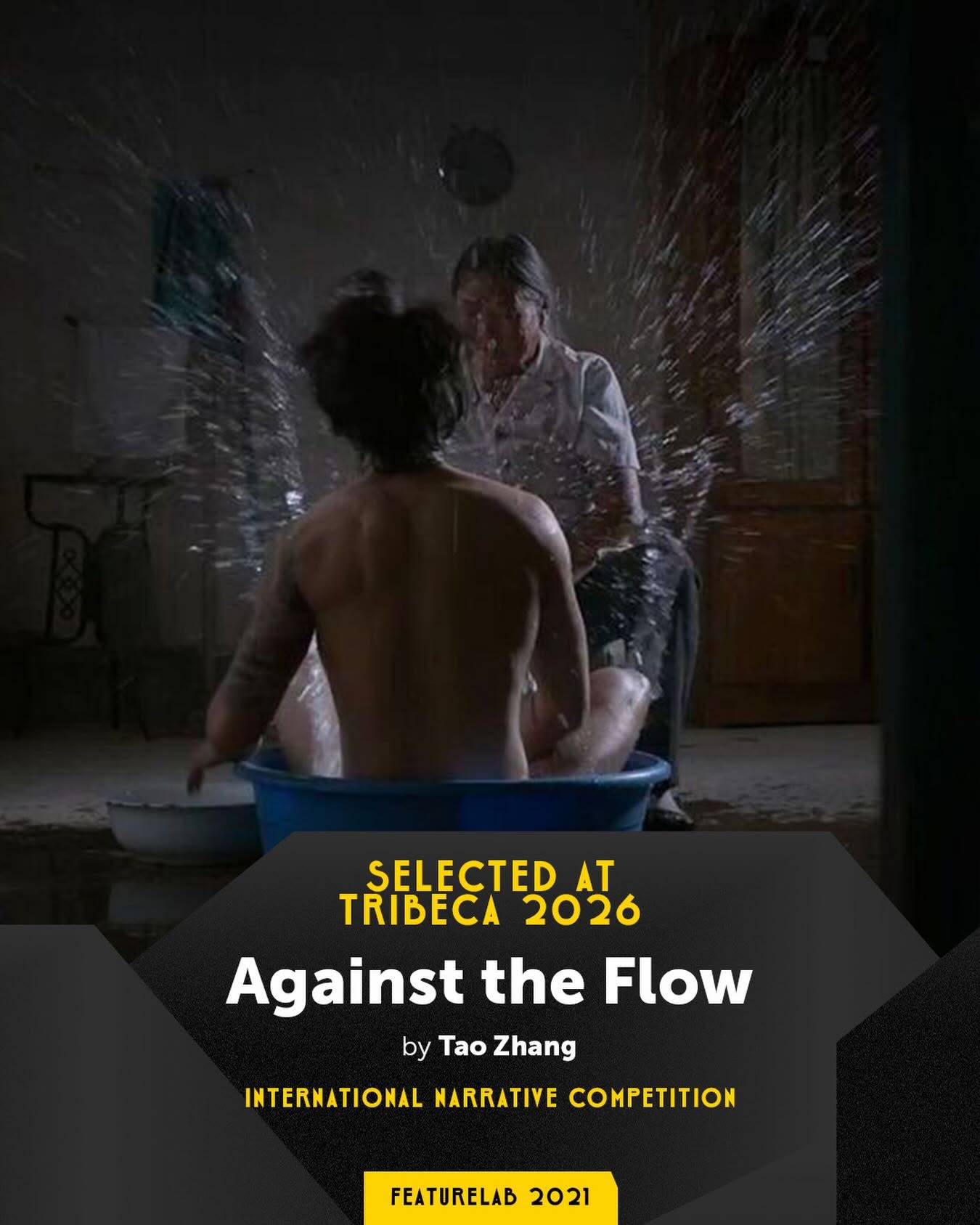
As a part of the cold open of the film Against The Flow, you are witness to a young married couple traversing from the countryside to the city – each of which forming two contrasting landscapes of sorts. In a way, both Dayao (Weihao Xu) and Tiantian (Lu Xingchen) represent the ambitious dreams of many folks who move to the city in order to improve their way of living. But beyond the surface, the reality is different – each of Dayao and Tiantian represent the two distinct landscapes, with the latter who is also pregnant, wanting to make an ambitious living in order to secure a future for her unborn child, while the former associated himself with the countryside and amidst nature. It remains a very specific irony of sorts wherein the trait of opposites attract doesn’t hold true – for one has always got to sacrifice for the other, in order to sustain the harmony of a relationship. In this case, the onus lies on Dayao who is driven by sacrifice, swallowing his own lifestyle in order to start another with his soon-to-be young family. And interestingly, this marks the start of a little conflict in play between the couple.
Written by Tao Zhang and Jeremie Dubois, Against The Flow offers a searing commentary on the working class that is a nod to Ken Loach in many ways – this when almost immediately, you are witness to the early financial struggles of the couple in the urban forest. There is a bleak undertone to it which is perhaps a far cry from the rose-tinted ambitions that may have been harboured by Tiantian, even as she gets a job of working as a cook in a busy city school cafetaria. Likewise, Dayao works at a construction site as a labourer – a blue-collar job that would soon land in a tragedy. And yet, you are witness to Tiantian harbouring an ambition of buying a plush real-estate while asking her husband to save every shilling, something that further widens the gap of affection between the couple. The undertone remains that of tiredness and frustration that are byproducts of the new life of the couple.
The writing here also treats the onset of a tragedy as a metaphor of sorts – leaving Dayao unharmed after a near-fatal accident, while stripping away all his burdens of adulthood. This basically meant that he was an adult reduced to the mentality of a five-year old, in what felt like a role-reversal of sorts for the couple. So suddenly, it is Tiantian who is dumped with the responsibility of the family, even as Dayao resembles a character similar to that of Sean Penn in I Am Sam (2001).
There is an undertone of grimness and pessimism that laces the narrative, something that could possibly disconnect the viewers given that there is no respite at all. The drama offers no symbol of hope whatsoever, even as the writing is quick to denote the new reality of Tiantian along with the consequences of her ambitions, now having to take care of potentially two-children. And it is interesting to note on how the mindset of Tiantian – being forced to go from a sea of ambition to ultimately being a caregiver while having to sacrifice her own ambitions.
In a way, the writing emphasized on the reversal of roles between the two protagonists wherein the responsibility of the family was shifted from Dayao to Tiantian, particularly after the death of the former’s mother. You empathize with the situation, and the characters that remain flawed – one due to his differentially abled condition, and the other on the basis of no emotional or physical support around here.
In that sense, the finale remains an epitome of pessimism while also retaining its poetic undertones with respect to the core traits of the characters – wherein both choose their respective paths of ambition and nature in starkly different ways. It is pondering, meditative and a hard pill to digest, even as the screenplay doesn’t mince its words with a sugar-coated happily ever after. It is practical, judgmental, hard-hitting and nightmarish while also offering a string of hope in what felt like a perfect prequel to I Am Sam (2001).
The dialogues are laden with a sense of heavyness with respect to its pessimistic themes that play out like notes of a horrific symphony. The BGM immerses the drama in silence and unsaid conversations that add emotional gravitas to the situations and the characters. The cinematography layers with drama with hues of grey that perfectly encapsulates the pessimistic nature of the proceedings through its wide frames. This, while alternating it with mid-shots that keep you abreast with the shifting emotional plight of the characters. The editing pattern doesn’t cheat the viewers with sudden cutaways while tapping into the lingering feeling of the drama, something that constantly contributes to the central theme of ongoing pessimism.
Director Tao Zhang build the world on silence and pessimism while tapping into the flawed ambitious mindset of his characters, even while offering an arc of practicality towards the end. The proceedings are grim, wherein the filmmaker creates the worst situation for the characters to thrive in, while showcasing their emotional vulnerability along the way. The lingering feeling of the drama is deliberate, handled wonderfully well even as the filmmaker taps into the complexities of the situation and the characters rather well.
The performances are pretty good by the members of the cast. Catherine Fang as Xiaoying is a pivotal character who acts as a window of ambition for the character of Tiantian to plan on shifting to the main city, and she does a fine job here. Shilan Chen as Dayao’s mother delivers a heartfelt performance, something that lingers on at a pivotal stage in the narrative towards the final act.
Xu Weihao as Dayao has an interesting character arc of essaying a character burdened with sacrifices to completely being stripped off it. There is a streak of innocence that wants you to empathize with his character, whose world suddenly changes. And he does a fine job in conveying his vulnerability in a very different sense, later on in the narrative. Lu Xingchen as Tiantian can be viewed as an ambitious character with selfish undertones to her personality. But the deeper you dwell in her character, the more acquainted you get with her vulnerability and emotions that drive her charactet towards practicality. There is an undertone of pessimism of acknowledging that her decision may have been ‘Against The Flow’ (a metaphor that is applicable to both its protagonists), but her internal conflict remains just that – fighting her situation for her ambitions. This remained a remarkable act that makes for a bittersweet impact.
As part of our Tribeca Film Festival coverage, Against The Flow is an immersive drama that offers a meditative look at ambition, sacrifice, and pessimism, backed by wonderful performances that make for a brilliant watch. Highly Recommended!


