
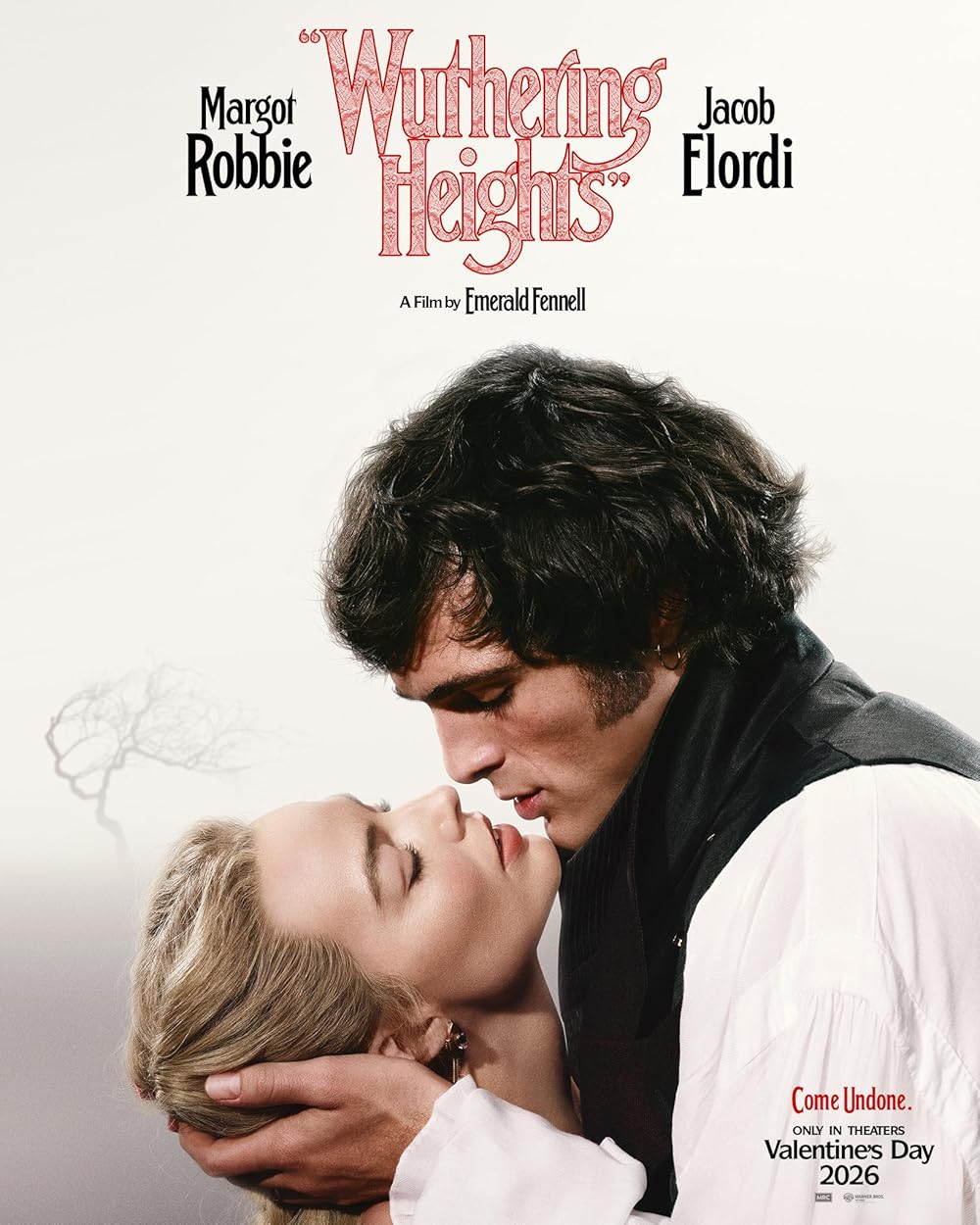
I often look for words to describe a film after I am done watching. These words precede the rating for a film that come into the picture later on, quantifying the words used to describe the piece of art in question. And the words that immediately came to mind after watching the English film Wuthering Heights were Dissociative, Derivative, Unfaithful and Toxic – much of which had got to do with this being a bold reimagining of Emily Bronte’s classic novel by the same name. It is interesting on the number of cinematic renditions that derive their source from the book Wuthering Heights – something being as late as last year’s Materialists. That quality is enough to tell you that the book is a classic, and in the same breath, I don’t really mind filmmakers wanting to reimagine the classic and give it their own voice. It remains similar to a version of a famous dish deconstructed and given a new identity in a Masterchef competition. But as they say – With Greater Power Comes Great Responsibility. In the process of reimagining the original source material, you cannot and should not compromise with its soul, something that would continue to be the USP of the ‘new’ product. And this is where the 2026 rendition of Wuthering Heights stumbles upon.
Adapted from Emily Bronte’s 1847 novel by the same name by Emerald Fennell, the first signs of a ‘loose’ adaptation of Wuthering Heights appear right at the start wherein you are witness to a sound of moaning intercutting with the sounds of creaking. The sound definitely creates a certain kind of kinky image in your head before the picture becomes clearer – the truth is stranger than fiction even as you are welcomed with the sight of a man hanging from a rope struggling for his final breath. In the moment, the filmmaker is clear on the route that she wishes to pave with this adaptation – it is going to be steamy, hot and with amplified levels of toxicity. Ironically, the setting remains that of the Georgian era even when the trending topic of toxicity is specifically targeted at the younger demographic of cinephiles who are oblivious of the original source material. Either I have crossed the passage of toxicity or I am in the minority of folks seeking for complex emotions on celluloid.
One thing that the filmmaker gets right with respect to the original source material is the setting – featuring misty hills covered with thick layers of fog that instantly recreate a gothic outlook to the moors of Yorkshire. But the main issue of the adaptation can be attributed to the characterization that steers away from a sense of ambiguity. For starters, the drama here deviates from the proceedings being narrated by the caretaker Nelly (Hong Chau), instead serving first-hand developments with respect to the characters. You are introduced to Catherine (Margot Robbie) who is acquainted with a young orphan boy Heathcliff (Jacob Elordi) brought in to double up as her pet. It must be noted on how a pivotal character by the name of Hindley (Catherine’s brother) is omitted here, thereby transferring his traits of alcoholism to Catherine’s father Mr Earnshaw (Martin Clunes).
The shallow nature of the drama can be redirected to the character of Heathcliff – a tall, handsome and fair-looking individual who is a far-cry from the dark-skinned version in the original source material. This may seem like a frivolous point at first but the layers of trauma and identity that Heathcliff was subjected to in the novel, doesn’t really come through here. The starting point of the character seems to be one-dimensional – often being at the receiving end of physical abuse after he chooses to take the blame for the mischiefs being carried out by Catherine. In this moment, you do sniff an intense love story around the corner, something that needed to cater to its emotional core more than its physicality.
The themes with respect to social class and power is directly tagged to Catherine who loves Heathcliff a lot but cannot see a future with him because he is poor. In a way, Catherine and Heathcliff are the same individuals in a world that is obsessed with the phrase ‘Opposites Attract’. In a scene, you see Catherine craving for the physical touch of Heathcliff by furiously fingering herself up on the moors. It is an early indication of the obsessive love that would form a full circle, while still catering to her uncertainty with respect to money – something that prompts her to marry a wealthy suitor Edgar Linton (Shazad Latif). This, whilst Heathcliff is heartbroken while feeling betrayed.
The derivatives in the screenplay are as clear as light and day, almost exuding of traces of Hindi films like Rockstar (2011), Dhadkan (2000) and Murder (2004; a remake of The Unfaithful (2002)) to name a few. It is important to note on how the core emotion of longing between Catherine and Heathcliff are traded with bouts of physical intimacy in the most rampant form possible. The latter here doubles up as a homage even as an unhappy Catherine is reintroduced to Heathcliff who is now wealthy. We get no information on how he undergoes this transformation – a la Dev from Dhadkan, while the focus remains on binary traits of intimacy and rage-filled revenge involving Isabelle (Alison Oliver), the sister of Edgar who is married to Heathcliff.
There is definitely a streak of Materialists (2025) too, with the female protagonist being the center of attraction of two men belonging to different classes. And oddly enough, one of them is sidelined in the wake of heavy bouts of intimacy in the second hour. The overuse of these sequences didn’t really allow me to connect with either of the characters who flirted with wild and twisty ambitions but never really took the plunge. In that sense, the screenplay itself isn’t brave enough to branch out into a twisted dirt road of its own – playing it safe with half-baked subplots involving a revenge angle that may have worked in isolation but never really ties itself to the main plot.
The end is also where the biggest flaw of the screenplay is exposed – almost restricting itself to only the first half of the source material while completely discarding the latter half of the book that truly had the generational complexities tagged to its characters. In the same breath, the ending here felt woefully abrupt given how the sudden death of a character leads to an immediate transformation of another character. The events on either side of this event felt disregarded, even though there was a solid attempt put forth to represent an era of love through a homage of imageries at the end.
It was the sort of an ending that didn’t necessarily tap into the emotional beats of the narrative despite being visually appealing, something that will leave you divided with your views. The depth was missing with respect to longing, even as the emphasis remained on multiple s*xual encounters – in what felt like a fourth rendition of Fifty Shades Of Grey.
The dialogues felt far too mechanical for my liking as opposed to being melancholic and heartfelt. If I felt nothing really during the exchanges between the two leads, then much of the issue was with respect to the flat lines catering to the characters. The BGM steers clear of a traditional period score while opting for a lot more intensity through its beats that do their bit in elevating the impact of the drama. The beats of fusion allow for a different ambience to be created – one that blends the gothic atmospherics against the sound of rock. The destructive nature of romance is perfectly encapsulated by the score. The cinematography ably creates a gothic atmosphere of gloom, instantly exuding traits of a Shakespearean tragedy (the Romeo-Juliet reference is a give away too). The frames wonderfully compliment the production design while using the shades of grey and blue against the backdrop of fog and mist, in a perfect recipe for a gothic setting.
The editing pattern remains a mixed bag – at times ably intercutting a searing homage for a particular character, but often doesn’t account for the frequent time leaps that are induced in the narrative. Often in the narrative, the time leaps are left to be assumed as opposed to creating transition shots to switch timelines. In the same breath, it is funny on how the makeup of the ‘aging’ characters just doesn’t change – even with the induction of the multiple time leaps. Director Emerald Fennell definitely tries to reimagine the original source material very differently here, but she isn’t always successful. While her world building remains faithful, the characterization remains flawed and woefully one dimensional, even as the emotional core of the drama is skewed too. As a result, the soul of the drama is compromised, in a narrative that is shallow with binary traits sprinkled throughout. The direction is decent here but it truly lacks the depth of the original source material, something that makes the drama middling in many ways.
The performances are pretty good by the members of the cast despite a clout of controversy spilling with respect to the casting. Owen Cooper (after his iconic act in Adolescence) and Charlotte Mellington as younger versions of Heathcliff and Catherine respectively, have their moments to shine. Martin Clunes as Mr Earnshaw exhibits traits of abuse and alcoholism with a certain sense of finesse. Alison Oliver as Isabelle exhibits a sense of playfulness filled with dark humour in a rather commendable manner. Shazad Latif as Edgar is sincere and earnest while carrying off his act with a dash of panache. Hong Chau as Nelly is excellent despite a compromised written character, leaving an impact despite being reduced in the background for most parts of the runtime. For a character who was the kingpin in terms of the conflict between the two leads, needed a more substantial character – but Hong still uses the minimalistic technique to put forth a commendable act.
Jacob Elordi as Heathcliff might be a one-dimensional character that is cliched in many ways. But he still uses his physicality and charm to woo the viewers, in a character that remained a sharp contrast from his tender act in Frankenstein (2025). Yes, the casting remained an issue wherein much of the layers of the character are taken away. But despite that, Jacob’s performance is quite good to witness here.
Margot Robbie as Catherine was another case of a controversial casting given how her character just doesn’t age through the time leaps, even whilst the writing doesn’t allow her character to mature along the way. Despite that, there is a sense of slyness mixed with toxicity that Margot taps into, something that makes her deliciously complex and always threatening (although the full potential of her character is never realised). She is a treat to watch in a performance wherein she uses her mannerisms and expressions to great effect.
Despite good performances, Wuthering Heights remains an unofficial rendition of Fifty Shades Of Grey veiled as a shallow and ‘unfaithful’ adaptation of the original source material (of the same name) that makes for a middling watch with mixed results. The traits remain binary while the complex emotions remain untapped in a drama that makes a perfect case for style over substance. Available in a theatre near you (from Friday, 13th Feb’26).


