

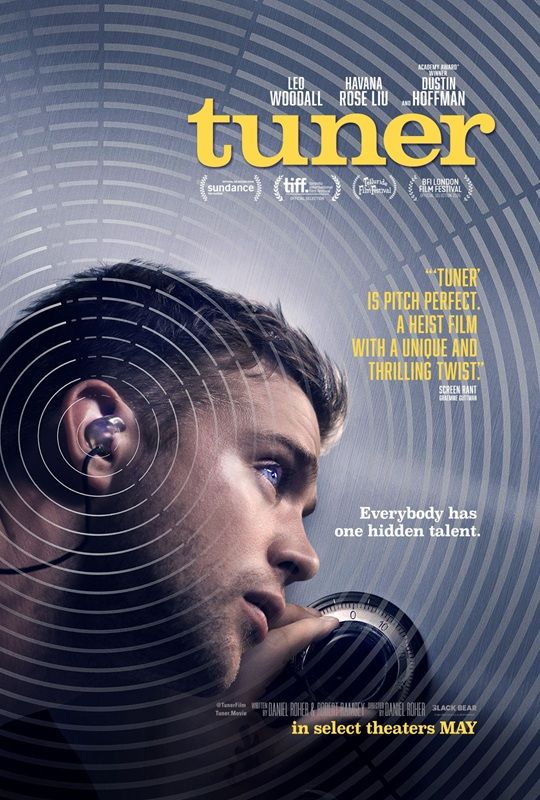
Almost immediately, you can deduce that the new English film Tuner is essentially a coming of age story. Except that this coming of age story is twisted and pretty unconventional. When you are first introduced to the protagonist Niki (Leo Woodall), you see him repairing a piano with his mentor and uncle Harry (Dustin Hoffman). The protagonist works as a tuner, given his ability to decipher and tune sounds – a sort of a ‘superpower’ that remains as an afterthought. The subtext remains that of pathos and loneliness, the latter erupting from the imability to create music given that the protagonist suffers from a hearing condition, Hyperacusis. In fact, this doubles up as the start of the coming of age drama – given that the writing has established the protagonist as an underdog, with much of his story having transpired offscreen. All you are left with is this underdog having to deal with a rocky relationship with his ears, always having his earplugs on, while also having to wear noise cancellation headsets, given his sensitivity to loud sound along the way. Hence, it won’t also be wrong to say that the protagonist finds himself in creative jail, except that his shortcoming would soon double up as a superpower.
Written by Robert Ramsey and Daniel Roher, Tuner has a very specific storytelling mechanism that uses sound as a propelling ingredient. For instance, there is a meta-reference-slang for the word ‘Tuner’, wherein the condition that the protagonist finds himself in is equated to a Tuna – a fish out of water fluttering for survival. Even from a sound design perspective, you notice the grimace on the face of the protagonist while having to deal with loud sounds, only for the finer ones to appease him. Hence, the central conflict of the protagonist discovering his superpower of using the sound mechanism to crack safes, is also based on this phenomena!
Elsewhere, even when Niki meets the potential love of his life Ruthie (Havana Rose Liu), their tryst is christened with his ability to denote false notes and tune them. In a terrific scene that acts as a foreshadow for the ending, you see Niki telling Ruthie on how a single key on the piano mustn’t be fine tuned in isolation, given that it skews the melody of the other keys. So by the very design of sound, the key events and conflicts are established – including a central event that involves the protagonist getting involved with an Israeli crime syndicate who would go onto use his services to commit robberies from their rich clients.
The reason why this deliberately remains a skewed coming of age story is because of the moral ambiguity presented in the journey of the protagonist. And add to that a dash of power dynamics in the reckoning too, even as the protagonist suddenly goes from a victim of circumstances given his hearing ailment, to someone who is a catalyst for the men in power. And so, the moral ambiguity is directly linked to the finances of the protagonist – one, in trying to pay the hospital bills of his mentor who has suffered from a heart-attack, and the other involving Ruthie, whom he wishes to impress.
The proceedings remain a slow burn, tactfully needling the narrative towards its conclusion. And at a point, you also witness a watershed moment in the life of Niki, even as he finds himself in the midst of a robbery that would test his ability to endure while further complicating the moral dilemma. His new life is s*xy, but the question remains at what cost – even as he inevitably is witness to a murder while being beaten up, and also experiencing a two-fold personal tragedy.
The smaller criticism that I had was with the final act that not only felt a little abrupt (despite being profound), but also slightly manipulative with the cultural references of the Nazis, and the Jews in play. Ideally, this would have worked if there was a prior reference of it at some point in the film – specifically with respect to a character that appears majorly in the final act to turn the tide of the drama (he was mentioned at the start too but he needed a deeper identity). In the process, the passages of realisation feel slightly half-baked, even though it does its bit in clearing the moral ambiguity of the protagonist.
And here is why the ending is still profound – it allows an arc of recovery for the protagonist who has escaped the clutches of his ailment, while having the opportunity to create the one thing that he loves the most. His music! And the bittersweet feeling is represented with the fact that although his ailment has disappeared, his earing ability is still impacted – or in other words, needs a tuner, much like final scene in the film. The screenplay here uses the medium of storytelling rather effectively, while serving up a solid crime thriller along the way.
The dialogues are conversational but the important metric remains the varied pitches of sound induced in lines through the characters, that adds layers to the drama. The BGM and sound design are terrific while not only elevating the emotional core of the drama, but also using sound to propel the narrative ahead. The cinematography features some tight frames that helps the viewers to tap into the psyche, and vulnerability of the protagonist. The frames don’t distance you from the characters, and that eventually adds to the emotional core of the drama.
The editing pattern employed us rhythmic – almost mixing a montage with the drama around the protagonist, that not only heightens the tension but also keeps the drama visually balanced and in accord with the thrills in play. Director Daniel Roher employs a very specific style of narrative by putting ‘sound’ in limelight, often using it as a catalyst to drive the conflicts, both internal and external to the protagonist. This creates a different narrative dynamic, coupled with a rhythmic form of tension that keeps the drama kinetic in many ways. And along the way, the filmmaker exhibits a lot of control in maintaining a firm grip on the narrative. The direction is pretty good here.
The performances are wonderful by the members of the cast. Jean Reno as Marius Maissner delivers a subtly dignified performance, while leaving a mark. Nissan Sakira as Benny and Gil Cohen as Yoni balance bouts of intimidation with lighter moments, that define their respective characters. Dustin Hoffman as Harry and Tovah Feldshuh as Marla are a delight to watch, exuding of a vibrant synergy and positivity even in crunch moments, that make them affable here. Lior Raz (you may have seen him in Fauda previously) as Uri is terrific – sly and calculative with a solid presence that adds layers of intimidation to his performance. Havana Rose Liu as Ruthie is quietly charming and understated, while providing the emotional hinge for the protagonist.
Leo Woodall as Niki is compelling with his act, something that required him to internalise his pain and vulnerability too. This remained a very specific character that required him to use his physicality, while mixing it with pronounced expressions and a body languagr that would transcend and blur the lines of his shortcoming. And he does a wonderful job in communicating the same, while putting forth a solid act.
Featuring a resounding sound design and solid performances, Tuner is an immersive harmony of kinetic tension and vulnerability wrapped in a near pitch perfect thriller that hits all the right notes. Available in a theatre near you.


