

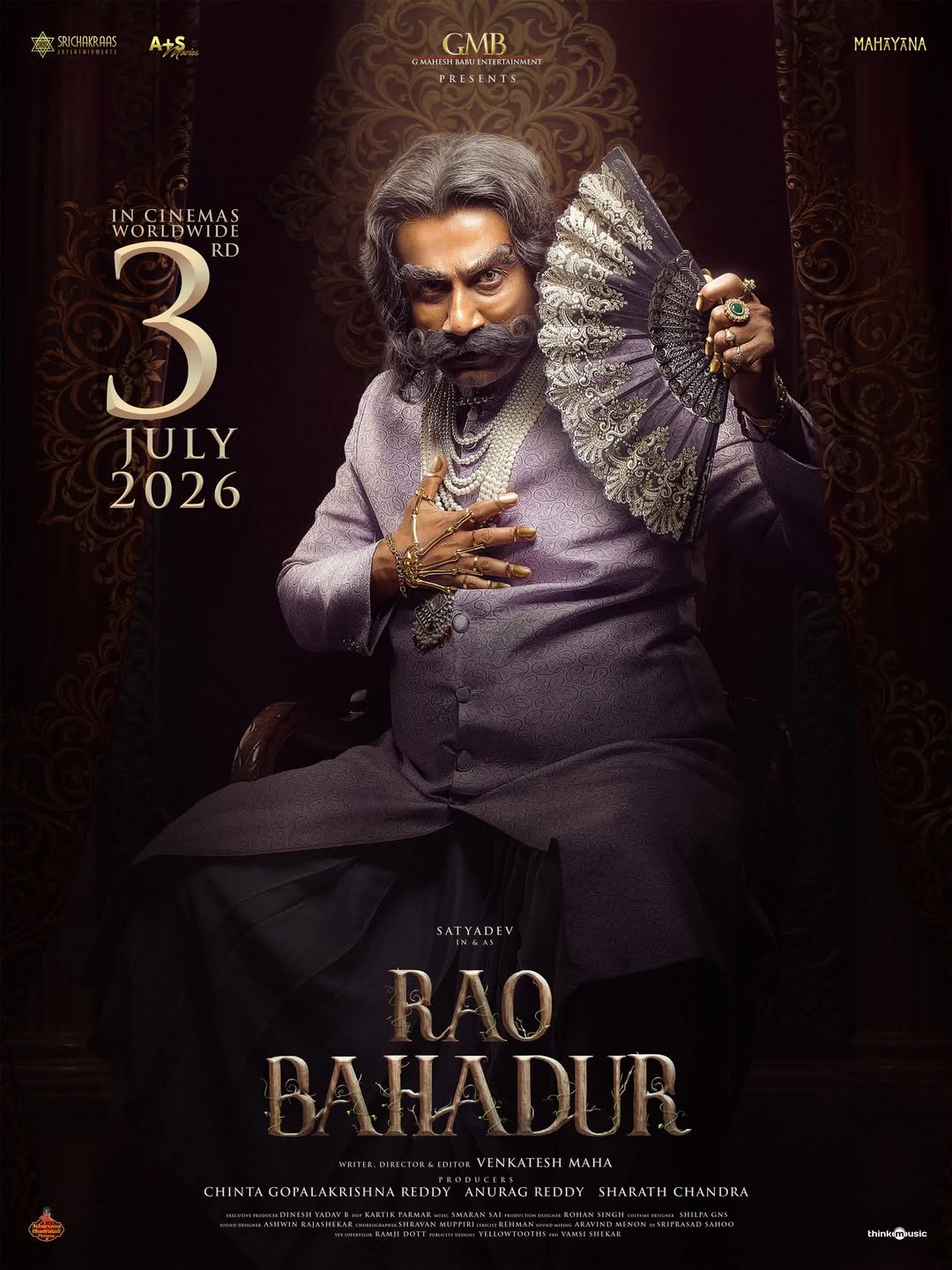
The beauty about the Telugu film Rao Bahadur is that it can be viewed through different prisms in hindsight. It can be viewed as a political allegory centered around the trait of delusion, particularly given the brainwashing themes employed for the protagonist. It can also be interpreted as a tragicomedy of a man whose life was built around lies, or even a searing commentary on patriarchal lineage that shapes up the delusional world of the protagonist. In fact, the latter is true during its cold open – even as the camera pans on the different frames on a wall on an individual level, before zooming out to capture a collective lineage. It is a perfect way to establish the one of the core themes that would define the personality of the protagonist Rao Bahadur (Satyadev Kancharana) – a delusional aging man suffering from liver cancer but still weirdly overcoming his prognosis by continuing to consume alcohol.
The latter isn’t coincidental either – a result of grief mixed with anxiety post the death of his younger son, whose dark skin makes him question his lineage and blood. It is interesting on how he imagines himself to be talking to ex-PM Sanjay Gandhi who was known to eliminate the lineage of many homes through the process of sterilization. And it is also interesting on how he exclaims on how he wished his son to be like a pumpkin – akin to an actual vegetable creeping in his room. But despite that, and the guilt of losing his son to death – his ‘aristocratic’ genes don’t allow him to sleep well at night, often being delusional and creating a similar aura for the people around him.
Written by Venkatesh Maha, the metamorphosis of the protagonist in Rao Bahadur offers a fine commentary on societal norms with regards to patriarchal, control, and the brainwashing of individuals based on generational bouts of ideology. For instance when you get a glimpse of the protagonist from the 1960s, you see a much more liberal version of his persona, rock n’ rolling inside a club – a distant version from the grumpty and delusional undertones of his persona from the 1990s. It is interesting however that you also spot him in a cage in the previous timeline – an allegory of his caged mind that would later on be influenced and brainwashed in the garb of his ancestral family lineage!
The contrasting personality of the protagonist cannot be denied, particularly with regards to his dynamic with Renuka (Deepa Thomas), the supposed love of his life. In the current timeline of the 1990s, you witness Renuka being confined to a dark room inside the palace, often being a victim of control – an immediate extension of the people enslaved in a land that was meant to be democratic. In the same breath, you also witness her character being beaten up by the protagonist at one point, based on his assumptions that he wasn’t the father of his younger son – an extension of his delusion based on his preconceived notion of a rich and royal family lineage.
But the same isn’t true in the past wherein the protagonist deftly exercizes his charm by volunteering to drop Renuka (who is working as a nurse for his ailing father) in his car, while sharing a bond of warmth and respect – even when she turns down his advances and proposal to be in a relationship, initially speaking. In fact, the dynamic that Renuka shares with the protagonist can be expressed through an instance wherein she is enamoured by the beauty of the lake and the prettiness of the swans – only for her to later realise that the white-skinned swans remain a programmed bias of the society who doesn’t wish to appreciate the black skin of the crow – much like the step-fatherly treatment imposed by the protagonist on his younger son, while often favouring his elder son who he believes is the rightful charismatic heir of his throne!
There is a searing political subtext being played out in the middle – often through the indicative POV of people who tend to be influenced by the rich and powerful, without questioning their legacy. In an incredible sequence, you witness the physical representation of the same – even as an animated fantastical image of the protagonist’s brain being sliced open and inducted with alternate yet collective thoughts of delusion are planted within him. In another fantastical sequence, you see a character telling the protagonist on how he continues to live on, given the obsession of the latter who refuses to let go of him in his memory – a strong anti-thesis on the art of letting go.
It is interesting on how the concept of a lie forms the foundation of the drama here – be it the delusionary world of the protagonist, or even the people in it. In fact at the start, you witness a seed of this when a character tells another on how a lie is enough to give hope to a dying person – a fact that wonderfully ties up at the end, in a wacky (but not entirely unexpected) revelation that completely changes the discourse of the drama. It makes you question on what if the fundamentals of your life are built around lies – be it the world around you, or even the politics in it, all of which want you to believe a certain fact that doesn’t exist.
There are minor roadbumps along the way with regards to being slightly indulgent and overstuffed with the writing. But the writing itself is so powerful that it wonderfully uses magical realism mixed with spiralling bouts of madness to drive home an important message that holds its relevance even today – even as individuals are committed to making living Godly versions of the powerful people, thinking it is their lineage. But is it again? Or is everything a lie? And have they been brainwashed?
The dialogues are quirky, wacky and poignant, also being deeply rooted to the world of the aristocrats – while holding a sense of relevance with a searing commentary that extends to current times. The music is phenomenal, with the songs literally playing out like a soap opera – with each set-piece used as a medium of transition for its characters or the world around them.
The cinematography offers another distinct reminder of how this remains a visual medium too – incorporating frames that are regal, quirky but also poignant. The emotional core and the madness of the protagonist is perfectly represented through the quirky frames – often allowing you to be a fly on the wall in an instance, while completely immersing you in his psyche through a clever transition through its production design. The costumes are regal, and definitely deserve a shoutout too.
The editing pattern is sharp another to hold the narrative through bouts of coherence, which itself was a big achievement given the structure of the narrative that was unconventional – while employing flashbacks within flashbacks. And to maintain the emotional core of the drama from one scene to another is no mean feat.
Director Venkatesh Maha does a phenomenal job here in establishing a wacky world of fantasy, and allowing his quirky and delusional protagonist to immerse in it. The narrative structure itself was tricky, and needed precision to execute it with coherence. And this is where the skills of the prolific filmmaker was on display – showing immense control through even the overstuffed bits, tactfully curating a narrative that is largely watertight (let’s not talk about ‘leaks’ here🥹) , while ensuring that the direction scores through and through.
The performances are wonderful to witness by the members of the cast. Anand as Inspector Jagannadhan is sincere and earnest while putting forth a commendable act. Master Kiran as Kusuma wonderfully exercizes his vulnerability with a hint of charm. Pranay Vaka as Lavana represents a character who would invariably inherit the lineage of his father, and in many ways he is a protagonist in a different timeline – accurately representing his initial indifferences with the protagonist pretty well. Vikas Muppala as Dr Achari is wonderfully understated, and carries forth his performance with earnestness. Deepa Thomas as Renuka has a phenomenal screen presence, and she uses her body language and expressions to such good effect in accounting for a searing arc of her character.
Satyadev Kancharana as Rao Bahadur is absolutely brilliant to witness here. Make no mistake – this was an extremely complex character to pull off, having shades of liberalism at one point, to completely been brainwashed in another. There is a certain sense of panache with which he pulls off his regal yet delusional act – using his body posture (including his right hand that was an allegory for pride) with such good effect. There is purpose to his performance, even in his wide-eyed gaze or blank looks, or the spirally maddening energy that he infuses in it. Here is an actor who completely surrendered to the vision of the filmmaker, while putting forth an astounding and towering act.
Backed by an ensemble of sublime performances, Rao Bahadur is a strikingly surreal visual poem that effortlessly balances high-concept magical realism with a protagonist’s terrifying, hallucinatory descent into madness. Through the decaying backdrop of a fading aristocracy, the narrative constructs a fierce, layered commentary on patriarchal authority and the paralyzing burden of family lineage, utilizing sharp political allegories to challenge how deeply biases are passed down through generations. This bold psychological dark comedy stands as a magnificent, boundary-pushing masterclass, making it one of the finest Telugu films of 2026. Available on Netflix, and Highly Recommended.


