

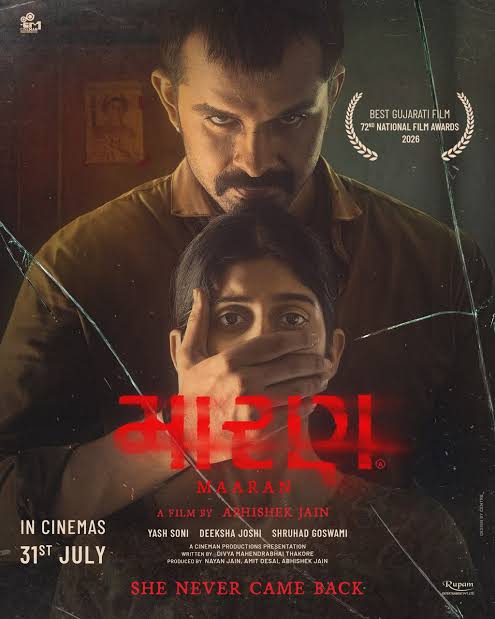
The contrasting traits in the new Gujarati film Maaran (National Award Winner : Best Gujarati Film) apply to its world as well as its characters. As a part of its cold open, you witness a group of kids loitering around a red suitcase until unknown fingers protrude out of it – a clear reminder on how innocence forms a contrasting picture to the darker themes of the narrative with regards to human trafficking. In that sense, even the antagonist Ratan (Yash Soni) leads a dual life of sorts – working as a creepy security guard of a high-rise building in an unknown location in Gujarat at night, and a key cog in the human trafficking chain by the night. And yet in his words, he is the victim of the society that has its roots firmly in the realms of patriarchy. It is this inculcated patriarchy that may have pushed him into becoming a monster – leacherously hovering his evil eye on a new female tenant in his wing, or holding girls as captive in order to be sold. In many ways, Ratan is the poster boy of the prevalence of patriarchy in a society that has been thriving on misogyny and narcissism – two traits that have been synonynous with the political fabric of the state lately.
Written by Divya Thakore, the events of Maaran unfold in the hyperlink format – an unsaid form of anthology that loosely connects its individual stories. So while Ratan is the key perpetrator oblivious to many, there is also a core conflict involving the disappearance of the then 17 year old girl named Birwa (Deeksha Joshi), that prompts her sister Purva (Tarjani Bhadla) to seek answers through frequent candle-light meetups, until spotting her sister on a p*rnographic site one day – thereby intensifying her search. This, even as Birwa acquaints herself to another young girl Urmi (Prachi Thaker) held captive by Ratan. On the other hand, you notice subtle hints of the state of the flat that is witness to its new tenant Tara (Druma Mehta) – a sort of a metaphor for the turn of events to follow under the rovering gaze of the antagonist.
One of the wonderful aspects of the screenplay remains its dynamics between the characters – something that allows the drama to be layered. For instance, you notice a hint of a Stockholm Syndrome between Birwa and Ratan, instantly reminding you of Veera and Mahabir in Highway (2014). Sure, the initial dynamic is reminiscent of Vash (2023), but the more you get to understand the psyche of Birwa, the more you realise on how this ‘new’ life of hers is more of a distraction, or even a form of escapism from the fractured fragments of the society who wouldn’t accept her the way she once was, given their prejudices and stigmas post her kidnapping.
For Birwa, it remains an act of sticking to the one hope of love in the form of Ratan, who in her words hasn’t been violent with her or abused her (despite kidnapping her; mistakenly), and reserving his bouts of affection just for her. Hence in a scene, you also see her mildly convincing Urmi to accept her reality – knowing fully well on how the society would treat her, even if she were to escape from the captives of Ratan. In a way, both Birwa and Urmi are the same person at different timelines – despite one being an idealist, and the other accepting.
The dynamics also extends to Babu (Shruhad Goswami), a Beta-replica of the antagonist – with whom he forms an unlikely partnership, much like the antagonists in Raakh (2026). You see his brutal side towards Urmi at the start, forcing his might on her, only to show glimpses of humanity later on. In a pivotal scene, you see him being palpable enough to confess on the pressures of being a ‘man’ in the society – while pushing his case of helping Urmi escape, as if this was his last chance for redemption.
The screenplay doesn’t always connect the three fleeting instances that play out like a hyperlink. In fact, each of the tracks often work in isolation – presenting itself like a horror tale, that ironically forms a connective tissue between the varied existing hierarchies of the society. For instance, you see a clear class divide between Tara and Ratan from the onset, with the former even mistreating the latter in a fleeting moment. But the subversive equation remains that of patriarchy and entitlement that cut through the class divide, even as Ratan is presented as a monster waiting to unleash his fury.
There are a few convenient curveballs thrown in the narrative, particularly with regards to the track involving Purva and her quest for searching for her sister. Or even modest tropes of the antagonist beating a dog to death, all in order to showcase his monstrous trait. But in the larger context, the drama plays out like an endless loop – something that doesn’t always have a finishing line to boast of. It is a stark reminder on the unfolding nightmares encircling the society through its characters that make for a bittersweet, haunting and deeply disturbing end, again signalling a contrast of sorts with regards to their personalities.
The writing does make you question on whether the real antagonist remain people like Ratan who participate in human trafficking, or the society who don’t allow their daughters to return, and people like Ratan to change – thereby keeping the nightmarish loop in tact. The screenplay might seem slightly disjointed, but it definitely creates a psychological impact – so much so that it had been thinking about Birwa and other characters long after the end credits had rolled.
The dialogues are conversational, but searing with the edgy tone employed in the narrative. There is a psychological undercurrent nicely tapped into, by the lines on offer – something tjat is vital in creating a fearful ambience. The BGM is pulsating, ably constructing an arena of fear through multiple sequences that are elevated by the score. The cinematography comprises of frames that ably creating a fearful atmosphere that automatically contributes to the unpredictability of the drama. In fact, some of the blurring motion capture sequences offer a psychological edge to the proceedings – while maintaining its focus on the characters that are presented to be “isolated” from the society.
The editing pattern needed a little more work in order to be seamless from one sequence to another. The transitions felt a little disjointed, that in turn created an aura of every track being isolated from one another – as opposed to being a part of the same world. But even in that isolated state, the sequences are well edited – retaining the bouts of fear in the narrative. Director Abhishek Jain expertly laces his world with a psychological edge that invariably creates a deeply disturbing atmosphere. Even from a characterization POV, he scores really well – minutely curating the characters such that every character appears to be grey, irrespective of their morality. As a result, the drama is supremely impactful – often spilling into your psyche and creating a resounding affect, long after the end credits roll. The direction is pretty solid here.
The performances are phenomenal by the members of the cast. Kulkul Tarmaster as Chandu, Parmeshwar Sirsikar, and Vaishakh Rathod have their moments to shine, and all of them manage to impress. Garima Bhardwaj as Anshu has a solid screen presence, and she manages to impress in a brief role. Morli Patel as Birwa’s mother is an epitome of the perennial stigma attached to the society, and her wonderful performance remains pivotal to the plot. Abhinay Banker as Sameer and Dheirya Thakkar as Banti are sincere and earnest, while putting forth commendable acts. Prachi Thaker as Urmi is phenomenal to the core, in a character that is oblivious of the stigmas of the society that won’t allow her to return to normalcy ever. She also has a commanding screen presence that is laced with confidence, wherein she puts forth a superb act.
Druma Mehta as Tara offers an oblivious outlook to the alternate realms of the society for most parts of the narrative, and she taps into this trait wonderfully well. Her track deserves a spin-off film of her own. Tarjanee Bhadla as Purva is assertive despite bouts of convenience plaguing her track. She impressively uses her expressions and body language to convey the plight of her character. Shruhad Goswami (what a turnaround from his last film Laalo; budding actors take notes on how he breaks this stereotype) as Babu has a strong and problematic demeanor on the outside, often suppressing his humanitarian emotions deep within him. Shruhad ably strikes a balance between these two contrasting traits, while putting forth an excellent act.
Yash Soni as Ratan is a revelation, using his tactfully curated menace to create a fearful ambience around him. Be it his smirk, or his widely-threatening eyes – every move of his is resounding and brilliant to witness, in a repulsive character that is played to great effect, even whilst adding a whiff of human emotions to his persona. And that is a sign of an actor who is in top form here.
Deeksha Joshi as Birwa is such a layered character that demands your empathy, whilst also rooting for her freedom. And yet, there is an undercurrent of hopelessness that makes her gravitate and hold onto her last ray of love in the form of Ratan, something that makes you fear for the worst. Deeksha ably curates these palpable emotions with streaks of grey that allow you room to invest in her journey, while also deliberately maintaining distance – the latter which is the allegory of the society on which the film is mounted on. Her expressions and body language are excellent, even as she delivers a quietly towering act that is laced with brilliance.
Featuring strong performances, Maaran is a gripping psychological thriller tackling themes of patriarchy and entitlement that quietly escalate into an absolute nightmare. Despite a disjointed narrative pattern, the film remains deeply impactful and disturbing, building to a haunting finale that lingers long after the credits roll. Ultimately, its minor structural flaws are overshadowed by a searing, vital message that demands attention in today’s world. Available in a theatre near you.


