

The dysfunctional thread in the Marathi film Tighee is evident from the opening shot wherein you spot a wide gap separating the two sets of characters in the frame. There isn’t an immediate context of the frame, but you do realise the distance acting as a metaphor for a rift, something that would go on to form the basis of the drama. And it is this dysfunctional thread that extends as a characteristic trait for most of its characters too. For instance when you are introduced to Swati (Nehha Pendse), the setting remains that of her workplace – a seemingly unassuming place of toxicity wherein you witness the quiet yet evident advances of her boss (Jaimini Pathak) who has lent her a huge sum of money, only to exploit her work and presence in and outside the office premises. In that specific scene, he also makes a remark on her silver strands, a sign of aging that Swati quickly dismisses – simply by discreetly plucking her stresses as a part of a conscious solution. It remains a very specific trait of dysfunctionality, almost extending as a metaphor for people in her life, except that plucking them out isn’t as easy as plucking her grey strands.
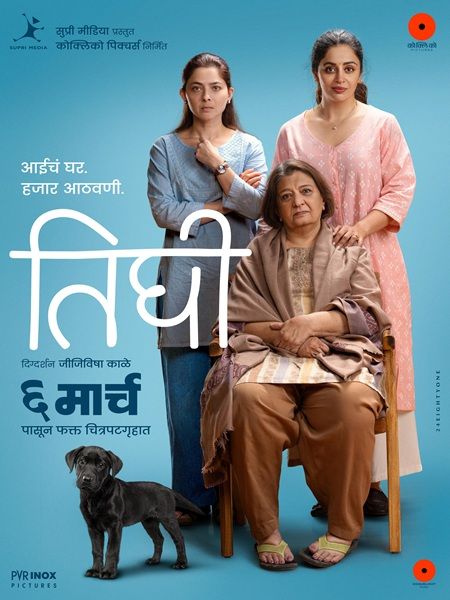
Written by Jeejivisha Kale, Nikhil Mahajan and Prajakt Deshmukh, the early premise of Tighee immediately reminded me of the English film His Three Daughters (2023), a seemingly quiet but aching tale of responsibility amidst the rocky dynamics between characters. So when Swati is forced to leave Mumbai and visit Pune, it boils down to a very specific reason of having to meet her ailing mother Hemalata (Bharti Achrekar) who is virtually on her last leg of her life, while suffering from an ovarian cancer. Also, she has her sister Sarika (Sonalee Kulkarni) for company who is dealing with issues of her own. Amidst the three characters lies a specific ‘mystery’ linked to the past that threatens to shake the foundation of their relationship.
By its texture, the complexity of the drama can be felt through its characters and the situations that each one of them find themselves in. For instance, the gulf between Swati and Sarika can be estimated from their appearances – the former donning a slightly more modern outlook to drive her professional duties as the only earning member of her family. The latter is a caregiver, having lost the urge to dress up in the wake of having to deal with the deteriorating health of her mother. In fact in a fleeting moment, you see Sarika smiling at a compliment she gets from a guy at a function, only later on to contradict the idea of dating by simply telling others (and herself) that she doesn’t have the bandwidth for it. Furthermore, you see the idea of sacrifice peeping through her demeanor even as she has ‘almost’ given up the idea of working for a US company, while eventually agreeing to join a startup in the capacity of a co-founder with her pleasant friend Gandharva (Nipun Dharmadhikari).
This ambiguity of dysfunctionality also extends to Swati’s husband, Malhar (Pushkaraj Chirputkar) who himself remains a complex personality. He is well aware of the advances that Swati’s boss makes towards her, but it remains a situation of helplessness in a game of power dynamics, particularly given the hefty loan that his wife has incurred from her boss. In that sense, Malhar paints an alternate picture of patriarchy, given how he is left of living on the expenses of his wife after his startup fails during the Covid pandemic. And yet, there is a gentle trait to his character that you witness in a scene wherein he asks for money from his wife. When the latter quicks responds to his gentle demand, he is quick to assert on how he did visit Pune because he cares for her and his mother-in-law. It is at once ambiguous, complex and helplessness for Malhar in this moment.
One of the important core that forms an emotional hinge in the narrative lays Hemalata’s dynamic with her daughters. At about 40 minutes into the film, you get a fleeting perspective of a specific conflict that flirts with the idea of ‘maintaining secrets’ of the past. In the same breath, her current situation with her daughters remains symbiotic – she wants to be pampered but also wishes for her daughters’ happiness, wanting to spend her last days in her bed but not really wanting her daughters to pay visit. It formulates the last phase of motherhood, something that has been misunderstood all her life, when she wants the best for her daughters even during her dying moments.
Another important core in the drama is linked to the past, that holds a shocking revelation for the family. It has a specific trait of past trauma and a whiff of patriarchy that also extends to the current timeline with respect to the characters. But the tone of the drama is so deft, that even the specific issue which is disturbing and alarming in the same breath, is also exceedingly sensitive and subdued.
It reminded me of the Telugu film Mangalavaaram (2023) particularly with the psychological order of the protagonist there, which is only hinted at here. And that mystery is revealed coincidently, when Hemalata spots Swati in a particular manner, without the writing choosing to be abrupt towards the end. It remains a heartfelt trait of motherhood that can directly be linked to protecting her children, that eventually resulted in a heartfelt and subtly moving finale that circles back to the metaphor at the start of the film. The screenplay is very well written by having the potential to move you in more ways than one.
There is a sense of groundedness to the lines, even when they lead up to a reveal that is startling. The focus remains on being tonally understated with exchanges that are conversational, and the complexity being a byproduct of the dialogues. The music and BGM are sparingly used, almost allowing the grim nature of the surroundings to engulf the narrative. In the same breath, the drama uses silence really well in communicating the most complex emotions in a rather effortless manner. The cinematography comprises of frames that are designed to be emotionally connected to the characters. I liked how the frames are used as metaphors for a dysfunctional relationship like the start of the film, while getting closer and closer to tap into the complexity of every character.
The editing pattern is unhurried, almost allowing the drama to unfold at a leisurely pace. In fact, the trajectory of the drama is complimented by the editing style here, being devoid of fast cuts or jump cuts while never giving the drama an abrupt overlook. Director Jeejivisha Kale in her directorial debut hits a homerun, showing impeccable control and precision with regards to a sensitive subject matter on display. She boldly taps into the complexities of the characters without romanticizing or sensationalizing their situation. There is a deft gaze of feminism that ably drives the narrative, something that portrays even the most startling aspects of the drama with a gentle coat of paint. And another positive remains on how well she maintains the tone of the drama, keeping the proceedings understated and subtle. Overall, the direction is excellent here in what remains a fascinating debut by Jeejivisha.
The performances are wonderful by the members of the cast. There is a gentle streak of calmness associated with actors like Mrinmayee Godbole and Suvrat Joshi, even while performing a seemingly dramatic with an understated tone tagged to their acts. And that was superb to witness here. Nipun Dharmadhikari as Gandharva has a quietly charming presence in a character that will invariably put a smile on your face. In fact, it is through his character that you are introduced to a little puppy – a symbol of hope and life to the family of Swati, who until then have been dealing with a grim outlook of hopelessness and death. Pushkaraj Chirputkar as Malhar taps into the complexity of his character with a ease, maintaining a deft outlook of ambiguity, care and patriarchy in equal measures. Jaimini Pathak as Swati’s boss is vile and repelling, two traits that tell you on what a solid act he has pulled off here. His mannerisms are subtle but enough to infuriate you, something that had me seething with anger. His minimalistic approach is excellent to witness here.
Bharti Achrekar as Hemalata accounts for a powerful yet subtle emotional core in the drama. There is a sense of playfulness to her character, even while holding on to a mountain of pain and angst within her that is put forth in the form of a moving monologue. She is brilliant to witness here in a moving act of the highest order.
Sonalee Kulkarni as Sarika delivers an understated act, in a character who is a giver whilst willing to sacrifice her own dreams. There are subtle bouts of frustration that momentarily creep up, only for her to surge forward and come to terms with her situation. She remains resilient in a commendable act that is beautiful in every sense of the word.
Nehha Pendse as Swati delivers an effortless act of brilliance here. Like her mother and sister, she too has been quietly carrying a plethora of emotions within her while fighting a battle of her own, and being the sole breadwinner for her family. And yet unlike Sarika, she remains a character that constantly looks for solutions in resolving her issue – a trait given that she is the elder daughter of Hemalata. Nehha uses her body language and expressions to such great effect in a brilliant performance that stays with you, long after the film has ended!
Tighee is an aching tale of dysfunctional relationships, also featuring sensitive performances that make for a beautifully poignant watch. Available in a theatre near you and Highly Recommended.


