
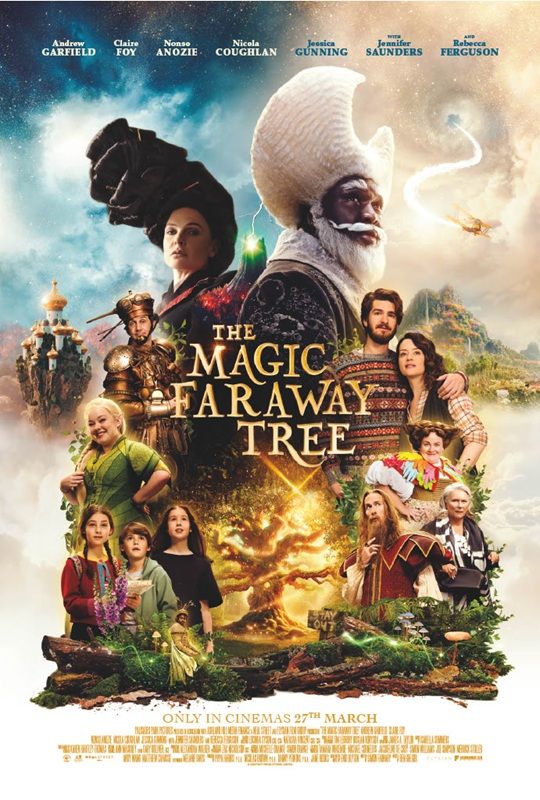
There is a touch of symbolism during the cold open of the new English film The Magic Faraway Tree, even as you are introduced to the character of Tim (Andrew Garfield) reading a book titled ‘Fairies And Pixies’. It remains a fleeting moment that not only acts as a foreshadow of the magic to follow in narrative, but also forms a searing contrast to the immediate surroundings featuring Tim’s kids who are immersed in the technology. It is interesting on how it is technology that ties the lives of the kids together, even as you notice Beth (Delilah Bennett-Cardy) being active on social media, her brother Joe (Phoenix Laroche) who is into video games, and the youngest Fran (Billie Gadsdon) who has literally gone mute (or has chosen to be so) in the midst of the technology. In the same breath, even Tim’s wife and the children’s mother Polly (Claire Foy) has a tryst with technology – being an inventor herself, while eventually having to take an ethical stand against the perils of an invasive spyware. Hence, the collective arc of the family to step away from technology is determined by a real-world economic crisis – even as the group begins their contrasting but enchanting journey to the countryside.
Based on the novel of the same name by Enid Blyton, and written for the screen by Simon Farnaby, The Magic Faraway Tree also doubles up as a commentary on the idea of discovering magic, once one takes away a step away from the technology. In a world wherein faces are immersed in cellular devices – the idea of glancing into the setting sun by the beachside, or patiently admiring the beauties of nature on a hill top, is the exact bout of magic that the writing wishes to tap into. And in the context of the drama, this foundation is only established when the setting shifts from a dingy room of a bustling city to the enchanting woods of the countryside.
I liked the adjustment period here, something that brought with it, its share of laughs. The setting remained a near-dilapidated wooden house that itself would make for a great horror movie location. The place remained stripped off any electricity which automatically meant no wifi, and hence, the focus would directly shift to the lush green surroundings of the countryside that would host strings of magic deep within the woods. It is ironic given that the first person to discover this magic was Fran – a young developing mind resembling a sponge, who was at the crossroads of discovering the world around her.
It is interesting given that her astral wavelength was palpable to the magic around her, unlike most adults who would have steadily distanced themselves with the magical bouts of nature. In a searing moment, you witness her crossing paths with a wonderfully warm fairy named Silky (Nicola Coughlan), who in-turn takes a liking to her, and decides to invite her over for a little pixie tea-party. The bearings of imagination mixed with the magic of the elementals plays an important part here – even as Fran not only ventures into the woods, but also rediscovers her voice, a perfect ground for the symbolism of self discovery in many ways. The narrative is linear and simplistic, but the subtext remains enchanting even while imparting crucial life-lessons along the way. For instance in a sequence on The Land Of The Birthdays, Fran learns an important life lesson on how not to be greedy, even while getting a chance to collect and indulge in a variety of goodies.
One of the themes explored remains that of togetherness, something that has been a recurring thread in most literary works of Enid Blyton. In this instance, it remains the rub of the magic extending to Joe and Beth too, the latter being a hard nut to crack while still feeling isolated with the surroundings, with an affinity to head back home to the comfort of technology. And it is interesting on the conflict of the third act is mounted on this very sentiment – be it the idea of Beth writing a love-hate letter to her grandmother to rescue her from the countryside, or her frivolous wish designed to send the family packing back to the city. Ironically, this segment coincides with her transformation that makes matters slightly complicated for her.
The one little criticism that I had with the narrative was with regards to the adventure bits of the story in its third act – each of wish felt simplistic and convenient with its writing, despite retaining the warmth and sincerity of the narrative. I did feel that the events felt a tad too rushed, more focused on the resolution as opposed to the enchanting journey itself. And so even when it intends to bring about a fuzzy and feel-good ending, the moment felt a tad underpar that wasn’t fully earned.
But even in the mix, I still was connected to the emotional quotient of the drama – be it in the invisible land of the fairies that made me believe in their magic all over again (just as I did as a child, once upon a time), or the bittersweet ending that did touch me with regards to one of the characters (even while closing a collective arc from the start) – something that felt like an extension of me in the same context of the drama. Hence, I did think of quietly shutting away my critical piece of mind in the wake of this narrative that was nothing short of a warm hug! Perhaps there is a fairy sitting beside me after all, smiling away as I finish penning this review!
The dialogues are simplistic but christened with inherent doses of magic that are not only refreshing to witness in the context of today, but something that had me genuinely enchanted and in awe of the imagination on offer. The BGM is soft and tender while perfectly being in sync with the warmth that the narrative has to offer with magical traces. The cinematography comprises of frames that elevate the micro emotions of the characters, even while scoring with the high magical doses of the proceedings. Either way, the frames do enough to keep you emotionally invested with the warmth of the characters in question. The VFX felt a little compromised in a couple of scenes, but it still pulls through in the wake of stronger themes in the narrative.
The editing pattern is crisp here, while doing fairly well to hold the narrative together. If anything, the edit itself felt slightly abrupt in the final act – something that gently pushed the drama towards convenience. But that is a small blemish in an otherwise razor sharp narrative that scores with its emotions. Director Bob Gregor beautifully christens the narrative with the right doses of emotions and magic, while constructing a contrasting yet collective arc of sorts. He does a fine job with the imaginations on offer, translating vivid descriptions from the literary work to some breathtaking moments of warmth, whilst keeping the magic of the narrative intact. The direction is pretty good, despite a late blip in the final act.
The performances are wonderful by the members of the cast. Jennifer Saunders as the snooty grandma is a joy to witness here, a reimagined take on Miranda Priestly from The Devil Wears Prada (2006). The likes of Hiran Abeysekara as the Angry Pixie, Oliver Chris as Mr Watzisname, and Dustin Demri-Burns as Saucepan Man offer some goofy antics whilst wonderfully contributing to the humorous quotient of the drama. Jessica Gunning (you may remember her from the show Baby Reindeer) as Dame Washalot is warm and affectionate with her act, and she does a fine job here. Rebecca Ferguson as Dame Snap offers a mischievious dimension to the narrative, with her act that is stoic and deftly intimidating with humour sandwiched in between. Nonso Anozie as Moonface is quite affable with the bouts of emotions that are conveyed through his character, particularly towards the end – wherein he is supremely impressive with his act.
Nicola Coughlan as Silky is a character bustling with energy and warmth, and she epitomizes the spirit of her character wonderfully well, while putting forth a commendable act. Claire Foy as Polly and Andrew Garfield as Tim are sincere and earnest with their respective acts, while providing frequent moments of comfort and joy. Each of Phoenix Laroche as Joe, Delilah Bennett-Cardy as Beth, and Billie Gadsdon as Fran have distinct personalities that drive the narrative here, and each of them bring a refreshing zing mixed with genuine emotions in the mix that had me invested in their individual journeys. They were a treat to witness here, and they really managed to shine.
Despite being slightly abrupt in its third act along with it being simplistic and predictable with its storytelling, The Magic Faraway Tree is a charming, whimsical drama that christens the narrative with enchantment and grounds it in genuine emotion through palpable, heartfelt performances. The film balances its fantastical elements with deeply relatable human connections, ensuring that the spectacle never overshadows the story’s emotional core. This delicate harmony results in a wonderfully fuzzy watch that effortlessly wrapped around me, ultimately feeling like a long, warm hug that lingers well after the credits roll. Available in a theatre near you.


