
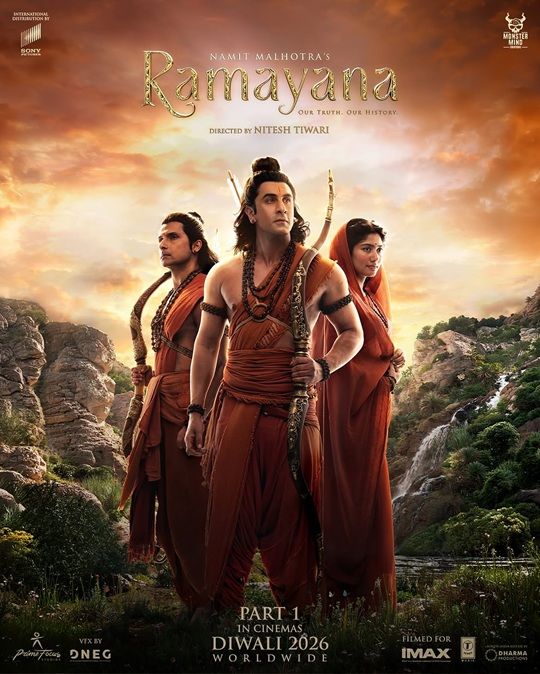
On a macro-level, the new Hindi film Ramayana Part 1 is a template story of good versus evil. It is a tale that often formed an integral part of our childhood, not because of its religious undertones – but a larger message of good triumphing over evil, a sentiment that is fast pushed towards oblivion in current times. It is a template that one can’t go wrong with – except if the film is a travesty on the lines of Adipurush (2023). Namit Malhotra’s Ramayana (thankfully) isn’t that film.
One of the best ways to analyze Ramayana – a story that is majorly familiar to all of us, is to tap into the varied journeys of the two important characters in the mix – Lord Rama and Ravana. Notice on why we add the term ‘Lord’ in front of one of the characters – when both the characters have a few overlapping traits. In the film, these overlapping traits are depicted as a deft little footnote – both these characters fight for their families, respect women, bring a wave of prosperity for their respective folks of the kingdom, and are driven by their respective principles. The only difference that separates the two is that one of them represents the ideal manifestation of human virtues, while the other has built an empire on the virtue of arrogance.
Written by Nitesh Tiwari and Shridhar Raghavan, the film Ramayana Part 1 is as much an examination of ‘Dharma’ vs ‘Adharma’, as much as it is of good versus evil. And the writing does well in tapping into the latter through the impeccable origin story of Ravana (Yash). At once, the antagonist remains an interesting character to explore (and you notice the kind of creative freedom enjoyed by the writers here as compared to the exploration of the protagonist) – someone who is showcased to be playing the veena, staying oblivious of the fact that the Devas led by Lord Indra have overpowered the Asuras (demons), leaving them to fend for themselves underground. On being provoked by his mother, you notice a searing transformation modelled on discipline and patience, presenting him as a Shiva Bhakt who is given a boon by Lord Brahma on the lines of immortality. The metaphor of emerging from a veena (read: sur) to an asura fighting for his own people while imposing himself as the Chosen One maybe a familiar template – but in the context of the proceedings, it is an insightful one.
On the other hand, the writing is much more cautious in depicting the rise of Lord Rama (Ranbir Kapoor), the seventh Avatar of Vishnu born in a direct response to counter the atrocities of Ravana. The sincerity of depiction is laced with a more dramatic representation of a young prince from Ayodhya riding on a horse, in a kingdom that is christened with peace and prosperity led by King Dashrath (Arun Govil). The only trojan horse appears in the form of Manthara (Sheeba Chadha) who consistently is known to spew her evil intentions on Rani Kaikeyi (Lara Dutta Bhupathi) – constantly nudging her to favour her own son Bharath, even as she is initially spotted feeding a younger version of the protagonist first before any of the other kids.
The writing is successful in denoting the righteous qualities of the protagonist – be it the one being chosen to protect his Dharma; in a scene wherein he assures his skeptical father of protecting the land from the Asuras, while willingly agreeing to assist Sage Vishmamitra (Ajinkya Deo). Or in a scene following a spectacular fight sequence wherein he pauses before having to kill a female asura with a reason on how he can’t raise his weapons on females. The subsequent scene involving Sita Ma’s swayamvar also goes a mile in highlighting this virtue – even as the protagonist’s righteousness is christened with a hint of humility, immediately pausing and seeking forgiveness after lifting and later breaking the Ram Baan (bow). There is a also beautiful scene later on in the second hour with Sita Ma wherein he conveys how her presence makes the exile beautiful. The latter also offers one of the fewer emotional moments in the narrative that really land.
One of the fewer demerits of the screenplay is the real lack of a strong emotional core (and the visuals do their bit to paper over the cracks here). Be it the sequence involving a helpless father who has to let his son go off for a 14-year exile, or of the protagonist who would willingly sacrifice his existing world to protect the honour of his father, or even a son getting to know the passing of his father without getting to meet him one final time, or the eventual Bharath Milap that is christened with affection and beauty – I expected to be a lot more moved that I eventually was. The reason wasn’t the staging that was predominently laced with sincerity.
The issue was the lack of a character exploration of some of the other characters in the mix. For instance, the bond between Kaikeyi and Lord Rama didn’t go beyond that one moment of her feeding him. Or the virtue of sacrifice on behalf of a character like Lord Lakshmana (Ravi Dubey) never fully realised its potential, given how the bond between the two characters was only based on loyalty, christened with some rather obnoxiously unfunny one-liners. There was no scope for humour here, instead devotion needed to be the key ingredient! Even an understated character like Bharath (Adinath Kothare) needed to have a little more presence to fully realise the depth of the Bharath Milap scene. If the emotions do land for you, then it is more to do with your familiarity of the epic as opposed to the film doing enough to rile them up!
That said, the writing definitely creates ripples in the second hour, particularly while focusing on the events transpiring around the antagonist. Be it his impeccable face-off with his brother-in-law Vidyutjihva (Vivek Oberoi) that wonderfully creates a complex imagery of domination and control mixed with his idea of serving people, or a spectacular sequence of getting a literal glimpse into his psyche that ultimately ends up with the physical representation of his ten heads.
Elsewhere, the drama also finds its footing with the intersection of the two worlds, primarily when Ravana’s sister Surpanakha (Rakul Preet Singh) crosses paths with the protagonist – triggering a series of events that elevate the stature of the drama through multiple sequences of combat laced with greed and desire. The events around the Lakshmana Rekha is laced with intrigue and fascination. Even the sequence of ‘Sita Haran’ has neat detailing tagged to it, as the antagonist is never shown to ‘touch’ his victim. The latter slightly papers over some of the elongated sequences that needed a crisper edit (more on that later).
The final act featuring the face-off between the antagonist and Jatayu (voiced by Anupam Kher) will go down as one of the most spectacular moments in the narrative. It is visually designed to give you a massive high, with trickling bouts of intensity that ultimately leads to a searing tragedy. It is a cinematic moment that is brilliant in every sense of the word while setting the stage for the second part of this world to unfold in a rather intriguing manner. The mid-credit scene is a smaller glimpse to this raging sentiment. And that sums up the screenplay here – a good adaptation that could have been great if the emotional beats in the narrative were highlighted even more.
The dialogues are grounded in a world that is immersive, and while the lines do their bit in highlighting virtues of the characters – the emotions are a little hollow in some pivotal moments. One of the biggest letdowns for me was the music here. With a collaboration as iconic as AR Rahman with Hans Zimmer – I did expect the music to soar, but that wasn’t completely the case. Even the BGM flattens out the set of emotions while being designed to do a lot of its heavy-lifting work. The arrangement needed to be more sentimental and devotional to ring in the right kind of emotions – along with christening the narrative with scale and opulence. As a result, the emotional beats of the narrative remain severely compromised, even though the notes complimenting the combat sequences reach a crescendo.
The cinematography by Pankaj Kumar and Mahesh Limaye is visually stunning and dazzling, in every sense of the word. The frames do their bit in creating an immersive world that offers intrigue and fascination in equal measures. The camera work avoids rapid, dizzying cuts, opting instead for wide, sweeping frames that capture the sheer weight of the characters within these vast landscapes. This deliberate pacing grounds the legendary scale of the story, transforming massive computer-built sequences – like the highly praised Ravana-Jatayu battle, into high-stakes, believable moments rather than looking like an erratic video game. The VFX are top-notch and look beautiful onscreen.
The editing pattern could have offered better transitions in the narrative, as opposed to treating each event in isolation. Additionally, there are a few lags sprinkled in the narrative owning to a few elaborate sequences that meander on, only adding to the runtime. They definitely needed to be ironed out for a crisper edit. But having said that, the editing does enough to hold the narrative together – allowing the drama to be immersive and fascinating in equal measures.
Director Nitesh Tiwari breathes fresh life into the ancient epic by balancing grand, mythic proportions with deeply human storytelling, ensuring the characters never get swallowed up by the massive scale. However, this massive scale occasionally works against him, as he falters in key intimate scenes where the emotional weight falls flat and causes the narrative momentum to stall. By prioritizing story clarity over simple action beats, he creates an organic tension that builds naturally toward the legendary conflicts. The result is a grounded yet slightly uneven cinematic journey that respects the spiritual source material while occasionally losing its dramatic pulse.
The performances are quite good by the members of the cast. Chetan Hansraj as Sumali, Shobana as Kaikeshi, Mukesh Tiwari as Sage Agastya, Kunal Kapoor as Indra, and Kajal Aggarwal as Mandodari have their moments to shine. Indira Krishna as Kaushalya and Sonal Jha as Sumitra are sincere and earnest in their respective characters. Shishir Sharma as Sage Vasishtha and Ajinkya Deo as Sage Vishwamitra add stature and texture to the drama, while wonderfully imbibing the traits of patience and righeteousness through their respective performances.
Sheeba Chadha as Manthara gets the body language and posture of her character just right, adding streaks of opportunism to her demeanor. Adinath Kothare as Bharath is pretty good, although the writing slightly undermines his character before a pivotal scene. Lara Dutta Bhupathi as Kaikeyi is pretty good to witness here, trying her best to infuse her character with the right set of emotions – the latter which is unfortunately flattened by the musical score. The voiceovers by Anupam Kher as Jatayu and Faisal Malik as Kumbhakarna are effective in communicating the plight of their characters.
Saurabh Sachdeva as Maricha is outstanding to witness despite a limited screen time, using his physicality and body language rather effectively here. Vivek Oberoi as Vidyutjihva latches on to the arrogance and cockiness of his character really well, while shining in a face-off with the antagonist. Arun Govil as King Dashrath remains understated, using his sincerity and helplessness to great effect in a role that adds some levels of an emotional gravitas.
Rakul Preet Singh makes a striking impact as Surpanakha, infusing the pivotal character with a sharp blend of seductive allure and venomous malice. Despite her limited screen time, she maximizes her presence by navigating the character’s swift transition from wounded pride to explosive, vengeful fury with impressive precision.
Ravi Dubey brings a sincere dignity to Lakshmana, capturing the character’s fierce loyalty and protective instincts with great emotional earnestness. However, his genuinely heartfelt performance is repeatedly undercut by jarring, comically misplaced one-liners that disrupt the solemn tone of his scenes. When allowed to break free from these bizarre script choices, his expressive performance shines as a powerful testament to brotherly devotion.
Sai Pallavi breathes soul into Sita with a deeply moving, emotionally resonant performance that anchors the emotional weight of the epic. I liked how she is introduced as a warrior princess – something that immediately adds personality to her character. Her expressive eyes and remarkably nuanced gestures convey profound grace, serenity, silent resilience, and pure devotion without ever relying on melodrama.
Ranbir Kapoor delivers a technically dedicated but notably stiff portrayal of Lord Rama, often lacking the fluid, effortless divinity required for such an iconic role. While his physical transformation and poise are commendable, his facial expressions frequently feel overly calculated and rigid during moments of deep emotional turmoil. This lack of natural warmth and spontaneity marginally prevents his performance from achieving the transcendent, mythic status it aims for.
Yash steals the entire spotlight as Ravana (dubbed wonderfully by Sharad Kelkar in Hindi), delivering a towering, larger-than-life performance packed with raw screen presence and magnetic intensity. He commands every frame with a perfect blend of menacing arrogance and complex vulnerability, ensuring his portrayal becomes the film’s definitive highlight. His thunderous voice modulation and fierce body language effortlessly elevate the character, leaving a lasting impression that completely overshadows the rest of the ensemble.
Ramayana: Part 1 is a visually dazzling spectacle that remains an engaging watch, even though its flat background music and low emotional core hinder its potential for greatness. While the narrative lacks deep emotional weight, the immersive VFX and sincere performances keep viewers constantly hooked. The film successfully balances its cinematic scale with a drama that highlights impactful virtues that must be implemented in real life, outside a narrative typically aimed at the masses in reality, making it a film you must watch on the biggest screen possible. Available in a theatre near you.


