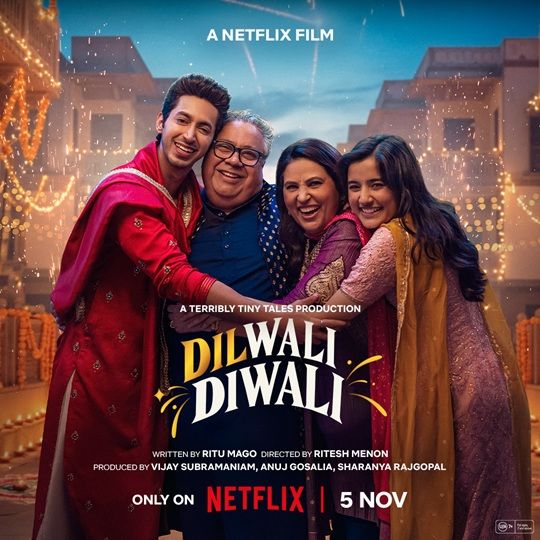

The idea of homecoming is what ties the short little festive premise of the new Hindi Netflix film Dilwali Diwali. The setting remains that of a middle class household during Diwali, interestingly tied with an invisible string of urgency. And the initial shots reiterate this trait. In its opening scene, you are introduced to the elderly statesman Sudhir (Manoj Pahwa) having a good little time with his friends. A phone call later, he scrambles his way home – a sort of a homecoming that is laced with a hint of urgency, something that would catapult with the passing minute. The occasion remains that of Diwali, a festive that is the breath of fresh air for middle-class families, and the reunion that transpires within families. One such homecoming is also of Sudhir’s Norway based son Ansh (Mihir Ahuja) who is returning home after three long years. It is interesting how the two homecomings are tied together in a narrative that doesn’t wish to compartmentalize the idea of togetherness, or associate togetherness with characters under one particular roof. The definition changes from one character to another, while tapping into a sweet little can of worm-shaped sweets that would form an uncanny companion piece to the festive season.
Written by Ritu Mago, there is an air of sweetness that christens the ambience of the film Dilwali Diwali, much like last week’s release Meethe Mein Kya Hai (2026). And this sweetness takes the form of a disarming conflict, even as you are witness to Sudhir and his family comprising of Sukhi (Neelu Kohli), ans their 13 year old daughter Mahi (Aurra Bhatnagar Badoni) hustle from a rickety old apartment to a plush space in a high-rise building, just before Ansh is scheduled to arrive. The catch remains that they prefer to stay in the dilapidated old space but just don’t have the heart to share it with their son, whose idea of spreading joy is to free his parents from the troubles of aging. And this little short, almost forms a premise for what would have been the final act of a film – even as Ansh wishes to throw a lavish Diwali party at his place.
There is a neat diversion from a genre POV as far as the cultural backdrop of the drama is concerned. The loud bouts of comedy that you wish equate with a lively Punjabi household is instead subverted with dollops of emotions – most of which remain repressed and discreet from every other character in the household. For instance, the protagonist Ansh is quietly carrying a mountain of burden within him, even as he is running short of paying an EMI. His idea remains to sell-off the old dilapidated space of his parents, in return for a lump sum of money. On probing further, you get a fleeting glimpse of the justification for it – even as a young Ansh is witness to his friends stepping away with regards to the social upgrade of their parents. You witness a small little aspiration erupting in the moment, something that circles back to his adulthood.
Oblivious to Ansh, you are also witness to the contrasting POV of his father Sudhir – a dynamic that is synonymous to indifferences owing to invisible walls built around a male ego. And yet, the dynamic remains of care and respect – one that often treads into a space of lies, given how it is Sudhir who enjoys his time with the folks that he shares a comforting equation with at his old home. This is in contrast to his fractured equation with the members of the high-rise – each of whom remain aloof and emotionally hollow to the presence of him and his family. The old house is mentioned to have its roots tracing back ancestors of Sudhir, who in his words were ‘Refugees’. It is a subtle reference but an important one on why he finds comfort in a space that is crumbling. The writing also deftly touches upon the concept of change, and how it is increasingly harder to adapt once you cross a certain age limit – often ably finding your comfort within a space that is familiar to you.
I also enjoyed the portrayal of the female characters here, each of whom are sandwiched between bouts of patriarchy. You often notice Sukhi and Mahi to be quiet during the discussions between Ansh and Sudhir, the latter showcased to be visiting a friend, while the former being an aiding spectator to each of the two men in her life without wishing to specifically take sides. In a searing scene, you notice Sukhi talking to a fellow neighbour – an independent, single woman who refers to her by her full name ‘Sukhmani’; an identity that continued to be lost in her daily chores and activities. It drops a smaller hint in a critical plot point that circles back at a pivotal moment towards the end. The idea of feminism here is equated to ‘service’ and ‘solitude’, while deliberately willing to stay distant and distracted from the bouts of patriarchy in the vicinity.
The proceedings are layered, simply because the writing doesn’t wish to take the easy way out – defiantly resisting the urge to simplify the issues at hand. And by not doing so, it invariably added layers to the persona of the characters here. Also, it didn’t wish to vilify any side – balancing the events with an air of maturity through the individualistic lens of every character. It is a small but crucial detailing on how a difference of opinion is the most healthy thing to unravel – be it in a democratic country or a family. And whilst the resolution remains convenient and simplistic wrapped in a warm little Diwali surprise, the writing offers subtle arcs of not only redemption but a heartwarming middle-ground for celebrations to thrive . After all, Diwali is all about togetherness irrespective of the defining space between families, right?
The dialogues are light-hearted nuggets of sweetness without compromising on the emotional depth of the proceedings. The music and BGM wonderfully account for a vibrant festive vibe at the end, while deftly aiding each scene to tap into the emotional core of the characters, and elevate its beats. The cinematography comprises of frames that keep you within touching distance of the characters, allowing space to weigh in on their individual emotions. This, while also allowing the dual setting of the twin houses to play individual characters – each tagged to the ideology and mindset of the characters in question. The editing pattern remains crisp, while effectively holding the narrative together. The final act could have been a little more fleshed out, but that is just me nit picking again to justify my job!
Director Ritesh Menon effectively navigates through the family-conflicts featuring unresolved bouts of tension that unfold against the backdrop of the festive season. He ably taps into the unsaid family-dynamics laced with vulnerability, while deftly adding a layer of emotions that are pivotal in anchoring the arcs of individual characters. And the emotions land beautifully, in a drama that nicely circles back to the feeling of togetherness – something that is wonderfully handled in a piece of direction that is very good.
The performances are wonderful by the members of the cast. The likes of Shrirao Swapnil Avinash as the watchman, Manmeet Singh as Ratandeep, Vivek Tandon as Jethmalani, and Ashish Kaul as Shampy have their moments to shine. Nimisha Sirohi as Anita epitomizes the aspirational character that Sukhi wishes to be, riddled with an identity of her own and living on her own terms in life. Nimisha remains wonderfully understated while using her posture effectively in communicating the stature of her character laced with a hint of vulnerability.
Aurra Bhatnagar Badoni as Mahi delivers a solid performance, infusing the film with a refreshing innocence and an emotional maturity well beyond her years. Acting as the innocent observer of the family’s friction, her expressive eyes and natural screen presence provide the story with its ultimate moral compass. Her scenes offer a poignant, clear-eyed perspective that grounds the film’s highest dramatic stakes.
Neelu Kohli as Sukhi delivers a powerful and resonant performance, portraying the family matriarch with a perfect blend of fierce resilience and tender warmth. She commands the screen during intense confrontations, serving as the emotional glue holding the fractured family together. Her ability to convey deep-seated anxiety through just a glance gives her character a rich depth.
Mihir Ahuja as Ansh brings a vibrant, modern energy to the screen, capturing the restless angst and yearning for acceptance of a vulnerable character. His performance is remarkably nuanced, shifting seamlessly from rigid individual to a character with raw, heartfelt vulnerability. He was brilliant to witness here.
Manoj Pahwa as Sudhir anchors the film with a masterclass in emotional vulnerability, effortlessly balancing his trademark comedic timing with moments of profound uncertainty. As the family patriarch, his expressive performance captures the heavy burden of unexpressed love, and the rigidity that is equated with aging. His subtle shifts in body language elevate the narrative, turning routine family exchanges into deeply moving highlights. He was terrific to witness here
Despite a convenient conclusion, Dilwali Diwali thrives as a heartfelt tale of individuality subverting traditional patriarchy, thereby delivering a sweet, comforting celebration of togetherness. Powered by heartwarming performances, this byte-sized entertainer skillfully balances emotional depth with festive cheer, eventually standing as a resonant, well-crafted watch perfect for the holiday season. Available on Netflix.