

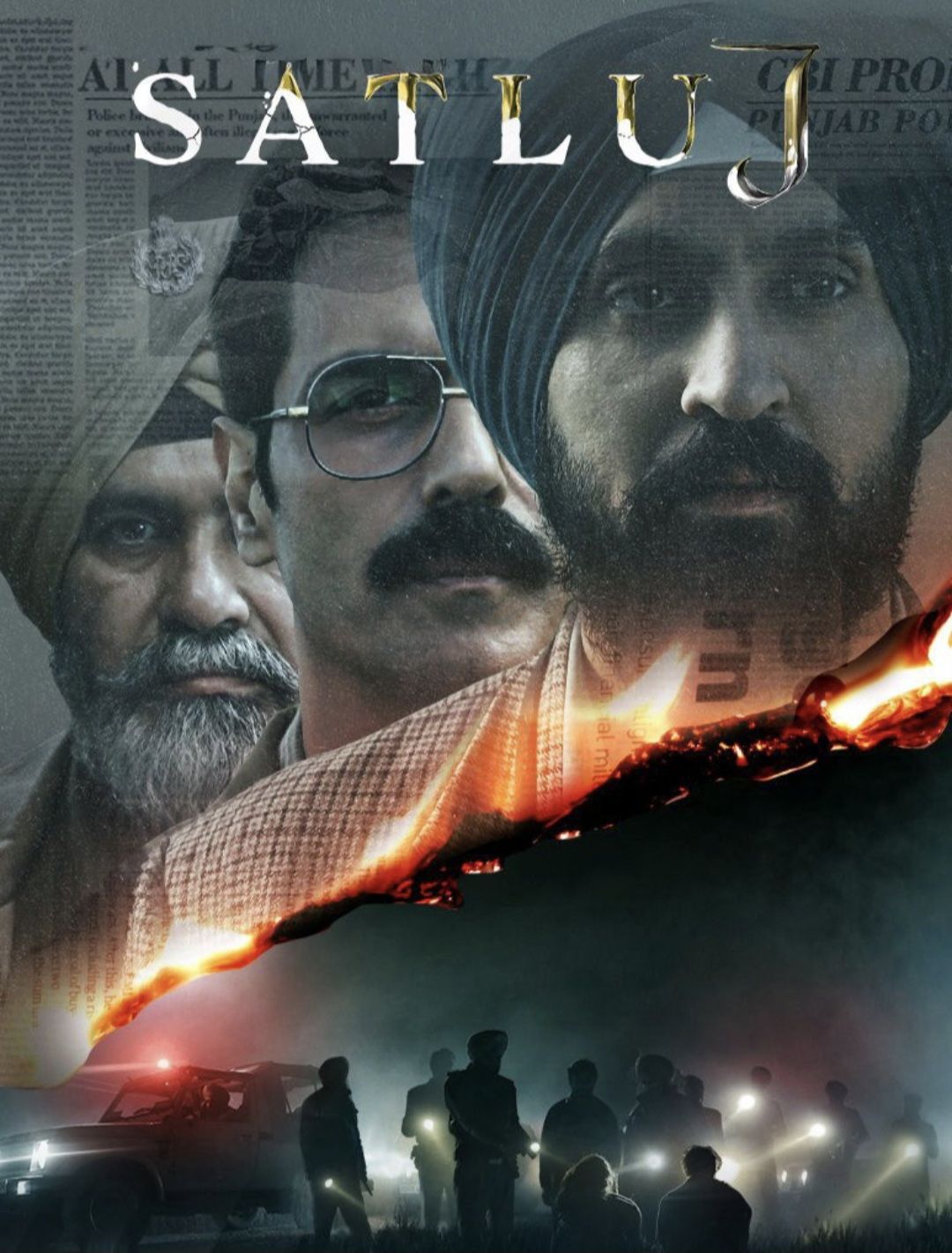
Not all battles are fought for victory. Some are fought simply to tell the world that someone was there on the battlefield – Ravish Kumar
It is interesting on how Indian Cinema has often been guilty of representing the cops just as ‘saviours’ with films like Singham (2011) or Dabangg (2012). While this may still be true, it is imperative to shed light on the other side of things – when law is merely a word in the English dictionary to shield their existence, and the cops literally act like Gods in deciding who is a terrorist and who isnt, also who gets to live and who doesn’t. In that sense, the much awaited Hindi film Punjab ’95 now titled Satluj has an unsettling premise – with a grainy and eerie setting that increasingly reminded me of the show Kohrra.
But unlike the latter, the era remains that of the mid 90s when Punjab was slowly emerging out of the period of insurgency – something that ranged from the Khalistani movement to Operation Blue Star, and from the assassination of the then PM of India, Indira Gandhi to the anti-Sikh riots. The state had been through a lot, probably prompting the authorities to give a free-hand to the cops to eradicate terrorism – in turn prompting them to act like Gods and kill innocent lives and throw them in canals. This is reflective through a voiceover in the film claiming that even the river Satluj had changed its course in order to run away from the truth – a sad reality that may still persist in a few states today, while being unreported.
Written by Honey Trehan, Niren Bhatt, and Utsav Maitra, it was outrageous on how the CBFC had demanded as many as 120 cuts to the film (re)titled Satluj. And one look at its cold open is enough to make you understand why (further exposing the body in question as being a mere mouth piece of the ones who must not be named; no questions asked in some ‘other films’, may I add). In a scene, you are witness to a group of cops drunk and making merry in the presence of a handful of commoners, who are soon aimed and shot at, almost resembling targets in video games. There is an unsettling ambience created even as a cop character is viciously told that he is promoted to the rank of an Inspector days before his marriage, after another shot an innocent victim for him before dumping the body in the Satluj river. It is deeply disturbing, even as I found myself seething with anger.
It is interesting on how the protagonist Jaswant Singh Khalra (Diljit Dosanjh) is leading a simple life with his wife Pammi (Geetika Vidya Ohlyan) and his children, while working in a cushy job as a bank manager. And so, his sudden awakening from slumber also stems from a personal loss of his friend, and later his friend’s mother – the former being killed off randomly, and the latter having disappeared off the grid, much like thousands of others in hindsight. What follows is a brief investigative trail that leads the protagonist to a crematorium that houses several ‘unclaimed’ dead bodies of folks who were recorded as disappeared. And the stance of the cops is clear – they haven’t killed anyone innocent, and are not anti-government.
The politics of the drama plays a crucial part in the narrative, even as innocent lives are taken away in the garb of cleaning up the state from terrorism. It probably is a very specific talking point of a crisis that is tight-lipped even today – even as you are witness to the politicians and cops working in tandem in the drama, both trying to save their perceptions in the eyes of the public. This is true so much so that DGP Bitta (Kanwaljit Singh) chooses to bring one of his trustworthy men, SSP Surjit Singh Sugga (Suvinder Vicky) to the fore.
SSP Sugga is your typical antagonist who would offer stereotypical antics to convey his evilness. He is cold, calculating and intimidating – a trait that we evidently witness in a riveting scene involving him entering the household of a junior cop, have saag and later ambush the entire family in the garb of assisting terrorism. That sequence was not only chilling but also worthy of a million nightmares, something that was enough to establish the vicious character of Sugga. Elsewhere, another sequence scarred me with its bouts of disturbance – a presumed dead body being brought for forensics, only to be discovered alive. And the cops pumping in bullets at the acquired location and driving it back. The anger in me had reached its zenith, so much so that I had to pause the narrative and let out a few deep breaths before continuing.
It is interesting on how the protagonist found support from foreign land too, a trait that could easily be mapped to the modern setup on the multiple issues only being whispered in the homeland. The same is represented in a particular sequence when a character claims on how it isn’t right to present a bad picture of the country on foreign land – a convenient act of hiding one’s own flaws in the name of nationalism. But the underlying act of nobility lay with the protagonist, when he chose to opt out of his asylum, and continuing fighting for what is right – citing on how his absence would die down the movement, also having to later face the repercussions of disappearance, much like the millions of people that he had fought for. It is the price that you pay for raising the voice for what is right – and I will leave that open for interpretation in the modern setup too.
There is a layer of uncertainty even as the focus shifts to the CBI officer Samudra Singh (Arjun Rampal), who is tasked with the investigation behind the disappearance of the protagonist. This, while he is shown to deal with several issues related to bureaucracy, red tape protocols, and hostile witnesses – that further exposes the decaying justice system, even as a few pawns are sacrificed along the way for the larger good of the folks at the top. It all felt like the zenith of frustration that we all might be feeling at some point while glancing at the news notifications on our phone.
There is a Shakespearean undertone to the proceedings, particularly in a reconstructed flashback sequence that literally touched my heart, even as a character in question almost knowingly pierces through the guilt-driven soul of another. It perfectly encapsulates the spirit of the drama, that is known to voice an opinion on things that it deems to be right. And that scene was a quiet little reminder of the same – despite ending on the most disturbing and unsettling note possible to conclude the narration that had me numb while seething with anger . If I had to take turns to wash my face repeatedly after the film had ended, you can imagine the impact that it had on me – something that stayed for hours after the end credits had rolled. The screenplay will go down as the most impactful piece of writing for an Indian film in years, something that will make you question every move of the authorities. But does that make us all anti-n*tional?
The dialogues are conversational, but the authenticity of the dialect makes the drama even further grounded in reality. And that itself felt so refreshing from a technical standpoint – playing its part in creating an immersive viewing experience. The BGM has an eerie undertone to it, that perfectly creates a chilling ambience around every scene. This, while maintaining the emotional core of the drama. In fact, the use of silence also plays an ominous part in the construction of some pivotal scenes – often targetting the psyche of the viewers for maximum impact. Be it a character walking away to the ‘sound’ of gunshots – a scene that will have you glued to your screens.
The cinematography features frames that are christened with hues of grey, something that creates an ambience of hopelessness and chills to kickstart the drama. In fact, the frames don’t really focus on the gore while employing an implied technique to completely scar your psyche in the process. This, while also keeping the frames close enough to account for the powerful emotional core of the characters involved. And shooting at the actual locations of the crime, made it even more unsettling to watch. The editing pattern is unlike a typical biopic that would divide the proceedings into chapters. There is a searing attempt to create a cohesive thread that would ltransfer the emotions from one scene to another.
Director Honey Trehan may just have delivered one of the finest Indian films of recent times. Firstly, it may not have been easy to fight against an entire system that wanted to dilute the impact of a story that is seemingly the need of the hour today. But from a filmmaking front, the focus remains on creating an ambience of fear through an unsettling buildup, while recreating one of the most gruesome chapters of the country from the 90s. And in the midst, the clear demarcation of the characterization that elevates the impact of the drama ten-fold. The idea was never to sensationalize it, but instead offer a poignant piece of art that is deeply disturbing and unsettling in the same breath. In that regard, the direction is brilliant while also doing its bit in creating a psychological impact on the minds of the viewers.
The performances are wonderful to witness by the members of the cast. The likes of Amardeep Jha as Satnam’s mother, Neeta Mohindra as Mindro, Corinne Meadors as Colleen, Nasser as SP Varma, and Anil Charanjeett as Sanjiv are pivotal cogs in the narrative, and each of them deliver (quietly) impactful performances. Varun Badola as Adv Ravinder is well restrained while delivering a searing performance in the most understated manner possible. Jyoti Dogra as Bibi offers a gut-wrenching act that will leave you devasted by the end of things. Saurabh Sachdeva as Satnam allows his eyes to do the talking, in a character that remains a quiet bystander in the police department. And his silence speaks a thousand words! Geeta Agrawal Sharma as Dr Geeta is sincere and earnest while quietly grappling with fear. And she accounts for all of these emotions beautifully.
Amit Dhawan as DSP Jagpal, Vansh Bhardwaj as Inspector Shivender, Vikas Hohla as SI Harinder, and Ramji Bali as Inspector Ajay are ruthless to the core, and they will leave you seething with anger. In the same breath, Kanwaljit Singh as DGP Inderpal Singh Bitta is cold and manipulative, while putting forth a commendable act that also left me infuriated. Jagjeet Sandhu as SPO Kuljit offers a layer of empathy mixed with fear and guilt, while possessing such expressive eyes that had me emotionally invested in his journey towards the end. The tenderness and softness of his character felt like a direct counter not only to masculinity, but also morality – in what felt like a brilliant act.
Geetika Vidya Ohlyan as Pammi is such a phenomenal actor who uses her body language to utmost perfection here, while accounting for the heavy baggage that she has to endure of the disappearance of her husband. Arjun Rampal as Samudra yet again proves his mettle as a solid performance by coming across as well restrained, and anchoring his grounded act with a lot of grace and dignity.
Suvinder Vicky has got to be one of the finest actors doing the rounds at the moment, and as SSP Sugga – he delivers one of the most chilling performances ever. He isn’t your regular antagonist. In fact, his approach is cerebral and visceral – inculcating fear into the minds of the viewers through his subtle antics. And yet, his cold expressions unveil a chilling and ruthless side to his persona, that literally had me stuttering for words. This was an acting masterclass of the highest order, in a performance that may well be in the top five performances of the decade across languages.
Diljit Dosanjh is a blessed performer, whose offscreen sincerity transcends onscreen too. As Jaswant Singh Khalra, there is a layer of groundedness and empathy to his persona, subtly transforming into a voice of the affected that remains a pillar of resilience. His understated approach reflects of sincerity and earnestness, while his eyes offer a glimmer of hope in an otherwise hopeless situation. And because you are emotionally invested in his character, you also are deeply affected by the fate of his character – signalling a performance that stays with you long after the end credits roll.
Satluj (aka Punjab ’95) is a visceral, deeply unsettling thriller that refuses to pull its punches. Rooted in devastating real-world events, the film delivers raw, powerhouse performances that make it an absolutely brilliant—yet painful—watch, easily standing as one of the most powerful pieces of Indian cinema in decades. It is the rare kind of film that leaves you seething with righteous anger while completely shattering you emotionally by the time the credits roll. It is the absolute need of the hour, so watch this uncensored version immediately before it gets tangled in another inevitable legal battle. And honestly? B*lls to the censor board for constantly trying to stifle such vital stories. Available on Zee5 and Highly Highly Highly Recommended!


