

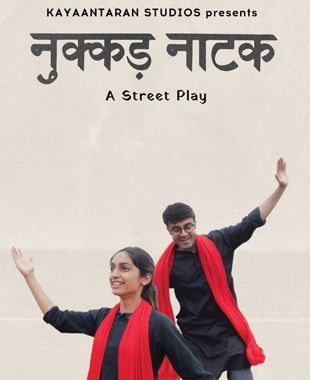
Unlike Do Deewane Seher Mein (2026) wherein both protagonists suffered from an inferiority complex while being romantic partners, the protagonists in the new Hindi film Nukkad Naatak are poles apart in their personalities. When you are acquainted to Shivang (Shivang Rajpal), he seems to be this underconfident guy who isn’t confident about his body and identity. It can be implied that Shivang has been subjected to a lot of bullying in his life, so much so that he remains in a ‘closet’ even whilst being in supposedly the last leg of his education journey. Hence even in his engineering days, you see him living a quiet life away from the limelight at the start, spending most of his nights on gay-cam websites whilst secretly holding on to his identity of being a closet homos*xual – so much so that even his parents don’t know about it.
In the same breath when you are introduced to Molshri (Molshri), she is an assertive and confident individual often coordinating the ‘Nukkad Naataks’ (plays) of her college – each driven by a purpose. You can sense that her primary trait is that of a rebel, although it can also be said that she is a rebel without a proper cause. In a scene, you see her getting back at a canteen by stealing his supplies, all because he was rude to a poor employee. It is interesting on how the form of activism that she conducts in the form of plays, often coincides with her larger purpose of what she thinks is her definition of being rebellious. In other words, the world that you see unfolding is strictly through the gaze of the two Gen-Z protagonists, which in a way doubles up as a coming of age story.
Written by Tanmaya Shekhar, Nukkad Naatak can be viewed as a couple of films crammed into a single film. But such is the sincerity of the writing, that you are still willing to be emotionally invested in the drama and its characters. For instance, the coming of age story of both protagonists Molshri and Shivang coincides with a common trait of being naive and oblivious of how the world around them functions. Given the character traits, it is Molshri who remains a dominant one in her equation with Shivang.
So whilst the latter remains subdued, the activist in Molshri rises to the occasion – helping Shivang overcome a bunch of bullies while absorbing him in her Nukkad Naatak. In fact, even the grain of morality is dictated by Molshri simply given how she is programmed at the start. She remains an idealist who wishes to change the world around here by hook or by crook, contrary to her yang who reminded me of Raju Rastogi from 3 Idiots (2009) in a very different light! Even after the ‘stealing’ incident when both the protagonists are reprimanded and almost expelled, you see Molshri holding onto that last strand simply because of the idealistic world that she chooses to live in.
The core conflict remains simple – both Molshri and Shivang are tasked with enrolling five children from a nearby slum into a school, a task that feels simpler than it actually is. In a subtly hilarious scene, when the Dean (Danish Husain) inquires about their research of poverty in the wake of education, both Molshri and Shivang reference the internet and documentaries for their source of information. It remains similar to the infinite film critics who haven’t consumed enough cinema but are still entitled and trusted with their opinions. But more importantly at the start, both protagonists do not view this as an opportunity to learn but simply a task bartered to get back to college. Hence despite all difficulties including the parents refusal of allowing their kids to study simply because it would reduce their daily income, the dynamic duo find a way to self fund the admissions.
Given that this is a coming of age story, the writing also branches into the individual arcs of the protagonists. Interestingly the better arc is of Molshri that rides on her wave of activism and idealism to literally trace the journey of a young girl from the slums whom she had previous helped getting admission. And hence her transformation from being a rebel to a teacher coincides with a change that she witnesses in front of her. It is imperative to note on how her definition of activism and idealism changes too – she doesn’t believe in changing the whole world, instead taking baby steps to transform the life of a single child.
In a sharp contrast, the writing loses its steam with the arc of Shivang that doesn’t really circle back to the main plot. My issue remained on how isolated his arc turned out to be, almost seemingly being a part of another movie altogether. At no point could I completely feel a sense of empathy for Shivang, even as he miraculously and abruptly finds himself to be a part of the LGBTQ+ club in college. The arc felt abrupt and mildly gimmicky given how he is also shown to type an email to his dead grandfather.
However, I liked how the ending of the film encapsulated the spirit of the drama that echoed the use of art to portray a sense of activism in a positive sense for the society. It remained an idea of staying back for a change as opposed to opting for better opportunities abroad, an event that felt grounded in the context of the drama. The sequence although abrupt, felt like an earnest attempt – something that did reflect in the overall journey as well.
The dialogues are a little raw while being guilty of spoonfeeding the context. For instance, the voiceover of Shivang at the start of the film could easily have been replaced with visuals left to decipher his state. The music and BGM by Parthhesh is earthy and heartfelt while being an understated representation of the current generation seeking for a purpose in life. The cinematography by Ihjaz Aziz ably captures the rawness of life with a change in the setting for the protagonists. For instance, the idealistic college life of Molshri is completely changed when she ventures into the slums. The idea of shooting in real locations automatically adds depth to the drama, while the frames allow you to be emotionally connected to the characters. In the same breath, the production design by Shadman Ali and Mehvish Ali is pretty good given the budgetary constraints of the film.
The costumes by Amruta Date add a sense of authenticity to the characters driven by idealism and activism but wanting a purpose in life. The editing pattern opted by Sruthy Sukumaran is crisp and sharp while maintaining the intended raw outlook of the proceedings. Perhaps, the integration of varied character arcs could have been better but the emotions still felt real, regardless of it.
Director Tanmaya Shekhar does a good job in maintaining the tone of the drama here although the staging of a couple of scenes towards the end could have been a little better. Nevertheless, his biggest strength lies in conveying the intended emotions of the characters, a consistent streak that you notice throughout the narrative – something that adds to the feel-good nature of the drama too. His characterization adds depth to the proceedings even though individual arcs didn’t always circle back to the core theme of the drama. But for a debut outing, it remained a stellar effort!
The performances are pretty good by the members of the cast. It was so good to spot Danish Husain here, an actor that I deeply admire – and he remained impeccable with the restraint and demeanor of his character. The likes of Lalit Saw as Mukund and Mayank Shandilya as Piyush are raw but work in the context of the drama, even as their performances end up being sincere. Nirmala Hajra as Chhoti is really affable while holding onto her streak of naivety and innocence. Monita Sinha as Chhoti’s mother has her moments to shine, as does Kishore Kumar as the School Principal.
Shivang Rajpal as Shivang is decent here, being subdued with his body language and doing a fair job – although the empathy towards his character towards the latter half of the drama could have been a little more pronounced. Nevertheless, he does possess a pleasing energy onscreen that allowed me room to invest in his journey. Molshri as Molshri is incredible here, possessing a spunky assertive synergy that drives her rebellious trait initially. And she handles her character arc a lot better, gradually leaning towards the shifting emotional core of her character and putting forth a commendable act. Hope she gets to feature in many such meaty roles in future.
Despite its flaws, Nukkad Naatak is a spirited coming-of-age drama wrapped in a feel-good fabric of social activism and idealism that makes for a solid watch. On a side note, this further remains a commendable effort given how the film is crowd-funded, self-produced, and distributed with a masterclass in film marketing on social media. Hope this paves the way for many such indie films that are the need of the hour today. Available in a theatre near you.


